Und dann auf "Zum Home-Bildschirm [+]".

Stöbern
genialokal zum Startbildschirm hinzufügen
Installieren Sie die genialokal App auf Ihrem Startbildschirm für einen schnellen Zugriff und eine komfortable Nutzung.
Installieren Sie die genialokal App auf Ihrem Startbildschirm für einen schnellen Zugriff und eine komfortable Nutzung.
Ihr gewünschter Artikel ist in 0 Buchhandlungen vorrätig - wählen Sie hier eine Buchhandlung in Ihrer Nähe aus:

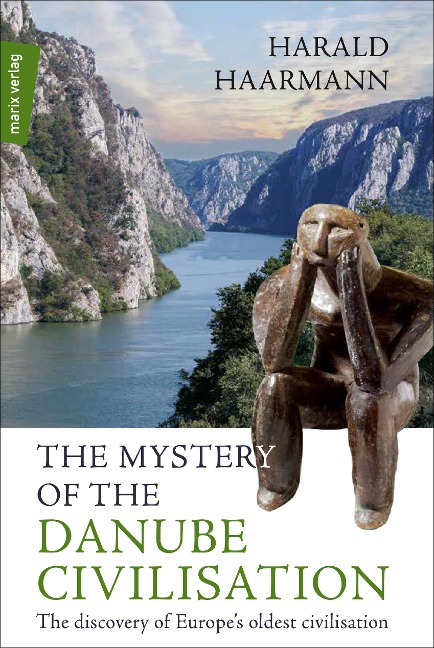
Over the last few years, archaeologists have been finding more and more evidence for the existence of a civilisation on the Balkan peninsula which, between the 6th and 4th millennia BCE, was using a writing system long before the Mesopotamians. In this book, Harald Haarmann provides the first comprehensive insight into this enigmatic Old European culture which, until recently, was unknown. He describes trade routes and settlements, arts and crafts, the mythology and writing system of the Danube Civilisation; he traces its origins to the Black Sea area and shows which cultural influences it had on Ancient Greece and the Near East.
Harald Haarmann is one of the world's best-known linguists. He studied general linguistics, various philological disciplines and prehistory at the universities of Hamburg, Bonn, Coimbra and Bangor. He obtained his PhD in Bonn and his Habilitation (qualification at professorship level) in Trier. He taught and researched at a number of German and Japanese universities. Since 2003 he has been Vice-President of the Institute of Archaeomythology (main office in Sebastopol, California, USA) and director of its "European Branch" (located in Luumäki, Finland). Professor Haarmann has authored more than 70 books in German and English, some of which have been translated into over a dozen languages. In addition to this study on the Danube Civilisation, he has produced remarkable insights into the roots of ancient Greek civilisation and the early history of Rome. His work has earned him the Prix logos (1999), awarded by the Association européenne des linguistes et des professeurs de langues (Paris) and the Premio Jean Monnet (Genova, 1999) for essay writing. In 2006 he received the Plato Award (UK). He lives and works in Finland.
Contents The puzzle of a 7,000 year-old civilisation 9 1. The transition to the Neolithic in Europe (ca. 7500-5500 BCE) 13 Early farmers in Southeast Europe 14 The emergence of regional cultures 40 Cultural timeline of Old Europe 48 2. In search of the Old Europeans 51 The genetic footprint 51 Linguistic traces 56 3. Commerce and living space 79 Trade routes and commodities 79 Settlements and architecture 88 Religious sites and graves 99 4. Arts and crafts 109 Weaving and textiles 110 Pottery and firing techniques 114 Metallurgy 118 Art forms and cultural symbols 122 5. Model of an egalitarian society 141 Matriarchal or matrilineal? 144 Families and clans 146 Oecumene and trade 148 6. Religion and mythology 153 The world view of hunter-gatherers and farmers 155 Female deities in Old Europe 156 The bull - Animal symbols as attributes of the goddess 160 Cults and rituals 161 Music and dance 169 7. Counting, measuring, recording 173 Numerical signs and numerology 173 Calendrical notation 175 Weights and measures 180 Potter's or ownership marks 181 8. The invention of writing 183 Origin and development of the Danube script 184 The spread of writing in Old Europe 190 Writing materials, inscriptions and varieties of text 193 The repertory of Old European signs 196 Written legacy of the Danube Civilisation 200 A script in the service of religion 212 The demise of the use of writing 214 9. The decline and legacy of the Danube Civilisation (from around 4500 BCE) 217 Political and cultural upheavals 218 The Balkan-Ancient Aegean cultural drift 227 Minoan-Cypriot contacts: How Aegean script was exported 243 Epilogue 249 Bibliography 259 Key to inside cover map 279