Und dann auf "Zum Home-Bildschirm [+]".

Stöbern
genialokal zum Startbildschirm hinzufügen
Installieren Sie die genialokal App auf Ihrem Startbildschirm für einen schnellen Zugriff und eine komfortable Nutzung.
Installieren Sie die genialokal App auf Ihrem Startbildschirm für einen schnellen Zugriff und eine komfortable Nutzung.
Ihr gewünschter Artikel ist in 0 Buchhandlungen vorrätig - wählen Sie hier eine Buchhandlung in Ihrer Nähe aus:

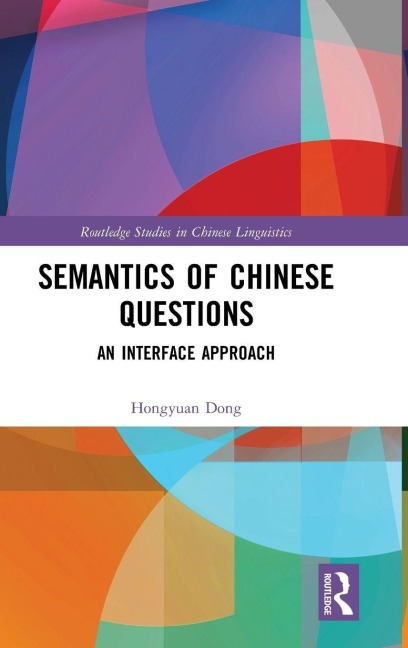
Semantics of Chinese Questions is the first major study of Chinese questions, especially wh-questions, within the framework of Alternative Semantics.
Hongyuan Dong is Assistant Professor of Chinese Language and Linguistics in the Department of East Asian Languages & Literatures at the George Washington University.
List of illustrations Preface Acknowledgements List of symbols List of abbreviations Chapter 1 Introduction Main ideas Questions and Chinese questions The meaning of questions Inquisitive semantics Chapter overview Chapter 2 LF Movement and Binding in Chinese Questions 2.1 Chinese wh-in-situ 2.2 The LF movement theory 2.3 The binding theory 2.4 The status of the particle -ne 2.5 The diachronic semantics of the particle -ne Chapter 3 Alternative Semantics of Questions in Chinese 3.1 The alternative semantics theory 3.2 Manner and causal wh-questions 3.3 Verbal "zenme" questions 3.4 A-not-A questions 3.5 Alternative questions 3.6 Polar questions 3.7 The grammaticalization of the particle -ma 3.8 Alternative semantics and inquisitive semantics Chapter 4 Scope Marking of Questions by Phonological Prominence 4.1 Scope marking of questions phonologically in Chinese 4.2 Experimental data for the scope-marking strategy 4.3 Cross-linguistic comparisons of scope marking of wh-questions 4.4 Focus and wh-pronouns 4.5 Scope isomorphism of focus and its computational derivation Chapter 5 Revisiting the Argument-Adjunct Asymmetry 5.1 Argument-adjunct asymmetry of Chinese wh-in-situ 5.2 The nominal-adverbial asymmetry 5.3 Operator movement and its problems 5.4 A correlational account of island sensitivity 5.5 A phonological reason for adjoining to scope positions 5.6 Island constraints of A-not-A questions explained Chapter 6 A Distributional Account of Existential Wh-indefinites 6.1 Distributions of interrogative and existential wh-indefinites 6.2 Alternative semantics and existential readings of wh-indefinites 6.3 Syntactic and phonological factors that disfavor existential readings 6.4 Pragmatic reasoning and licensors of existential readings 6.5 Scope variability of Chinese existential wh-indefinites Chapter 7 Concluding Remarks 7.1 Theoretical contributions of the interface approach 7.2 Limitations and further research directions Appendix References Index