Und dann auf "Zum Home-Bildschirm [+]".

Stöbern
genialokal zum Startbildschirm hinzufügen
Installieren Sie die genialokal App auf Ihrem Startbildschirm für einen schnellen Zugriff und eine komfortable Nutzung.
Installieren Sie die genialokal App auf Ihrem Startbildschirm für einen schnellen Zugriff und eine komfortable Nutzung.
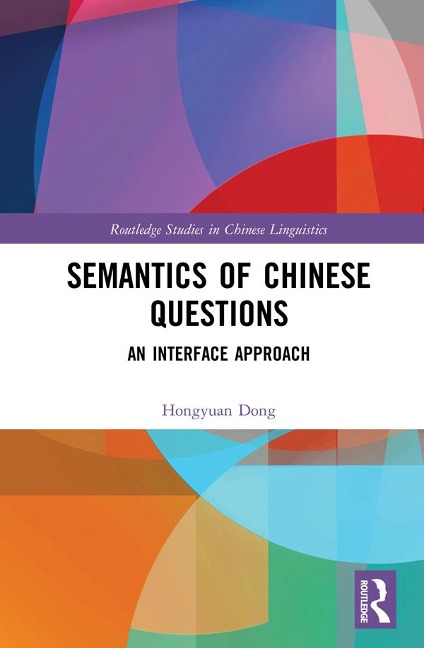
Semantics of Chinese Questions is the first major study of Chinese questions, especially wh-questions, within the framework of Alternative Semantics. It takes an interface approach to study the syntax, semantics, and phonology of questions and proposes a phonological scope-marking strategy in Chinese questions, based upon experimental data. It also incorporates historical linguistic data regarding the grammaticalization of sentence-final particles such as -ne and -ma to study the formal diachronic semantics of questions. Primarily suitable for scholars in the field of Chinese linguistics, this book makes new theoretical contributions to the study of questions.
Hongyuan Dong is Assistant Professor of Chinese Language and Linguistics in the Department of East Asian Languages & Literatures at the George Washington University.
List of illustrations Preface Acknowledgements List of symbols List of abbreviations Chapter 1 Introduction - Main ideas - Questions and Chinese questions - The meaning of questions - Inquisitive semantics - Chapter overview Chapter 2 LF Movement and Binding in Chinese Questions 2.1 Chinese wh-in-situ 2.2 The LF movement theory 2.3 The binding theory 2.4 The status of the particle -ne 2.5 The diachronic semantics of the particle -ne Chapter 3 Alternative Semantics of Questions in Chinese 3.1 The alternative semantics theory 3.2 Manner and causal wh-questions 3.3 Verbal "zenme" questions 3.4 A-not-A questions 3.5 Alternative questions 3.6 Polar questions 3.7 The grammaticalization of the particle -ma 3.8 Alternative semantics and inquisitive semantics Chapter 4 Scope Marking of Questions by Phonological Prominence 4.1 Scope marking of questions phonologically in Chinese 4.2 Experimental data for the scope-marking strategy 4.3 Cross-linguistic comparisons of scope marking of wh-questions 4.4 Focus and wh-pronouns 4.5 Scope isomorphism of focus and its computational derivation Chapter 5 Revisiting the Argument-Adjunct Asymmetry 5.1 Argument-adjunct asymmetry of Chinese wh-in-situ 5.2 The nominal-adverbial asymmetry 5.3 Operator movement and its problems 5.4 A correlational account of island sensitivity 5.5 A phonological reason for adjoining to scope positions 5.6 Island constraints of A-not-A questions explained Chapter 6 A Distributional Account of Existential Wh-indefinites 6.1 Distributions of interrogative and existential wh-indefinites 6.2 Alternative semantics and existential readings of wh-indefinites 6.3 Syntactic and phonological factors that disfavor existential readings 6.4 Pragmatic reasoning and licensors of existential readings 6.5 Scope variability of Chinese existential wh-indefinites Chapter 7 Concluding Remarks 7.1 Theoretical contributions of the interface approach 7.2 Limitations and further research directions Appendix References Index
Dieses eBook wird im PDF-Format geliefert und ist mit einem Adobe Kopierschutz (DRM) versehen. Sie können dieses eBook mit allen Geräten lesen, die das PDF-Format und den Adobe Kopierschutz (DRM) unterstützen.
Zum Beispiel mit den folgenden Geräten:
• tolino Reader
Laden Sie das eBook direkt über den Reader-Shop auf dem tolino herunter oder übertragen Sie das eBook auf Ihren tolino mit einer kostenlosen Software wie beispielsweise Adobe Digital Editions.
• Sony Reader & andere eBook Reader
Laden Sie das eBook direkt über den Reader-Shop herunter oder übertragen Sie das eBook mit der kostenlosen Software Sony READER FOR PC/Mac oder Adobe Digital Editions auf ein Standard-Lesegeräte mit epub- und Adobe DRM-Unterstützung.
• Tablets & Smartphones
Möchten Sie dieses eBook auf Ihrem Smartphone oder Tablet lesen, finden Sie hier unsere kostenlose Lese-App für iPhone/iPad und Android Smartphone/Tablets.
• PC & Mac
Lesen Sie das eBook direkt nach dem Herunterladen mit einer kostenlosen Lesesoftware, beispielsweise Adobe Digital Editions, Sony READER FOR PC/Mac oder direkt über Ihre eBook-Bibliothek in Ihrem Konto unter „Meine eBooks“ - „online lesen“.
Schalten Sie das eBook mit Ihrer persönlichen Adobe ID auf bis zu sechs Geräten gleichzeitig frei.
Bitte beachten Sie, dass die Kindle-Geräte das Format nicht unterstützen und dieses eBook somit nicht auf Kindle-Geräten lesbar ist.