Und dann auf "Zum Home-Bildschirm [+]".

Stöbern
genialokal zum Startbildschirm hinzufügen
Installieren Sie die genialokal App auf Ihrem Startbildschirm für einen schnellen Zugriff und eine komfortable Nutzung.
Installieren Sie die genialokal App auf Ihrem Startbildschirm für einen schnellen Zugriff und eine komfortable Nutzung.
Ihr gewünschter Artikel ist in 0 Buchhandlungen vorrätig - wählen Sie hier eine Buchhandlung in Ihrer Nähe aus:

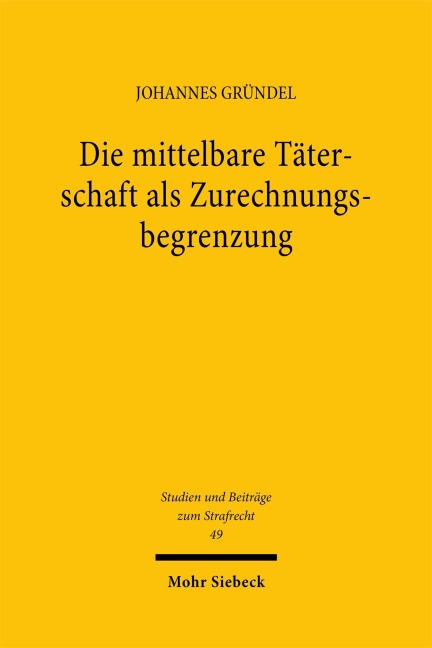
Indirect perpetration is typically understood as a mechanism of attribution in which the conduct of the direct actor is imputed to the indirect perpetrator. Johannes Gründel examines whether this attribution of conduct can be dispensed with and whether, instead, the focus can be placed on the indirect perpetrator's causal contribution. The key question is whether the direct actor's conduct interrupts the chain of attribution or whether the result remains objectively attributable to the indirect perpetrator. In this context, objective attribution is supplemented by an element of perpetrator responsibility; at the same time, established categories such as autonomous intervening conduct and atypical causal courses remain relevant. Perpetrator responsibility derives from control over the act, insofar as it is not normatively displaced, or from normative attribution, for instance on the basis of duties of care.
In classic cases involving a deficit of criminal liability, the chain of attribution generally remains intact due to the direct actor's lack of responsibility. The approach offers convincing explanations for constellations of a perpetrator behind the perpetrator, particularly in cases of manipulated error in persona vel obiecto and of graded mistakes of fact. Situations of organizational control can likewise be explained through control over the act.
With regard to general doctrine, this approach also reveals a previously unrecognized possibility of withdrawal: withdrawal pursuant to § 24(1) sentence 1 alternative 1 of the German Criminal Code by restoring the victim's autonomy. Finally, Johannes Gründel develops a three-step test for offences requiring personal commission: the limits of the wording, the existence of a causal chain, and the integration of the perpetrator's person into the chain of attribution.
Born in 1993; PhD in 2025 (Erlangen-Nuremberg); research assistant at Friedrich-Alexander University Erlangen-Nuremberg; legal clerkship at the Higher Regional Court (OLG) Bamberg.
Einleitung
Kapitel 1: Bisheriges Verständnis von mittelbarer Täterschaft und objektiver Zurechnung
§ 1 Bisheriges Verständnis der mittelbaren Täterschaft
§ 2 Bisheriges Verständnis der objektiven Zurechnung
Kapitel 2: Allgemeine Schwierigkeiten der h.M.
§ 1 Zwei normative Einschränkungen
§ 2 Unterschiedliche Anforderungen an Zurechnung bei Vorsatz- und Fahrlässigkeitsdelikt
§ 3 Täter hinter dem Täter
§ 4 Friktionen der herrschenden Meinung
§ 5 Zusammenfassung
Kapitel 3: Mittelbare Täterschaft als eigener neuartige Ansatz einer Zurechnungsbegrenzung
§ 1 Inkorporierung der mittelbaren Täterschaft in die objektive Zurechnung
§ 2 Die verschiedenen Täterformen des § 25 StGB
§ 3 Kriterien der objektiven Zurechnung nach diesem Ansatz
§ 4 Auswirkungen des eigenen Ansatzes auf allgemeine Lehren
§ 5 Zusammenfassung des eigenen Ansatzes
Resümee