Und dann auf "Zum Home-Bildschirm [+]".

Stöbern
genialokal zum Startbildschirm hinzufügen
Installieren Sie die genialokal App auf Ihrem Startbildschirm für einen schnellen Zugriff und eine komfortable Nutzung.
Installieren Sie die genialokal App auf Ihrem Startbildschirm für einen schnellen Zugriff und eine komfortable Nutzung.
Ihr gewünschter Artikel ist in 0 Buchhandlungen vorrätig - wählen Sie hier eine Buchhandlung in Ihrer Nähe aus:

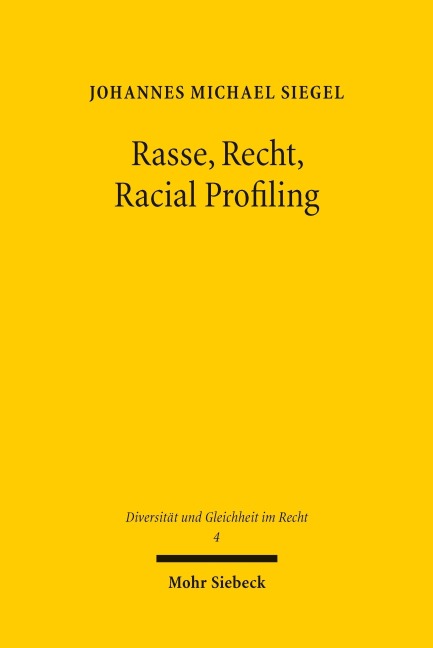
Johannes Michael Siegel places the focus of his study on the legal conceptualization of racial profiling beyond the individual case. He develops a doctrinal definition of racial profiling and demonstrates that it does not consist of isolated instances of unlawful conduct but rather constitutes a structural problem of police law enforcement. He bases this on a precise interpretation of the legal concept of race as a process of social ascription within the meaning of Article 3(3) of the German Basic Law. On this basis, the author conceptualizes racial profiling as an executive measure based on a racializing discretionary decision - also when unintentional - operating to the detriment of structurally discrimination-vulnerable groups. He shows that racial profiling is invariably unlawful and yet continues to be reproduced within the existing framework of police law. The study systematically examines the relevant statutory authorization bases of federal and state police law as well as their application in practice. By combining doctrinal legal analysis with empirical insights from policing research, it becomes apparent that discretion, institutional routines, and police knowledge structures interact in a problematic manner. This synergy gives rise to structural racial profiling, even though the legal norms themselves are not necessarily designed in a discriminatory way. Finally, Johannes Michael Siegel develops concrete strategies of containment, demonstrating how effective legal responses to racial profiling can be achieved through procedural safeguards, external oversight mechanisms, and institutional reforms. In doing so, he makes a fundamental contribution to anti-discrimination doctrine, police law, and the socio-legal analysis of state action.
Born 1990; studied law at the University of Konstanz and at the University of Cardiff; 2017 First State Examination in Law; legal clerkship (Referendariat) at the Berlin Higher Regional Court; research associate at Freie Universität Berlin; 2019 Second State Examination in Law; research associate at the University of Konstanz and at the Research Institute on Social Cohesion; 2025 PhD; government councilor at the Federal Ministry for Economic Affairs and Energy, Berlin.
Einleitung
A. Gegenstand der Arbeit
B. Forschungsstand
C. Methode
D. Gang der Arbeit
Kapitel 1 - Der Begriff der Rasse
A. Dynamische Begriffsgeschichte
B. Biowissenschaftliches und sozial- und geisteswissenschaftliches Verständnis
C. Rasse als Rechtsbegriff
D. Gesamtfazit
Kapitel 2 - Die Polizei und Racial Profiling
A. Polizei als Institution im Wandel
B. Profiling
C. Von präventivem Profiling zu Racial Profiling
D. Stets rechtswidrig?
Kapitel 3 - Die Ermächtigungsgrundlagen
A. Gefahrenabwehr und Gefahrenvorsorge
B. Struktur der Ermächtigungsgrundlagen
C. Bundesrecht
D. Landesrecht
E. Zwingendes Racial Profiling per Rechtsnorm?
F. Fazit
Kapitel 4 - Das strukturelle Racial Profiling
A. Institution trifft auf Rechtsgrundlage
B. Eine Struktur, die zu institutionellem Rassismus führt
Kapitel 5 - Die Einhegung
A. Kontrollvorgang
B. Externe Kontrolle der Polizei
C. Reformierung der Polizei
D. Fazit
Gesamtbetrachtung
A. Antworten
B. Schlüsse
Literaturverzeichnis