Und dann auf "Zum Home-Bildschirm [+]".

Stöbern
genialokal zum Startbildschirm hinzufügen
Installieren Sie die genialokal App auf Ihrem Startbildschirm für einen schnellen Zugriff und eine komfortable Nutzung.
Installieren Sie die genialokal App auf Ihrem Startbildschirm für einen schnellen Zugriff und eine komfortable Nutzung.
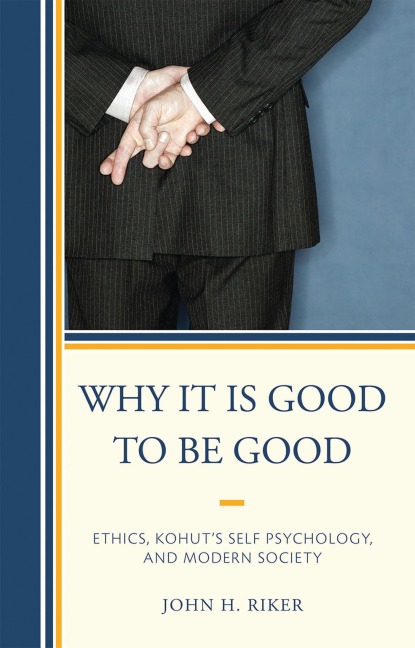
In Why It Is Good to be Good, John H. Riker argues that modernity, by undermining traditional religious and metaphysical grounds for moral belief, has left itself no way to explain why it is personally good to be a morally good person. Furthermore, modernity's regnant concept of the self as an independent agent organized around the optimal satisfaction of desires and involved in an intense economic competition with others intensifies the likelihood that modern persons will see morality as a set of limiting constraints that stand in the way of personal advantage and will tend to cheat when they believe there is little likelihood of getting caught. This cheating has begun to severely undermine modernity's economic and social institutions.
Riker proposes that Heinz Kohut's psychoanalytic understanding of the self can provide modernity with a naturalistic ground for saying why it is good to be good. Kohut sees the self as a dynamic, unconscious structure which, when coherent and actively engaged with the world, provides the basis for a heightened sense of lively flourishing. The key to the self's development and sustained coherence is the presence of empathically responsive others-persons Kohut terms selfobjects. Riker argues that the best way to sustain vitalized selfobject relations in adulthood is by becoming an ethical human being. It is persons who develop the Aristotelian moral virtues-empathy for others, a sense of fairness, and a resolute integrity-who are best able to engage in the reciprocal selfobject relations that are necessary to maintain self-cohesion and who are most likely to extend empathic ethical concern to those beyond their selfobject matrixes.
Riker also explores how Kohut's concept of the self incorporates a number of the most important insights about the self in the history of philosophy, constructs an original meta-psychology that differentiates the ego from the self, re-envisions ethical life on the basis of a psychoanalytically informed view of human nature, explores how pe
John H. Riker, PhD, is professor of philosophy at Colorado College. His publications include Ethics and the Discovery of the Unconscious, Human Excellence and an Ecological Conception of the Psyche, and The Art of Ethical Thinking.
Chapter 1-The Moral Problem of Modernity
Chapter 2-Kohut's Theory of the Self
Chapter 3-Kohut and the Philosophic Tradition
Chapter 4-A New Metapsychology: Freud, Aristotle, Heidegger, and Kohut
Chapter 5-Why It Is Good to Be Good
Chapter 6-A Self Psychological Vision of Ethical Life
Chapter 7-Self Psychology and Modernity: Actualizing Self in the Age of Desire
Chapter 8-Social Transformations
Chapter 9 Bibliography
Dieses eBook wird im PDF-Format geliefert und ist mit einem Adobe Kopierschutz (DRM) versehen. Sie können dieses eBook mit allen Geräten lesen, die das PDF-Format und den Adobe Kopierschutz (DRM) unterstützen.
Zum Beispiel mit den folgenden Geräten:
• tolino Reader
Laden Sie das eBook direkt über den Reader-Shop auf dem tolino herunter oder übertragen Sie das eBook auf Ihren tolino mit einer kostenlosen Software wie beispielsweise Adobe Digital Editions.
• Sony Reader & andere eBook Reader
Laden Sie das eBook direkt über den Reader-Shop herunter oder übertragen Sie das eBook mit der kostenlosen Software Sony READER FOR PC/Mac oder Adobe Digital Editions auf ein Standard-Lesegeräte mit epub- und Adobe DRM-Unterstützung.
• Tablets & Smartphones
Möchten Sie dieses eBook auf Ihrem Smartphone oder Tablet lesen, finden Sie hier unsere kostenlose Lese-App für iPhone/iPad und Android Smartphone/Tablets.
• PC & Mac
Lesen Sie das eBook direkt nach dem Herunterladen mit einer kostenlosen Lesesoftware, beispielsweise Adobe Digital Editions, Sony READER FOR PC/Mac oder direkt über Ihre eBook-Bibliothek in Ihrem Konto unter „Meine eBooks“ - „online lesen“.
Schalten Sie das eBook mit Ihrer persönlichen Adobe ID auf bis zu sechs Geräten gleichzeitig frei.
Bitte beachten Sie, dass die Kindle-Geräte das Format nicht unterstützen und dieses eBook somit nicht auf Kindle-Geräten lesbar ist.