Und dann auf "Zum Home-Bildschirm [+]".

Stöbern
genialokal zum Startbildschirm hinzufügen
Installieren Sie die genialokal App auf Ihrem Startbildschirm für einen schnellen Zugriff und eine komfortable Nutzung.
Installieren Sie die genialokal App auf Ihrem Startbildschirm für einen schnellen Zugriff und eine komfortable Nutzung.

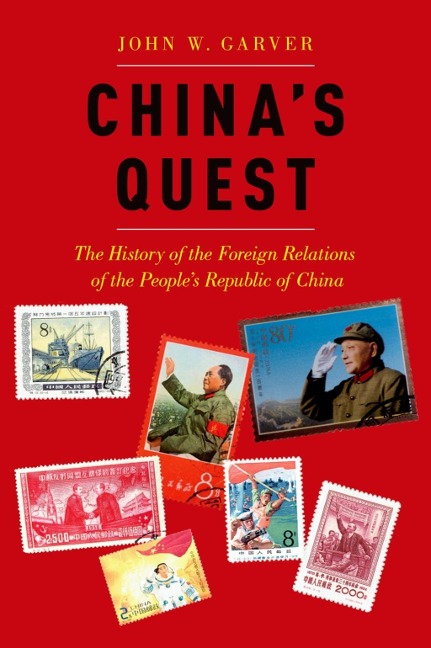
From its founding 65 years ago, the People's Republic of China has evolved from an important yet chaotic and impoverished state whose power was more latent than real into a great power on the cusp of possessing the largest economy in the world. Its path from the 1949 revolution to the present has been filled with twists and turns, including internal upheavals, a dramatic break with the Soviet Union, the 1989 revolution wave, and various wars and quasi-wars against India, the USSR, Vietnam, and South Korea. Throughout it all, international pressures have been omnipresent, forcing the regime to periodically shift course. In short, the evolution of the PROC in world politics is an epic story and one of the most important developments in modern world history. Yet to date, there has been no authoritative history of China's foreign relations.
John Garver's monumental China's Quest not only addresses this gap; it will almost certainly serve as the definitive work on the topic for years to come. Garver, one of the world's leading scholars of Chinese foreign policy, covers a vast amount of ground and threads a core argument through the entirety of his account: domestic political concerns-regime survival in particular-have been the primary force driving the People's Republic's foreign policy agenda. The objective of communist regime survival, he argues, transcends the more rudimentary pursuit of national interests that realists focus on. Indeed, from 1949 onward, domestic politics has been integral to the PROC's foreign policy choices. Over the decades, the regime's decisions in the realm of international politics have been dictated concerns about internal stability. In the early days of the regime, Mao and other part leaders were concerned with surviving in the face of American aggression. Later, they came to see the post-Stalinist Soviet model as a threat to their revolutionary program and initiated a stunning break with Khrushchev regime. Finally, the collapse of other communist regimes in and after 1989 radically altered their relationships with capitalist powers, and again preserving regime stability in a world where communism has been largely abandoned became paramount.
China's Quest, the result of over a decade of research, writing, and analysis, is both sweeping in breadth and encyclopedic in detail. Quite simply, it will be essential for any student or scholar with a strong interest in China's foreign policy.
John W. Garver is Professor of Political Science at the Sam Nunn School of International Affairs at the Georgia Institute of Technology
Table of Contents
1. Introduction: The Embrace of Communism and Its Consequence
Act I: Forging a Revolutionary State
2. Joining the Socialist Camp, 1949-1950 3. War in Korea and Indochina, 1950-1953 4. The Bandung 5. The Sino-Soviet Schism: the race to communism and great power status, 1956-1958 6. Sino-Indian Conflict and the Sino-Soviet 7. Reviving Revolutionary Momentum, 1962-1965 8. Revolutionary China's Quest to Transform Southeast Asia.............. 9. Countering the US in Vietnam: Proxy War with the United 10. The Cultural Revolution 11. Rapprochement with the United States, 1970-1972 12. Countering Soviet Encirclement and Trying to Preserve Mao's Legacy
Act II: The Happy Interregnum; the Possibility of Liberation Opens
13. Opening to the Outside World 14. China's Pedagogic War with Vietnam 15. The Strategic Triangle and the Four Modernizations 16. Rapprochement with Asian Powers: Soviet Union, India, Iran and Japan
Act III: The Leninist State Besieged; Socialism in One Country 17. The CCP's Near Escape and Its Aftermath 18. The Diplomacy of Damage Control 19. The Crisis Deepens: Collapse of Communism in Eastern Europe and the USSR 20. Constraining Unipolarity in a Unbalanced International System
21. China and American Hegemony in the Persian Gulf 22. The Recovery of Hong Kong 23. Military Confrontation with the United States over Taiwan 24. China's Long Debate over Policy toward the United States 25. China's Emergence as a Global Economic and Military Power
26. Reassuring and Unnerving the Neighbors: Japan 27 Reassuring and Unnerving the Neighbors: India 28. China's Quest for Modernity and the Tides of World History