Und dann auf "Zum Home-Bildschirm [+]".

Stöbern
genialokal zum Startbildschirm hinzufügen
Installieren Sie die genialokal App auf Ihrem Startbildschirm für einen schnellen Zugriff und eine komfortable Nutzung.
Installieren Sie die genialokal App auf Ihrem Startbildschirm für einen schnellen Zugriff und eine komfortable Nutzung.
Ihr gewünschter Artikel ist in 0 Buchhandlungen vorrätig - wählen Sie hier eine Buchhandlung in Ihrer Nähe aus:

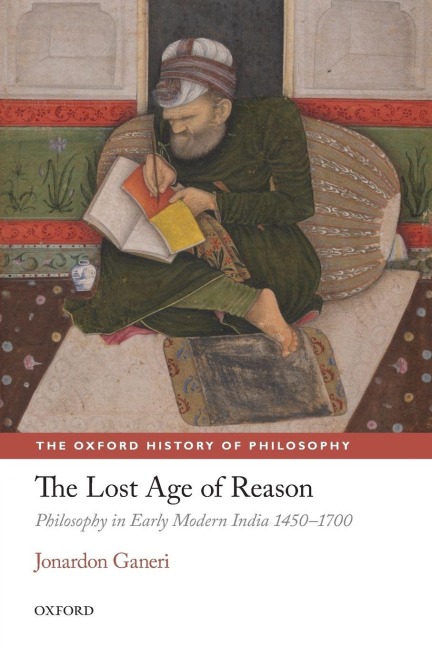

Jonardon Ganeri tells the story of a fascinating period in intellectual history, when Indian philosophy moved into the modern era. Philosophers no longer defer to ancient authorities, but draw upon their insights to seek a true understanding of knowledge, self, and reality. This missing chapter in the development of modernity can at last be read.
Jonardon Ganeri is a philosopher who draws upon Indian, European and Ango-American sources in his work. He is currently Professor of Philosophy at the University of Sussex. He read Mathematics at Cambridge before commencing graduate studies in Philosophy at London and Oxford. He has been a Jacobsen Fellow in Philosophy at King's College London and a Spalding Fellow at Clare Hall Cambridge. As well as teaching at various Universities in Britain, he has held visiting professorships at the University of Chicago and the University of Pennsylvania.
- Introduction
- PART I: INDIA EXPANDING
- 1: The World and India: 1656
- 2: Dãrã Shukoh: A Spacious Islam
- 3: The Cosmopolitan Vision of Yasovijaya Gani
- 4: Navadvïpa: A Place of Hindu-Muslim Confluence in Bengal
- PART II: TEXT AND METHOD
- 5: Contextualism in The Study of Indian Philosophical Literature
- 6: Philosophy outside Academies: Networks
- 7: An Analysis of the New Reason's Literary Artefacts
- 8: Commentary and Creativity
- PART III: THE POSSIBILITY OF INQUIRY
- 9: Inquiry: The History of a Crisis
- 10: Challenge From The Ritualists
- 11: Interventions in a New Research Programme
- PART IV : THE REAL WORLD
- 12: Realism in Question
- 13: New Foundations in the Metaphysics of Mathematics
- 14: Metaphysics in a Different Key
- PART V: A NEW LANGUAGE FOR PHILOSOPHY
- 15: The Technical Language Assessed
- 16: Rival Logics of Domain Restriction
- Conclusion
- Bibliography