Und dann auf "Zum Home-Bildschirm [+]".

Stöbern
genialokal zum Startbildschirm hinzufügen
Installieren Sie die genialokal App auf Ihrem Startbildschirm für einen schnellen Zugriff und eine komfortable Nutzung.
Installieren Sie die genialokal App auf Ihrem Startbildschirm für einen schnellen Zugriff und eine komfortable Nutzung.


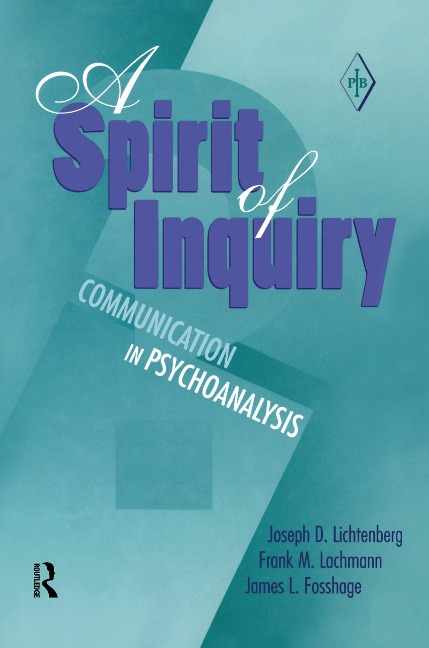
Thoroughly grounded in contemporary developmental research, A Spirit of Inquiry: Communication in Psychoanalysis explores the ecological niche of the infant-caregiver dyad and examines the evolutionary leap that permits communication to take place concurrently in verbal an nonverbal modes. Via the uniquely human capacity for speech, the authors hold, intercommunication deepens into a continuous process of listening to, sensing into, and deciphering motivation-driven messages. The analytic exchange is unique owing to a broad communicative repertoire that encompasses all the permutations of day-to-day exchanges. It is the spirit of inquiry that endows such communicative moments with an overarching sense of purpose and thereby permits analysis to become an intimate relationship decisively unlike any other. In elucidating the special character of this relationship, the authors refine their understanding of motivational systems theory by showing how exploration, previously conceptualized as a discrete motivational system, simultaneously infuses all the motivational systems with an integrative dynamic that tends to a cohesive sense of self. Of equal note is their discerning use of contemporary attachment reseach, which provides convincing evidence of the link between crucial relationships and communication. Replete with detailed case studies that illustrate both the context and nature of specific analytic inquiries, A Spirit of Inquiry presents a novel perspective, sustained by empirical research, for integrating the various communicative modalities that arise in any psychoanalytic treatment. The result is a deepened understanding of subjectivity and intersubjectivity in analytic relationships. Indeed, the book is a compelling brief for the claim that subjectivity and intersubjectivity, in their full complexity, can only be understood through clinically relevant and scientifically credible theories of motivation and communication.
Joseph D. Lichtenberg, M.D., is Editor-in-Chief of Psychoanaytic Inquiry, Director Emeritus of the Institute of Contemporary Psychotherapy and Psychoanalysis, and past President of the International Council for Psychoanalytic Self Psychology. He has authored and edited numerous books and articles, including Craft and Spirit: A Guide to the Exploratory Psychotherapies (Analytic Press, 2005) and, with Frank Lachmann and James Fosshage, A Sprit of Inquiry: Communication in Psychoanalysis (Analytic Press, 2002). Frank M. Lachmann, Ph.D., is a founding faculty member of the Institute for the Psychoanalytic Study of Subjectivity, Training and Supervising Analyst, Postgraduate Center for Mental Health, and Clinical Assistant Professor at the NYU Postdoctoral Program in Psychotherapy and Psychoanalysis. He has contributed over 100 articles to the journal literature, and is author of Transforming Aggression (Aronson, 2000), and co-author of Self and Motivational Systems (Analytic Press, 1992), The Clinical Exchange (Analytic Press, 1996), and Infant Research and Adult Treatment (Analytic Press, 2002). James L. Fosshage, Ph.D., is Cofounder, Board Director, and faculty member, National Institute for the Psychotherapies, NYC; founding faculty member, Institute for the Psychoanalytic Study of Subjectivity, NYC; and Clinical Professor of Psychology, New York University Postdoctoral Program in Psychotherapy and Psychoanalysis.
How Do We Explain the Development of Communication with Self and Other in Infancy? Part I. How Do We Explain the Development of Communication with Self and Other in Infancy? Part II. Open Flexible Communication in Moment-to-Moment Exchanges. Effective Communication Exchanges. Transference as Communication: The Language of the Body. Words, Gestures, Metaphors, and Model Scenes. Verbal and Nonverbal Communication During Analysis. Controversies and Answers: Communication and a Spirit of Inquiry Reconsidered.
Dieses eBook wird im PDF-Format geliefert und ist mit einem Adobe Kopierschutz (DRM) versehen. Sie können dieses eBook mit allen Geräten lesen, die das PDF-Format und den Adobe Kopierschutz (DRM) unterstützen.
Zum Beispiel mit den folgenden Geräten:
• tolino Reader
Laden Sie das eBook direkt über den Reader-Shop auf dem tolino herunter oder übertragen Sie das eBook auf Ihren tolino mit einer kostenlosen Software wie beispielsweise Adobe Digital Editions.
• Sony Reader & andere eBook Reader
Laden Sie das eBook direkt über den Reader-Shop herunter oder übertragen Sie das eBook mit der kostenlosen Software Sony READER FOR PC/Mac oder Adobe Digital Editions auf ein Standard-Lesegeräte mit epub- und Adobe DRM-Unterstützung.
• Tablets & Smartphones
Möchten Sie dieses eBook auf Ihrem Smartphone oder Tablet lesen, finden Sie hier unsere kostenlose Lese-App für iPhone/iPad und Android Smartphone/Tablets.
• PC & Mac
Lesen Sie das eBook direkt nach dem Herunterladen mit einer kostenlosen Lesesoftware, beispielsweise Adobe Digital Editions, Sony READER FOR PC/Mac oder direkt über Ihre eBook-Bibliothek in Ihrem Konto unter „Meine eBooks“ - „online lesen“.
Schalten Sie das eBook mit Ihrer persönlichen Adobe ID auf bis zu sechs Geräten gleichzeitig frei.
Bitte beachten Sie, dass die Kindle-Geräte das Format nicht unterstützen und dieses eBook somit nicht auf Kindle-Geräten lesbar ist.