Und dann auf "Zum Home-Bildschirm [+]".

Stöbern
genialokal zum Startbildschirm hinzufügen
Installieren Sie die genialokal App auf Ihrem Startbildschirm für einen schnellen Zugriff und eine komfortable Nutzung.
Installieren Sie die genialokal App auf Ihrem Startbildschirm für einen schnellen Zugriff und eine komfortable Nutzung.
Ihr gewünschter Artikel ist in 0 Buchhandlungen vorrätig - wählen Sie hier eine Buchhandlung in Ihrer Nähe aus:

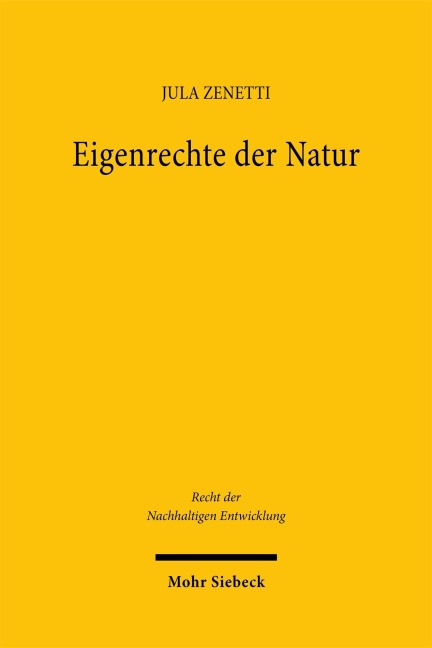
Jula Zenetti traces the development of the concept of intrinsic rights-that is, the idea of endowing nature with subjective rights. This development has unfolded over many decades and spans different continents and cultural contexts. She then identifies several variants of the concept as it appears today, some of which differ considerably from one another. To what extent can the legal interest of nature benefit from the recognition of its own rights in EU law and German law? To answer this question, the author compares the concept of intrinsic rights-in its various forms-with the existing legal frameworks of the EU and Germany. This comparison reveals both overlaps and protection gaps in each approach. At the same time, it uncovers a remarkable development: environmental law in the EU and Germany is increasingly evolving toward subjective rights of nature, showing clear tendencies toward subjectification. A more in-depth analysis of this development highlights, on the one hand, growing parallels between current environmental law and intrinsic rights. On the other hand, it becomes evident that in several areas, intrinsic rights of nature integrate more coherently into the legal systems of the EU and Germany than do traditional environmental obligations. In addition, Jula Zenetti examines the effects that subjective rights exert both within the legal system and outward into society. Subjective rights have profoundly shaped legal systems and social structures for centuries; today, they are regarded as having immense significance.
Born 1987; studied law at the University of Konstanz; completed LL.M. studies in Lyon, France, and Maynooth, Ireland; legal traineeship in Darmstadt and Frankfurt; lawyer in Stuttgart; policy officer at the Saxon Ministry of the Environment in Dresden; PhD awarded in 2025 (Leipzig); participation in scientific projects at the Helmholtz Centre for Environmental Research in Leipzig.
Einleitung
Kapitel 1: Von den Anfängen des Eigenrechtskonzepts bis zur aktuellen Dynamik der Anerkennung
A. Die Anfänge des Eigenrechtskonzepts - B. Die erste Welle der Anerkennung von Eigenrechten - C. Die zweite Welle: Aktuelle Dynamik der Eigenrechte - D. Stand der Forschung und Einordnung der Eigenrechtsidee in die Debatte um die Zukunftsfähigkeit des Umweltrechts - E. Ergebnis
Kapitel 2: Varianten des Eigenrechtskonzepts
A. Natur, Ökosysteme, Wilder Reis: Mögliche Träger*innen von Eigenrechten - B. Inhalt und Umfang von Eigenrechten - C. Formen der Vertretung - D. Ergebnis
Kapitel 3: Gegenüberstellung von Eigenrechten und objektivem Umweltrecht in ausgewählten Bereichen
A. Zum Prinzip der ökologischen Integrität - B. Präventiver Schutz von Arten und ökologischer Integrität - C. Umgang mit Kollisionen - D. Gerichtliche Durchsetzbarkeit von Umweltrecht - E. Ergebnisse und Folgefragen der Gegenüberstellung
Kapitel 4: Eigenrechte als nächster Schritt im Umweltrecht?
A. Zur Konformität von objektivem Umweltrecht im Vergleich zu subjektiven Eigenrechten mit dem Rechtssystem der EU und Deutschlands - B. Innerrechtliche Wirkungen subjektiver Rechte - C. Außerrechtliche Wirkungen: Transformation und Recht(e) - D. Kritik an Rechten der Natur - E. Ergebnis
Gesamtergebnis