Und dann auf "Zum Home-Bildschirm [+]".

Stöbern
genialokal zum Startbildschirm hinzufügen
Installieren Sie die genialokal App auf Ihrem Startbildschirm für einen schnellen Zugriff und eine komfortable Nutzung.
Installieren Sie die genialokal App auf Ihrem Startbildschirm für einen schnellen Zugriff und eine komfortable Nutzung.
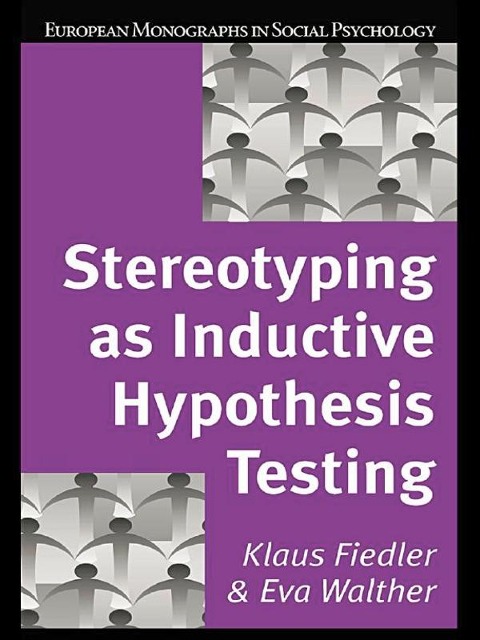
Traditional social hypotheses have a built-in tendency to verify themselves and so involuntarily resist attempts at stereotype change or correction. This is the insight demonstrated and discussed as the start point for an alternative approach to the problem of stereotyping and hypothesis testing. Stereotyping as Inductive Hypothesis Testing explicates the proposition that many stereotypes originate not so much in individual brains, but in the stimulus environment that interacts with and constitutes the social individual. This cognitive-ecological approach is then used to analyse the different aspects of language, sign systems and communication that can implicitly govern hypothesis testing procedures and lead to circular or reinforcing outcomes. The authors describe factors in tests such as judgment, memory and expectation and go on to suggest viable ecological learning approaches to them. An original research project based on a classroom situation is used to demonstrate and verify findings. The cognitive-ecological approach is then contextualised in relation to both the traditional approaches it can replace and the contemporary statistical sampling practices it can improve. Written with a profound understanding of the link between theoretical rigour and good empirical research practice this monograph will be invaluable to anyone with an interest in stereotyping or who wishes to enhance the reliability and self-awareness of their research methods.
The Topic of Social Hypothesis Testing. Stereotyping as a Cognitive-Environmental Learning Process: Delineating the Conceptual Framework. Learning of Social Hypotheses - Stereotypes as Illusory Correlations. The Auto-verification of Social Hypotheses. Information Search in the 'Inner World': The Origin of Stereotypes in Memory. Testing Social Hypotheses in Tri-variate Problem Space: Further Variants of Environmental Stereotype Learning. Explicit and Implicit Hypotheses Testing in a Complex Environment. The Vicissitudes of Information Sampling in a Fallible Environment: An Integrative Framework. Epilogue: Locating CELA in Modern Stereotype Research.
Dieses eBook wird im PDF-Format geliefert und ist mit einem Adobe Kopierschutz (DRM) versehen. Sie können dieses eBook mit allen Geräten lesen, die das PDF-Format und den Adobe Kopierschutz (DRM) unterstützen.
Zum Beispiel mit den folgenden Geräten:
• tolino Reader
Laden Sie das eBook direkt über den Reader-Shop auf dem tolino herunter oder übertragen Sie das eBook auf Ihren tolino mit einer kostenlosen Software wie beispielsweise Adobe Digital Editions.
• Sony Reader & andere eBook Reader
Laden Sie das eBook direkt über den Reader-Shop herunter oder übertragen Sie das eBook mit der kostenlosen Software Sony READER FOR PC/Mac oder Adobe Digital Editions auf ein Standard-Lesegeräte mit epub- und Adobe DRM-Unterstützung.
• Tablets & Smartphones
Möchten Sie dieses eBook auf Ihrem Smartphone oder Tablet lesen, finden Sie hier unsere kostenlose Lese-App für iPhone/iPad und Android Smartphone/Tablets.
• PC & Mac
Lesen Sie das eBook direkt nach dem Herunterladen mit einer kostenlosen Lesesoftware, beispielsweise Adobe Digital Editions, Sony READER FOR PC/Mac oder direkt über Ihre eBook-Bibliothek in Ihrem Konto unter „Meine eBooks“ - „online lesen“.
Schalten Sie das eBook mit Ihrer persönlichen Adobe ID auf bis zu sechs Geräten gleichzeitig frei.
Bitte beachten Sie, dass die Kindle-Geräte das Format nicht unterstützen und dieses eBook somit nicht auf Kindle-Geräten lesbar ist.