Und dann auf "Zum Home-Bildschirm [+]".

Stöbern
genialokal zum Startbildschirm hinzufügen
Installieren Sie die genialokal App auf Ihrem Startbildschirm für einen schnellen Zugriff und eine komfortable Nutzung.
Installieren Sie die genialokal App auf Ihrem Startbildschirm für einen schnellen Zugriff und eine komfortable Nutzung.
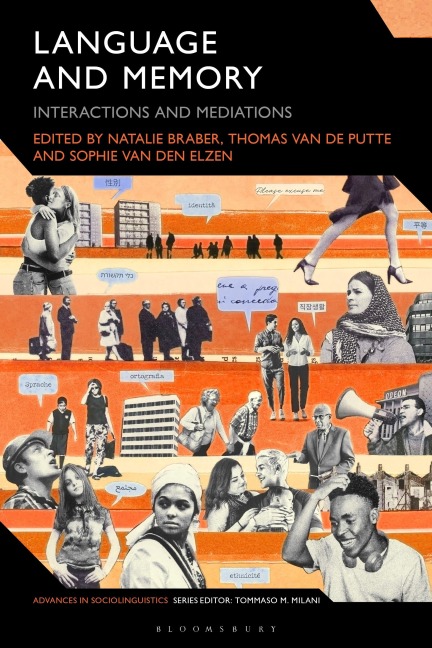
This interdisciplinary edited volume combines linguistic and memory approaches to study how people attribute meaning to the past.
It includes contributions by linguists who consider memory studies and its theories, and by memory studies scholars without linguistic background who look at sociolinguistic methods and concepts.
The book is divided into three parts and includes case studies from countries including Belgium, Chile, Cyprus, India, Italy, Poland and Sri Lanka. The first part considers ways in which memory scholars might reach out to discourse analytical and other sociolinguistic methods to make sense of a variety of memory phenomena. The second considers cutting-edge linguistic research which reaches out to memory scholars and their body of theories. The final section centres on how language itself can be studied as a 'site of memory'. Its symbolic power is salient for communities to make sense of continuities between past, present and future.
In addition to offering relevant theoretical recombinations and concrete methodological ways forward, the chapters indicate the different scales that come into play in this type of research, and what is at stake. The case studies from each chapter vary from the intimate, such as oral histories in the family setting and the difficult work of translators for asylum seekers, to the networked contexts of diasporic internet fora, and the grand-historical scale of the role of heritage in long-standing territorial disputes, as in the case of Cyprus. By bringing these scales together, readers are poised to discover new connections and instances of interscalar transfer.
This book makes a powerful case that the connections between language and memory are crucial across cultures and at different scales.
Natalie Braber is Professor of Linguistics at Nottingham Trent University, UK.
Thomas Van de Putte is British Academy Postdoctoral Fellow at King's College London, UK.
Sophie van den Elzen is Postdoctoral Researcher at Utrecht University, the Netherlands.
Introduction, Natalie Braber (Nottingham Trent University, UK), Thomas Van de Putte (University of Trento, Italy) and Sophie van den Elzen (Utrecht University, The Netherlands)
Part I: Interactions
1. Mnemonic infrastructures on the micro level: A discursive and interactional approach to family memory, Wouter Reggers (UCLouvain, Belgium)
2. The past is not our place: Discursive constructions of identity and positioning in post-conflict generations, Samara Velte (University of the Basque Country, Spain)
3. Language, identity and conflicted heritage: Two case studies from Cyprus, Constadina Charalambous (European University Cyprus, Cyprus) and Elena Ioannidou (University of Cyprus, Cyprus)
4. Making sense of exile as a family, Adriana Patino-Santos (University of Southampton, UK) and Peter Browning (UCL, UK)
5. 'We don't know what it means in Pashto': Multilingual memory and the disclosure of past experiences in interpreter-mediated interaction, Lotte Remue (Ghent University, Belgium)
6. Negotiating memories of conflict among second-generation Sri Lankan Tamils in London, Lavanya Sankaran (King's College London, UK)
Part 2: Mediations
7. Memory as a discursive practice: Halbwachs, dialogicality and multilingualism, Nicolas Villaroel (Austalian National University)
8. Encounters between past and present: Co-constructing memories in collaborative narratives among Polish immigrant women, Dominika Baran (Duke University, USA)
9. Shaping collective memory: The role of narrative composition in historical representation and identity, Orsolya Vincze (University of Pécs, Hungary)
10. Words of the past: A discourse analysis of seventy-six years of remembering collaboration in post-war Belgium (1944-2020), Louise Ballière (Max Planck Institute for Social Anthropology, Germany)
Dieses eBook wird im PDF-Format geliefert und ist mit einem Adobe Kopierschutz (DRM) versehen. Sie können dieses eBook mit allen Geräten lesen, die das PDF-Format und den Adobe Kopierschutz (DRM) unterstützen.
Zum Beispiel mit den folgenden Geräten:
• tolino Reader
Laden Sie das eBook direkt über den Reader-Shop auf dem tolino herunter oder übertragen Sie das eBook auf Ihren tolino mit einer kostenlosen Software wie beispielsweise Adobe Digital Editions.
• Sony Reader & andere eBook Reader
Laden Sie das eBook direkt über den Reader-Shop herunter oder übertragen Sie das eBook mit der kostenlosen Software Sony READER FOR PC/Mac oder Adobe Digital Editions auf ein Standard-Lesegeräte mit epub- und Adobe DRM-Unterstützung.
• Tablets & Smartphones
Möchten Sie dieses eBook auf Ihrem Smartphone oder Tablet lesen, finden Sie hier unsere kostenlose Lese-App für iPhone/iPad und Android Smartphone/Tablets.
• PC & Mac
Lesen Sie das eBook direkt nach dem Herunterladen mit einer kostenlosen Lesesoftware, beispielsweise Adobe Digital Editions, Sony READER FOR PC/Mac oder direkt über Ihre eBook-Bibliothek in Ihrem Konto unter „Meine eBooks“ - „online lesen“.
Schalten Sie das eBook mit Ihrer persönlichen Adobe ID auf bis zu sechs Geräten gleichzeitig frei.
Bitte beachten Sie, dass die Kindle-Geräte das Format nicht unterstützen und dieses eBook somit nicht auf Kindle-Geräten lesbar ist.