Und dann auf "Zum Home-Bildschirm [+]".

Stöbern
genialokal zum Startbildschirm hinzufügen
Installieren Sie die genialokal App auf Ihrem Startbildschirm für einen schnellen Zugriff und eine komfortable Nutzung.
Installieren Sie die genialokal App auf Ihrem Startbildschirm für einen schnellen Zugriff und eine komfortable Nutzung.

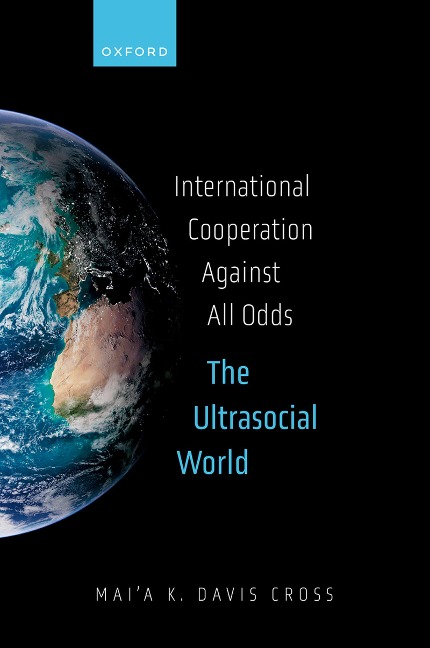
International Cooperation Against All Odds: The Ultrasocial World recasts how we understand international relations through an examination of how the human evolutionary predisposition to be "ultrasocial" as a species impacts which political ideas succeed, transform, manipulate, and inspire on a global scale. At a time when pessimism about our current world order is at an all-time high, this book overturns widespread assumptions that international relations is mainly about conflict, power, and national self-interest. In the last 10-20 years, scientists have discovered that as a species, we are biologically hard-wired, soft-wired, and pre-wired to be other-regarding and cooperative. Humans are an ultrasocial species, and yet this predisposition is completely ignored in governments across the world. Political leaders, experts, and the media have cultivated a myopic vision of global conflict, feeding an obsession on crises of the moment, rather than recognizing frequent and significant breakthroughs in peaceful cooperation and overall trends in the decline of violence. This book shows how time and time again our ultrasocial predisposition has pushed us towards big ideas that inspire and bring us together around the power of possibility. Featuring original research on international cooperation in outer-space exploration, European Union integration, nuclear weapons, and climate change, among other examples, Mai'a K. Davis Cross shows ultrasociality at work in a range of contexts. Tracing the path from social neuroscience and evolutionary biology (among others) to the power of ideas to international agreements, International Cooperation Against All Odds opens up an entirely new understanding of world politics. If we recognize our nature as a species and the potential we have to work together, we can start to transform institutions, and devise policies that take advantage of this. The book ends with a roadmap to promote more international cooperation, and eventually, a more stable, peaceful world order.
Mai'a K. Davis Cross is the Dean's Professor of Political Science, International Affairs, and Diplomacy and Director of the Center for International Affairs and World Cultures at Northeastern University. She is the author of four books, including The Politics of Crisis in Europe (Cambridge University Press, 2017) and Security Integration in Europe: How Knowledge-based Networks are Transforming the European Union (University of Michigan Press, 2011), which is the 2012 winner of the Best Book Prize from the University Association of Contemporary European Studies. She holds a PhD in Politics from Princeton University, and AB in Government from Harvard University. She is also a member of the Council on Foreign Relations.
- Introduction - Part I Humans are Ultrasocial Beings - 1: The Micro Level - 2: Biology Meets Culture - 3: The Social in Social Science - 4: In an Ultrasocial World, Certain Ideas Matter More - Part II European Integration - 5: The Federalist Idea and The European Movement - 6: European Transformation - 7: Optimism, Pessimism...and Repeat - Part III Space Exploration - 8: The Spaceflight Idea and The Spaceflight Movement - 9: International Cooperation and the Space Race - 10: A Permanent Presence in Space...and Beyond - Part IV Nuclear Weapons - 11: The Non-Use Idea and The Anti-Nuclear Movement - 12: The Nuclear Taboo and Disarmament - 13: The Taboo and Its Rivals - Part V Climate Change - 14: The Climate Movement - 15: The Net-Zero Idea and the Race to Save Earth - Conclusion - Bibliography