Und dann auf "Zum Home-Bildschirm [+]".

Stöbern
genialokal zum Startbildschirm hinzufügen
Installieren Sie die genialokal App auf Ihrem Startbildschirm für einen schnellen Zugriff und eine komfortable Nutzung.
Installieren Sie die genialokal App auf Ihrem Startbildschirm für einen schnellen Zugriff und eine komfortable Nutzung.
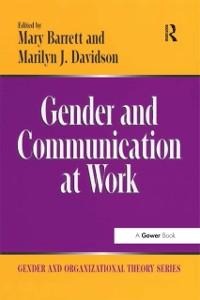
Written by leading researchers from four continents, this book offers a broad and contemporary assessment of the ways in which gender affects workplace communication and how this in turn influences people's choices, training, opportunities and career development. A range of work situations are considered (including communication within the normal routine, in a crisis or under pressure, and during those occasions important for career development) and examples are sourced from a variety of contexts (including international business, leadership, service work, and computer-mediated communication). Gender and Communication at Work includes a diversity of theoretical perspectives in order to most successfully map the range of communication strategies, identities and roles which impact upon and are influenced by gender at work.
Mary Barrett is Professor of Management in the School of Management and Marketing, University of Wollongong, NSW, Australia. Her research and teaching interests are in the fields of human resource management, employment relations and general management, with special emphasis on gender issues in management, organizational communication, and family business, including women in family business. She has published over 60 academic articles and 6 books. Marilyn J. Davidson is Professor of Managerial Psychology in the Manchester Business School, The University of Manchester, UK. She is Head of the Occupational Psychology Group and Co-Director of the Centre for Diversity and Work Psychology. Her research and teaching interests are in the fields of occupational stress, the management of diversity, equal opportunities, women in management, ethnicity and female entrepreneurs. She has published over 150 academic articles and 19 books.
Chapter 1 Gender and Communication at Work: An Introduction, Mary Barrett, Marilyn J. Davidson; Part 1 Gender and Communication Situations in the Employment Lifespan; Chapter 2 Gendered Performance and Communication in the Employment Interview, Patrice M. Buzzanell, Rebecca J. Meisenbach; Chapter 3 The Effect of Gender on the Transfer of Interpersonal Communication Skills Training to the Workplace, Kathryn S. O'Neill, Carol D. Hansen, Gary L. May; Chapter 4 Women and Promotion: The Influence of Communication Style, Jennifer J. Peck; Part 2 Gender, Communication and Organizational Boundaries: Linkages and Violations; Chapter 5 Gender Issues in Workplace Groups: Effects of Gender and Communication Style on Social Influence, Linda L. Carli; Chapter 6 Gender and Advisor-Client Communication, Joan Mulholland; Chapter 7 Gender, Communication and International Business, Beverly D. Metcalfe; Chapter 8 Gender, Violation and Communication at Work, Jeff Hearn, Wendy Parkin; Part 3 Gender and Communication Channels in Special Workplace Environments; Chapter 9 Communication Channels and Gender Structures at Work, Catherine W. Ng, Laura Byra; Chapter 10 Women's Work: The Language Use of Call Centre Representatives, Margaret Franken, Catherine Wallace; Chapter 11 Putting Gender in its Place: A Case Study on Constructing Speaker Identities in a Management Meeting, Judith Baxter; Chapter 12 Communication and Gender Issues in an Italian Medical Emergency Control Room: A Case Study, Isabella Paoletti; Part 4 Communicating to Get Things Done; Chapter 13 Gender, Leadership and Communication, Leonie V. Still; Chapter 14 'We Don't Need Another Hero!': Organizational Storytelling as a Vehicle for Communicating a Female Archetype of Workplace Leadership, Su Olsson; Chapter 15 Negotiating while Female: Research and Implications, Alice F. Stuhlmacher, Rebecca B. Winkler; Chapter 16 Gender and the Expression of Emotion in Organizations, Theresa A. Domagalski; Part 5 The Future: Gender and Computer-mediated Communication at Work; Chapter 17 Gender and Electronic Discourse in the Workplace, Rob Thomson; Chapter 18 The Email Gender Gap, Niki Panteli, Monica Seeley; Chapter 19 Gender and Diffusion of Email: An Organizational Perspective, Mark J. Brosnan; Chapter 20 Gender, Group Composition and Task Type in Virtual Groups, Victor Savicki, David A. Foster, Merle Kelley;
Dieses eBook wird im PDF-Format geliefert und ist mit einem Adobe Kopierschutz (DRM) versehen. Sie können dieses eBook mit allen Geräten lesen, die das PDF-Format und den Adobe Kopierschutz (DRM) unterstützen.
Zum Beispiel mit den folgenden Geräten:
• tolino Reader
Laden Sie das eBook direkt über den Reader-Shop auf dem tolino herunter oder übertragen Sie das eBook auf Ihren tolino mit einer kostenlosen Software wie beispielsweise Adobe Digital Editions.
• Sony Reader & andere eBook Reader
Laden Sie das eBook direkt über den Reader-Shop herunter oder übertragen Sie das eBook mit der kostenlosen Software Sony READER FOR PC/Mac oder Adobe Digital Editions auf ein Standard-Lesegeräte mit epub- und Adobe DRM-Unterstützung.
• Tablets & Smartphones
Möchten Sie dieses eBook auf Ihrem Smartphone oder Tablet lesen, finden Sie hier unsere kostenlose Lese-App für iPhone/iPad und Android Smartphone/Tablets.
• PC & Mac
Lesen Sie das eBook direkt nach dem Herunterladen mit einer kostenlosen Lesesoftware, beispielsweise Adobe Digital Editions, Sony READER FOR PC/Mac oder direkt über Ihre eBook-Bibliothek in Ihrem Konto unter „Meine eBooks“ - „online lesen“.
Schalten Sie das eBook mit Ihrer persönlichen Adobe ID auf bis zu sechs Geräten gleichzeitig frei.
Bitte beachten Sie, dass die Kindle-Geräte das Format nicht unterstützen und dieses eBook somit nicht auf Kindle-Geräten lesbar ist.