Und dann auf "Zum Home-Bildschirm [+]".

Stöbern
genialokal zum Startbildschirm hinzufügen
Installieren Sie die genialokal App auf Ihrem Startbildschirm für einen schnellen Zugriff und eine komfortable Nutzung.
Installieren Sie die genialokal App auf Ihrem Startbildschirm für einen schnellen Zugriff und eine komfortable Nutzung.
Ihr gewünschter Artikel ist in 0 Buchhandlungen vorrätig - wählen Sie hier eine Buchhandlung in Ihrer Nähe aus:

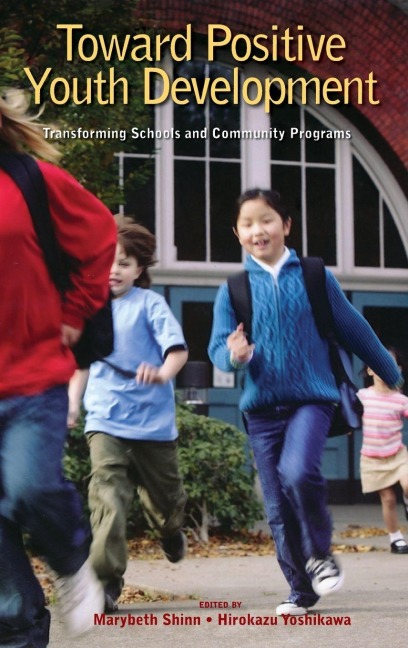
This book provides detailed strategies for transforming social settings to harness their power to promote positive youth development. The book shows schools and youth programs how to assess social settings and use data to motivate and guide change efforts and daily practices. Many chapters also focus on youth who are marginalized for reasons of race, ethnicity, immigration status, or sexual orientation, and show how settings can be transformed to improve the quality of experiences for all youth.
Marybeth Shinn is Professor of Applied Psychology and Public Policy at New York University. She received her Ph.D. in social and community psychology from the University of Michigan. Shinn studies how social contexts, including social settings, neighborhoods, socioeconomic circumstances, and social policies, affect individual well-being. With anthropologist Kim Hopper, she is using capability theory to understand questions about environments that foster capabilities for homeless and mentally ill adults, which parallel questions in the current book about settings that promote youth development. Other work focuses on causes, consequences, and prevention of homelessness for families and individuals. Shinn was a fellow at the Russell Sage Foundation. She has served as president of the Society for the Psychological Study of Social Issues and the Society for Community Research and Action and received awards for Distinguished Contributions to Theory and Research and Ethnic Minority Mentoring from the latter group. Hirokazu Yoshikawa is Professor of Education at the Harvard Graduate School of Education. He studies the effects of welfare and anti-poverty policies on children; the influence of low-wage work dynamics and conditions on family processes and children; the development of young children in immigrant families; and whole-grade approaches to music education. He has participated in multiple Congressional briefings on child and family policy and human development. He has received three early career awards from the American Psychological Association (the Louise Kidder Award from the Society for the Psychological Study of Social Issues, the Boyd McCandless Award for contributions to developmental psychology, and the Minority Fellowship Program's early career award), as well as the Ethnic Minority Mentorship award from the Society for Community Research and Action (Division 27 of the APA). He was recently a member of the National Academy of Sciences Committee on Family and Work Policies. In 2004 he was awarded a fellowship from the Center for Advanced Study in the Behavioral Sciences. He is editor (with Thomas Weisner and Edward Lowe) of Making It Work: Low-Wage Employment, Family Life, and Child Development (Russell Sage Foundation, 2006).
- 1: Marybeth Shinn and Hirokazu Yoshikawa: Introduction
- Part 1: Changing Classrooms
- 2: Robert C. Pianta and Joseph P. Allen: Building Capacity for Positive Youth Development in Secondary School Classrooms: Changing Teachers' Interactions with Students
- 3: David B. Henry: Changing Classroom Social Settings Through Attention to Norms
- 4: Stephanie M. Jones, Joshua L. Brown, and J. Lawrence Aber: Classroom Settings as Targets of Intervention and Research
- Part 2: Changing Schools
- 5: Rhona S. Weinstein: Schools that Actualize High Expectations for All Youth Theory for Setting Change and Setting Creating
- 6: Mica Pollock: An Intervention in Progress: Pursuing Precision in School Race Talk
- 7: Kenneth I. Maton, Freeman A. Hrabowski, Metin Özdemir, and Harriette Wimms: Enhancing Representation, Retention and Achievement of Minority Students in Higher Education: A Social Transformation Theory of Change
- 8: Stephen T. Russell and Jenifer K. McGuire: The School Climate for Lesbian, Gay, Bisexual, and Transgender (LGBT) Students
- 9: Laura M. Desimone: Whole-School Change
- Part 3: Changing Community Organizations
- 10: Robin Lin Miller, Shannon K. E. Kobes, and Jason C. Forney: Building the Capacity of Small Community-Based Organizations to Better Serve Youth
- 11: Charles Smith and Tom Akiva: Quality Accountability: Improving Fidelity of Broad Developmentally Focused Interventions
- 12: Paul W. Speer: Altering Patterns of Relationships and Participation: Organizing as a Setting-Level Intervention
- 13: Min Zhou: The Ethnic System of Supplementary Education: Non-profit and For-profit Institutions in Los Angeles' Chinese Immigrant Community
- Part 4: Changing Larger Social Structures
- 14: Richard D. Kahlenberg: Socioeconomic School Integration
- 15: Amanda Datnow: The Co-Construction of Educational Reform: The Intersection of Federal, State, and Local Contexts
- 16: Abigail A. Fagan, J. David Hawkins, and Richard F. Catalano: Using Community Epidemiologic Data to Improve Social Settings: The Communities that Care Prevention System
- 17: Milbrey McLaughlin and Margaret O'Brien-Strain: The Youth Data Archive: Integrating Data to Assess Social Settings in a Societal Sector Framework
- Part 5. Cross-Cutting Themes: Strategies for Measurement and Intervention
- 18: Andres Martinez and Stephen W. Raudenbush: Measuring and Improving Program Quality: Reliability and Statistical Power
- 19: Hirokazu Yoskikawa and Marybeth Shinn: Improving Youth-Serving Social Settings: Intervention Strategies for Schools, Youth Programs, and Communities