Und dann auf "Zum Home-Bildschirm [+]".

Stöbern
genialokal zum Startbildschirm hinzufügen
Installieren Sie die genialokal App auf Ihrem Startbildschirm für einen schnellen Zugriff und eine komfortable Nutzung.
Installieren Sie die genialokal App auf Ihrem Startbildschirm für einen schnellen Zugriff und eine komfortable Nutzung.
Ihr gewünschter Artikel ist in 0 Buchhandlungen vorrätig - wählen Sie hier eine Buchhandlung in Ihrer Nähe aus:

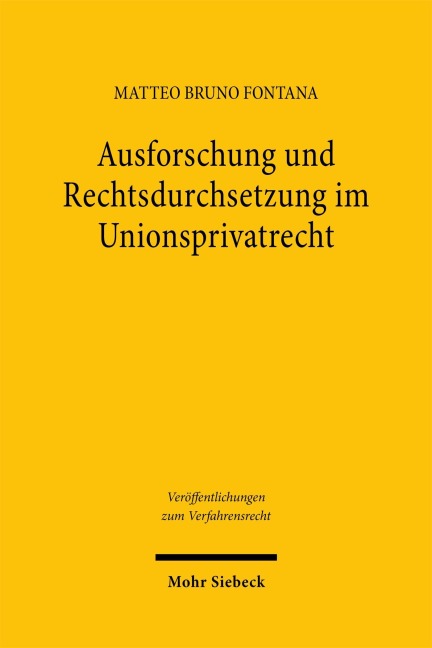
The traditional conception of German civil procedure is founded on the premise of a dispute between parties on equal footing. Accordingly, German case law and legal doctrine have historically adopted a restrictive approach to the parties' duties to disclose information: where two citizens meet as equals, the law need not intervene to assist either party with procedural rights to obtain information. In today's society, however, large platform providers and product manufacturers often possess a significant informational advantage over consumers and small businesses regarding the functioning of their highly complex products. The classical view of litigation as a clash between equals has thus become increasingly detached from reality. The imbalance of power - and consequently of information - between parties in modern civil proceedings was not lost on the European legislator. Through a range of directives, such as those concerning antitrust damages, product liability, and collective redress, the European Union has introduced what may initially appear to be a jungle of disparate disclosure obligations in civil litigation. Yet, these seemingly fragmented provisions on disclosure in EU private law can be traced back to a common underlying principle - the effective enforcement of EU law, aimed at fostering prosperity within the Union - and to uniform principles of interpretation.
Born in 1999; studied law in Munich; research assistant at the Chair of Civil Law, Commercial and Corporate Law, Private International Law, and Comparative Law at LMU Munich; legal clerkship; 2025 doctorate (Munich); master's degree at the University of Oxford.
Einleitung
§ 1 Informationsasymmetrien im klassisch-liberalen Zivilprozess
§ 2 Gang der Untersuchung und Ziele
§ 3 Begriffsklärungen und Abgrenzung der Themenfrage
Teil I: Präparatorische Informationsrechte im autonomen Recht
§ 4 Die Überwindung von Informationsasymmetrien im Zivilprozess
§ 5 Präparatorische Informationsrechte im internationalen Vergleich
§ 6 Einordnung und Systematisierung der Informationsrechte des autonomen Rechts
Teil II: Präparatorische Informationsrechte im europäischen Privatrecht
§ 7 Präparatorische Informationsrechte im gewerblichen Rechtsschutz
§ 8 Präparatorische Informationsrechte im Kartellschadensersatzrecht
§ 9 Präparatorische Informationsrechte im kollektiven Verbraucherprozessrecht
§ 10 Präparatorische Informationsrechte nach der Richtlinie über die Sorgfaltspflichten in der Lieferkette
§ 11 Präparatorische Informationsrechte im Produkt- und KI-Haftungsrecht
§ 12 Exkurs: Informationsrechte nach dem Kapitalanleger-Musterverfahrensgesetz
§ 13 Einordnung und Systematisierung der Informationsrechte des Unionsprivatrechts
Teil III: Auf dem Weg zu einer unionsrechtlichen discovery?
§ 14 Herleitung eines allgemeinen unionsrechtlichen Informationsrechts
§ 15 Umsetzung des allgemeinen unionsrechtlichen Informationsrechts
Fazit und Ausblick
§ 16 Fazit in Thesen
§ 17 Ausblick