Und dann auf "Zum Home-Bildschirm [+]".

Stöbern
genialokal zum Startbildschirm hinzufügen
Installieren Sie die genialokal App auf Ihrem Startbildschirm für einen schnellen Zugriff und eine komfortable Nutzung.
Installieren Sie die genialokal App auf Ihrem Startbildschirm für einen schnellen Zugriff und eine komfortable Nutzung.
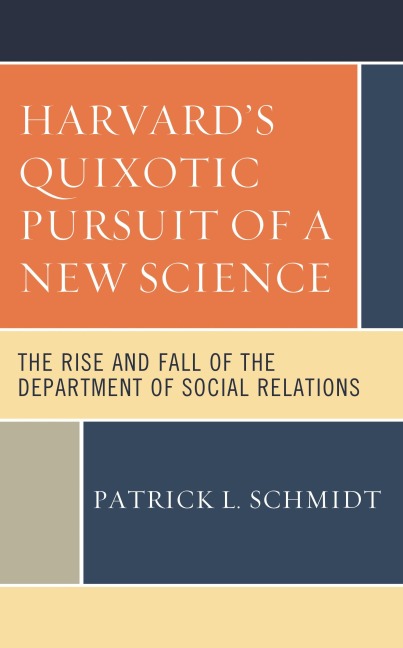
In Harvard's Quixotic Pursuit of a New Science, Patrick L. Schmidt tells the little-known story of how some of the most renowned social scientists of the twentieth century struggled to elevate their emerging disciplines of cultural anthropology, sociology, and social and clinical psychology. Scorned and marginalized in their respective departments in the 1930s for pursuing the controversial theories of Freud and Jung, they persuaded Harvard to establish a new department, promising to create an interdisciplinary science that would surpass in importance Harvard's "big three" disciplines of economics, government, and history. Although the Department of Social Relations failed to achieve this audacious goal, it nonetheless attracted an outstanding faculty, produced important scholarly work, and trained many notable graduates. At times, it was a wild ride. Some faculty became notorious for their questionable research: Timothy Leary and Richard Alpert (reborn as Ram Dass) gave the psychedelic drug psilocybin to students, while Henry Murray traumatized undergraduate Theodore Kaczynski (later the Unabomber) in a three-year-long experiment. Central to the story is the obsessive quest of legendary sociologist Talcott Parsons for a single theory unifying the social sciences- the white whale to his Captain Ahab. All in all, Schmidt's lively narrative is an instructive tale of academic infighting, hubris, and scandal.
Patrick L. Schmidt is an attorney in Washington, D.C. He received a BA, magna cum laude, from Harvard College, a JD from Georgetown University, and an MIPP from the Johns Hopkins University School of Advanced International Studies. He first examined the history of the Department of Social Relations in his undergraduate honors thesis at Harvard.
Preface
Acknowledgments
1 Psychoanalytic Thought Arrives at Harvard: Roiling the Disciplines
2 World War II Changes Everything: InterdisciplinaryResearch Emerges
3 The Founding of the Department: A Determined Dean Acts
4 The First Five Years: A Golden Age but Integration Proves Elusive
5 The 1950s: A Decade of Disunity
6 The 1960s: Drugs and Departmental Drift
7 The Final Unraveling: Soc Rel 149 Disrupts and Sociology Departs
8 Conclusion and Summary
Notes
Bibliography
Index
About the Author
Dieses eBook wird im PDF-Format geliefert und ist mit einem Adobe Kopierschutz (DRM) versehen. Sie können dieses eBook mit allen Geräten lesen, die das PDF-Format und den Adobe Kopierschutz (DRM) unterstützen.
Zum Beispiel mit den folgenden Geräten:
• tolino Reader
Laden Sie das eBook direkt über den Reader-Shop auf dem tolino herunter oder übertragen Sie das eBook auf Ihren tolino mit einer kostenlosen Software wie beispielsweise Adobe Digital Editions.
• Sony Reader & andere eBook Reader
Laden Sie das eBook direkt über den Reader-Shop herunter oder übertragen Sie das eBook mit der kostenlosen Software Sony READER FOR PC/Mac oder Adobe Digital Editions auf ein Standard-Lesegeräte mit epub- und Adobe DRM-Unterstützung.
• Tablets & Smartphones
Möchten Sie dieses eBook auf Ihrem Smartphone oder Tablet lesen, finden Sie hier unsere kostenlose Lese-App für iPhone/iPad und Android Smartphone/Tablets.
• PC & Mac
Lesen Sie das eBook direkt nach dem Herunterladen mit einer kostenlosen Lesesoftware, beispielsweise Adobe Digital Editions, Sony READER FOR PC/Mac oder direkt über Ihre eBook-Bibliothek in Ihrem Konto unter „Meine eBooks“ - „online lesen“.
Schalten Sie das eBook mit Ihrer persönlichen Adobe ID auf bis zu sechs Geräten gleichzeitig frei.
Bitte beachten Sie, dass die Kindle-Geräte das Format nicht unterstützen und dieses eBook somit nicht auf Kindle-Geräten lesbar ist.