Und dann auf "Zum Home-Bildschirm [+]".

Stöbern
genialokal zum Startbildschirm hinzufügen
Installieren Sie die genialokal App auf Ihrem Startbildschirm für einen schnellen Zugriff und eine komfortable Nutzung.
Installieren Sie die genialokal App auf Ihrem Startbildschirm für einen schnellen Zugriff und eine komfortable Nutzung.
Ihr gewünschter Artikel ist in 0 Buchhandlungen vorrätig - wählen Sie hier eine Buchhandlung in Ihrer Nähe aus:

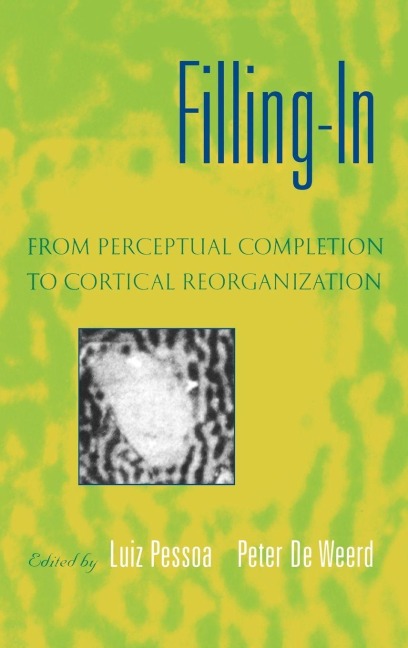
The best example of filling-in involves the blind spot, a region of the retina devoid of photoreceptors. Remarkably, the region of visual space corresponding to the blind spot is not perceived as a dark region in space, but instead as having the same colour and texture as the surrounding background; hence the expression "filling in." While this type of perceptual completion phenomenon is common in the visual domain, it is argued by the leading scientists who contribute to this book that forms of filling-in also take place in other sensory modalities, including the auditory, somatosensory, and motor systems. In a concluding chapter an integrative approach is taken, which attempts to provide a common framework for completion phenomena occurring on a fast time scale, and cortical reorganization in sensory and motor cortex induced by peripheral damage or skill learning taking place on a slower time scale. It is proposed that systematic changes in the interplay between inhibitory and excitatory inputs permit cortical neurons to become driven by new sources of input, which, in addition to initial perceptual consequences can lead to a long-term structural reorganization of cortex.
This book represents a truly interdisciplinary approach to neuroscience, with chapters covering computational modelling, visual psychophysics, functional brain imaging, single-cell physiology, and clinical patient cases. It will be of interest to researchers and graduate students in systems neuroscience, cognitive neuroscience, vision science, neuroimaging, perceptual psychology, computational neuroscience, and philosophy of mind.
1: De Weerd and Pessoa: Introduction - Filling-In: More than Meets the Eye
Part I: Fast-Acting Filling-In in Normal Vision
2: Grossberg: Filling-In the Forms: Surface and Boundary Interactions in Visual Cortex
3: Mendola: Contextual Shape Processing in Human Visual Cortex: Beginning to Fill-In the Blanks
4: Rossi and Paradiso: Surface Completion: Psychophysical and Neurophysiological Studies of Brightness
5: Spillman and De Weerd: Mechanisms of Surface Completion: Perceptual Filling-In of Texture
6: von Heydt, Friedman and Zhou: Searching for the Neural Mechanism of Colour Filling-In
7: Davis and Driver: Effects of Modal Versus Amodal Completion Upon Visual Attention: A Function for Filling-In?
8: Neumann: Completion Phenomena in Vision: A Computational Approach
Part II: From Permanent Scotomas to Cortical Reorganization
9: Fiorani, de Oliveira, Volchan, Gattass, Rocha-Miranda and Pessoa: Completion Through a Permanent Scotoma: First Interpolation Across the Blind Spot and the Processing of Occlusion
10: Kaas, Collins and Chino: The Reactivation and Reorganization of Retinotopic Maps in the Visual Cortex of Adult Mammals After Retinal and Cortical Lesions
11: Mattingly and Walker: The Blind Leading the Mind: Pathological Completion in Hemianopia and Spatial Neglect
Part III: Long-Term Cortical Remapping
12: Pantev, Weisz, Schulte and Elbert: Plasticity of the Human Auditory Cortex
13: Doyon and Ungerleider: Plasticity in Adult M1 Cortex During Motor Skill Learning
14: Mark and Taub: Cortical Reorganization and the Rehabilitation of Movement by CI Therapy After Neurologic Injury
15: Tremere, Pinaud and De Weerd: Conclusion: Contributions of Inhibitory Mechanisms to Perceptual Completion and Cortical Reorganization