Und dann auf "Zum Home-Bildschirm [+]".

Stöbern
genialokal zum Startbildschirm hinzufügen
Installieren Sie die genialokal App auf Ihrem Startbildschirm für einen schnellen Zugriff und eine komfortable Nutzung.
Installieren Sie die genialokal App auf Ihrem Startbildschirm für einen schnellen Zugriff und eine komfortable Nutzung.
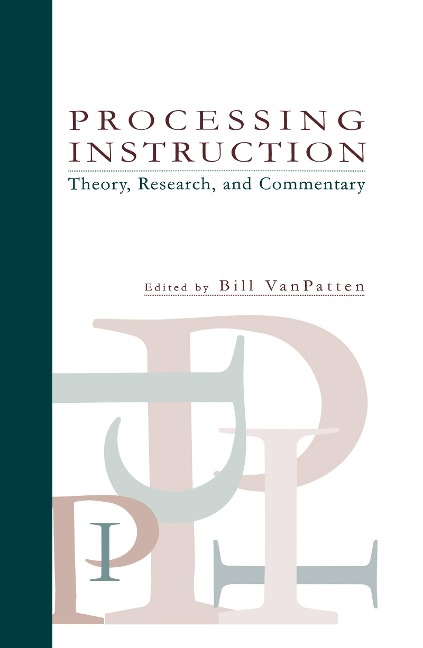
This new book, Processing Instruction: Theory, Research, and Commentary, edited by Bill VanPatten--a pioneer in processing instruction (PI)--is a refreshing presentation of 10 related and not widely available articles that illustrate the role of processing instruction in second language acquisition. The articles provide both historical and current context, as well as describe the influence of the input processing model on PI. The contents include empirical papers presenting new data that demonstrate both the theoretical and pedagogical threads of research. Aside from simply establishing where PI stands in the field of instructed SLA, the book addresses issues, such as processing instruction versus other types of instruction; the impact of processing instruction on various linguistic structures; the role of explicit information in instructional intervention; and the long-term effects of processing instruction. Each section of the book is highlighted by commentaries from noted researchers in instructed SLA. An attempt was made to include voices that offer critical perspectives on various issues of PI research. The book achieves an unusually balanced approach to a subject that has stirred debate in the field. Processing Instruction: Theory, Research, and Commentary will serve as an important source of information regarding research methodology and replication in second language acquisition. It will also be useful in graduate courses where students need exposure to research design and is especially useful for illustrating the usefulness of replication in SLA research.
VanPatten, BIll
Contents: Part I: Foundations.B. VanPatten, Input Processing in SLA. W. Wong, The Nature of Processing Instruction. P. Lightbown, Commentary: What to Teach? How to Teach? M. Harrington, Commentary: Input Processing as a Theory of Processing Input. Part II: Processing Instruction Versus Other Types of Instruction.B. VanPatten, W. Wong, Processing Instruction and the French Causative: Another Replication. A.C. Cheng, Processing Instruction and Spanish Ser and Estar: Forms With Semantic-Aspectual Values. A.P. Farley, The Relative Effects of Processing Instruction and Meaning-Based Output Instruction. J. Collentine, Commentary: Where PI Research Has Been and Where It Should Be Going. Part III: The Roles of Structured Input and Explicit Information.W. Wong, Processing Instruction in French: The Roles of Explicit Information and Structured Input. A. Benati, The Effects of Structured Input Activities and Explicit Information on the Acquisition of the Italian Future Tense. A.P. Farley, Processing Instruction and the Spanish Subjunctive: Is Explicit Information Needed? C. Sanz, Computer Delivered Implicit Versus Explicit Feedback in Processing Instruction. C.J. Doughty, Commentary: When PI Is Focus on Form It Is Very, Very Good, but When It Is Focus on Forms... Part IV: Long-Term Effects of PI.B. VanPatten, C. Fernandez, The Long-Term Effects of Processing Instruction. Part V: Final Commentaries.S. Carroll, Some Comments on Input Processing and Processing Instruction. J.F. Lee, On the Generalizability, Limits, and Potential Future Directions of Processing Instruction Research. B. VanPatten, Several Reflections on Why There Is Good Reason to Continue Researching the Effects of Processing Instruction.
Dieses eBook wird im PDF-Format geliefert und ist mit einem Adobe Kopierschutz (DRM) versehen. Sie können dieses eBook mit allen Geräten lesen, die das PDF-Format und den Adobe Kopierschutz (DRM) unterstützen.
Zum Beispiel mit den folgenden Geräten:
• tolino Reader
Laden Sie das eBook direkt über den Reader-Shop auf dem tolino herunter oder übertragen Sie das eBook auf Ihren tolino mit einer kostenlosen Software wie beispielsweise Adobe Digital Editions.
• Sony Reader & andere eBook Reader
Laden Sie das eBook direkt über den Reader-Shop herunter oder übertragen Sie das eBook mit der kostenlosen Software Sony READER FOR PC/Mac oder Adobe Digital Editions auf ein Standard-Lesegeräte mit epub- und Adobe DRM-Unterstützung.
• Tablets & Smartphones
Möchten Sie dieses eBook auf Ihrem Smartphone oder Tablet lesen, finden Sie hier unsere kostenlose Lese-App für iPhone/iPad und Android Smartphone/Tablets.
• PC & Mac
Lesen Sie das eBook direkt nach dem Herunterladen mit einer kostenlosen Lesesoftware, beispielsweise Adobe Digital Editions, Sony READER FOR PC/Mac oder direkt über Ihre eBook-Bibliothek in Ihrem Konto unter „Meine eBooks“ - „online lesen“.
Schalten Sie das eBook mit Ihrer persönlichen Adobe ID auf bis zu sechs Geräten gleichzeitig frei.
Bitte beachten Sie, dass die Kindle-Geräte das Format nicht unterstützen und dieses eBook somit nicht auf Kindle-Geräten lesbar ist.