Und dann auf "Zum Home-Bildschirm [+]".

Stöbern
genialokal zum Startbildschirm hinzufügen
Installieren Sie die genialokal App auf Ihrem Startbildschirm für einen schnellen Zugriff und eine komfortable Nutzung.
Installieren Sie die genialokal App auf Ihrem Startbildschirm für einen schnellen Zugriff und eine komfortable Nutzung.
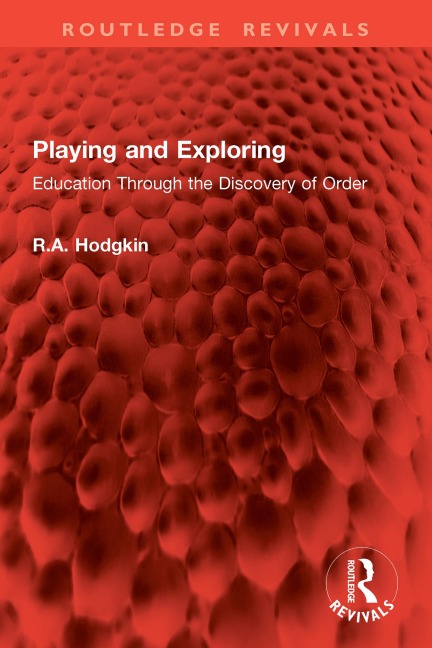
First published in 1985, Playing and Exploring draws on many disciplines in order to formulate a new way of thinking about the nature and power of education. As so often with creative thinkers, Robin Hodgkin's work is at once subversive and conservative. He is radical in insisting on the overriding need to question and subvert the external examination systems that now cripple education (and to raise standards by other means), conservative in asserting with Polanyi that an individual's or a group's enterprise draws on a living tradition. The book's most important contribution is to our understanding of the educational needs of young adults, of the need for adventure and commitment. The author develops a theoretical model that begins with the infant exploring its play space. He argues that the learner is an active, frontier-exploring agent; so too must be any effective teacher. Robin Hodgkin brings forward important new evidence from neuropsychology to show why doing is so important in teaching and learning. His argument that both visual and linguistic competence must cooperate actively in the learning process raises a fundamental question about the part television plays in our culture. In this as in his earlier books, his work is concerned with the real priorities in education, with demonstrating that first-hand feelings of friendship, of wonder, and of danger should be part of the education of all people, especially adolescents, and that our greatest and certainly most expensive failure is to deny the experience of educational success to so many children.
R.A. Hodgkin (1916-2013) was educationalist, Quaker and great mountaineer. He was principal of the Sudan Institute of Education from 1949-55; headmaster of Abbotsholme School, Derbyshire from 1955-67, and a Lecturer in the Oxford University Department of Education from 1969-77. From 1977-80, he was Chairman of the Mount Everest Foundation. He read widely in psychology, biology, anthropology and theology, and brought their lessons to bear on the curriculum.
Introduction 1. New ground 2. Education - making space for instruction 3. Things for use and things for meaning: tools and symbols 4. Competence 5. The four roles of a teacher 6. Embodied form 7. Many-levelled theory 8. Divided brain, uniting mind 9. Words and images 10. Success for all children Postscript: On human talents
Dieses eBook wird im PDF-Format geliefert und ist mit einem Adobe Kopierschutz (DRM) versehen. Sie können dieses eBook mit allen Geräten lesen, die das PDF-Format und den Adobe Kopierschutz (DRM) unterstützen.
Zum Beispiel mit den folgenden Geräten:
• tolino Reader
Laden Sie das eBook direkt über den Reader-Shop auf dem tolino herunter oder übertragen Sie das eBook auf Ihren tolino mit einer kostenlosen Software wie beispielsweise Adobe Digital Editions.
• Sony Reader & andere eBook Reader
Laden Sie das eBook direkt über den Reader-Shop herunter oder übertragen Sie das eBook mit der kostenlosen Software Sony READER FOR PC/Mac oder Adobe Digital Editions auf ein Standard-Lesegeräte mit epub- und Adobe DRM-Unterstützung.
• Tablets & Smartphones
Möchten Sie dieses eBook auf Ihrem Smartphone oder Tablet lesen, finden Sie hier unsere kostenlose Lese-App für iPhone/iPad und Android Smartphone/Tablets.
• PC & Mac
Lesen Sie das eBook direkt nach dem Herunterladen mit einer kostenlosen Lesesoftware, beispielsweise Adobe Digital Editions, Sony READER FOR PC/Mac oder direkt über Ihre eBook-Bibliothek in Ihrem Konto unter „Meine eBooks“ - „online lesen“.
Schalten Sie das eBook mit Ihrer persönlichen Adobe ID auf bis zu sechs Geräten gleichzeitig frei.
Bitte beachten Sie, dass die Kindle-Geräte das Format nicht unterstützen und dieses eBook somit nicht auf Kindle-Geräten lesbar ist.