Und dann auf "Zum Home-Bildschirm [+]".

Stöbern
genialokal zum Startbildschirm hinzufügen
Installieren Sie die genialokal App auf Ihrem Startbildschirm für einen schnellen Zugriff und eine komfortable Nutzung.
Installieren Sie die genialokal App auf Ihrem Startbildschirm für einen schnellen Zugriff und eine komfortable Nutzung.
Ihr gewünschter Artikel ist in 0 Buchhandlungen vorrätig - wählen Sie hier eine Buchhandlung in Ihrer Nähe aus:

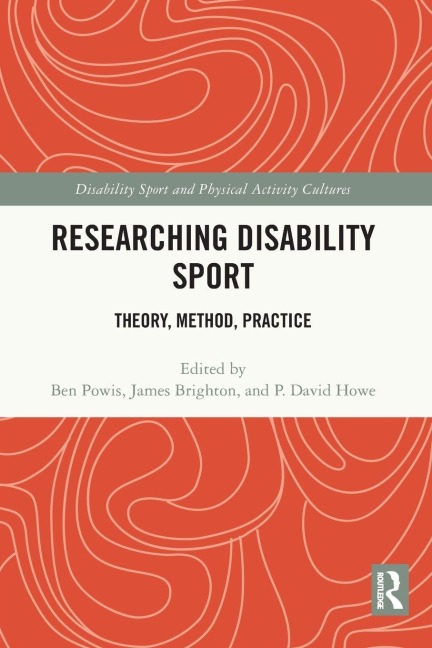
Marking a new direction for disability sport scholarship, this book explores cutting-edge issues and engages creatively with contemporary approaches to research in this important emerging discipline.
Ben Powis is a Course Leader in the Faculty of Sport, Health and Social Sciences at Solent University, UK. His current research interests lie in the sociology of disability sport, the embodied experiences of visually impaired people in sport and physical activity, and investigating the significance of sensuous sporting experiences. James Brighton is a Senior Lecturer in the Sociology of Sport and Exercise at Canterbury Christ Church University, UK. His theoretical and empirical research interests lie in disability studies, the sociology of the body and the social and cultural analyses of sport and fitness. Methodologically, he is interested in interpretive forms of qualitative inquiry including ethnography, life history, and narrative analyses. P. David Howe is a social anthropologist and holds the Dr. Frank J. Hayden Endowed Chair in Sport and Social Impact in the School of Kinesiology at Western University, Canada. His ethnographic research focuses on unpacking the embodied sociocultural milieu surrounding inclusive physical activity and disability sport. He is also editor of the Routledge book series Disability, Sport and Physical Activity Cultures.
1. Researching Disability Sport: An Introduction, Part I: Foundations for Disability Sport Scholarship, 2. Theorising Disability Sport, 3. Cultural Politics, Disability Sport and Physical Activity Research, 4. What Are We Doing Here? Confessional Tales of Non-Disabled Researchers in Disability Sport, 5. Barriers to Disability Sport Research and the Global South: A Personal View, Part II: Disability, Sport and Intersectionality, 6. Disabled Female Sporting Bodies: Reflections on (In)Visibility of disAbility in Sport, 7. Playing, Passing, and Pageantry: A Collaborative Autoethnography on Sport, Disability, Sexuality, and Belonging, 8. Race, Disability and Sport: The Experience of Black Deaf Individuals, 9. Disability and Ageing: Dads, Sons, Sport and Impairment, Part III: From Theory to Practice: Contemporary Issues in Disability Sport, 10. Seeing without Sight: The Athlete/Guide Partnership in Disability Sport, 11. Confronting Ableism from within: Reflections on Anti-Ableism Research in Disability Sport, 12. Exercise, Rehabilitation and Posthuman Disability Studies: Four Responses, 13. Para-Sport Activism in South Korea, 14. Conclusion: The Future of Disability Sport Research