Und dann auf "Zum Home-Bildschirm [+]".

Stöbern
genialokal zum Startbildschirm hinzufügen
Installieren Sie die genialokal App auf Ihrem Startbildschirm für einen schnellen Zugriff und eine komfortable Nutzung.
Installieren Sie die genialokal App auf Ihrem Startbildschirm für einen schnellen Zugriff und eine komfortable Nutzung.
Ihr gewünschter Artikel ist in 0 Buchhandlungen vorrätig - wählen Sie hier eine Buchhandlung in Ihrer Nähe aus:

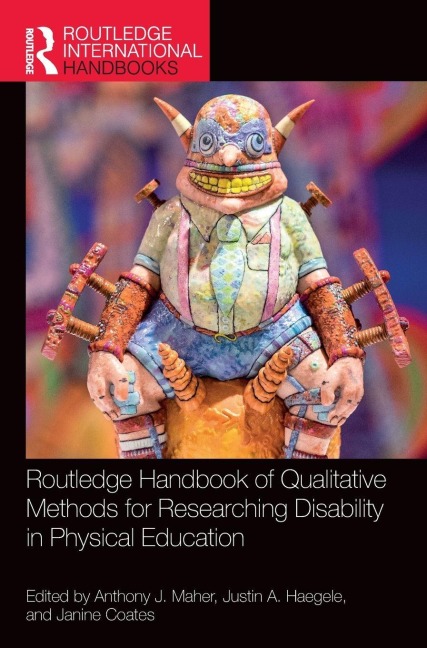
This is the first book to introduce qualitative research methods in the study of disability and physical education. It outlines key concepts and theories in disability and physical education, providing a platform for understanding, before exploring the range of methodologies and techniques for research, data gathering and representation.
Anthony J. Maher is the Director of Research and Professor of Special Educational Needs, Disability and Inclusion in the Carnegie School of Education at Leeds Beckett University, UK. His research is sociological, philosophical, and psychological in nature, using participatory, life history, (auto)ethnographical, and narrative approaches. Justin A. Haegele is the Colgate Darden Endowed Professor and the Director of the Center for Movement, Health, & Disability in the Department of Human Movement Studies & Special Education at Old Dominion University, US. He is the Immediate Past President of the North American Federation of Adapted Physical Activity, and the Editor-in-Chief for the peer-reviewed publication Adapted Physical Activity Quarterly. Janine Coates is a Reader in Equity and Inclusion in Physical Activity and Sport at Loughborough University, UK. She also serves as Associate Editor for the peer-reviewed journal Adapted Physical Activity Quarterly.
PART 1 Theoretical and conceptual considerations for researching disability in physical education 1 Physical education, disability and qualitative research: what are we talking about? Justin A. Haegele, Anthony J. Maher and Janine Coates 2 Ontological, epistemological and axiological considerations when using qualitative methods for researching disability in physical education Nancy L. I. Spencer and Gy-z- Molnár 3 Positionality and reflexivity in research about disability in physical education Antonios Ktenidis and Anthony J. Maher 4 Intersectionality and disability in physical education José Devís-Devís and Víctor Pérez-Samaniego 5 Critical-Ableist perspectives in physical education Martin Giese and Tobias Buchner 6 Posthumanism, disability and physical education Kay Sidebottom and Kate Bancroft 7 Dignity in disability representation in physical education: see me for who I am Donna Goodwin, Amanda Ebert, Morgan Cathcart, Keith Gilliard, Bruce Fleming, Debra Kennedy, Phil Krol, Tonia LaRiviere, Christine Schuster and Armando Venditti 8 Rigour in qualitative research about disability in physical education Anthony J. Maher PART 2 Methodologies for researching disability in physical education 9 Narrative inquiry, disability and physical education Marta Oliver-Álvarez, Erica Bennett, Kassandra Welch and Javier Monforte 10 Using cripistemologies as a grounding for participatory research with communities that are non-verbal: "What's best for you?" Emma V. Richardson, Helen Black, Christian T. Wilson and Rebecca Foster 11 Appreciative inquiry in disability and physical education Joanne Hill and Alex Baird 12 Phenomenological inquiry, disability and physical education Maureen Connolly 13 Ethnography and disability in physical education Colum Cronin 14 Life histories, disability, and physical education: recognising the path of inequality marked as destiny Maria Luiza Tanure Alves, Isabella dos Santos Alves and Náthali Fernanda Feliciano 15 Action research: a methodology to inform inclusive physical education Kirsten Petrie, Kate Kernaghan and Patsie Frawley 16 Participatory research for examining disability in physical education Janine Coates, Lesley Sharpe and Carolynne Mason 17 Co-production, disability and physical education Brett Smith and David Swanston 18 Grounded theory as a method for researching disability in physical education Laura Davies 19 Reflexive thematic analysis, disability and physical education Lisa R. Trainor and Andrea Bundon 20 Qualitative text analysis, disability and physical education Sebastian Ruin PART 3 Gathering and representing data from/with disabled children and young people 21 Individual and focus group discussions with disabled children and youth Josephine Blagrave, T N Kirk, and Katherine Holland 22 Using photo-elicitation with children for researching disability in physical education Clare Woolhouse, Leon Fraser and Simon Dougherty 23 Using sensory methods for researching disability in physical education James Brighton, Ben Powis and Laura Gubby 24 Dabbling, daubing and discovering: the value of arts-based research in exploring the physical education and sporting experiences of young disabled students Annette Stride and Hayley Fitzgerald 25 Keeping it real... using realist tales to understand special educational needs and disabilities in physical education Alan Thomson, Jess Macbeth and Olivia Williams 26 Creative non-fiction, disability and physical education Daniel Martos-Garcia, Wenceslao GarcíäPuchades, Bernat Espí and Rodrigo Atienza Gago 27 Visual representation of data in disability and physical education Lesley Sharpe, Carolynne Mason and Janine Coates 28 Poetic representation of data in disability and physical education Shrehan Lynch and Stephen Palmer 29 Physical education, disability, and qualitative research: concluding thoughts Janine Coates, Justin A. Haegele, and Anthony J. Maher