Und dann auf "Zum Home-Bildschirm [+]".

Stöbern
genialokal zum Startbildschirm hinzufügen
Installieren Sie die genialokal App auf Ihrem Startbildschirm für einen schnellen Zugriff und eine komfortable Nutzung.
Installieren Sie die genialokal App auf Ihrem Startbildschirm für einen schnellen Zugriff und eine komfortable Nutzung.
Ihr gewünschter Artikel ist in 0 Buchhandlungen vorrätig - wählen Sie hier eine Buchhandlung in Ihrer Nähe aus:

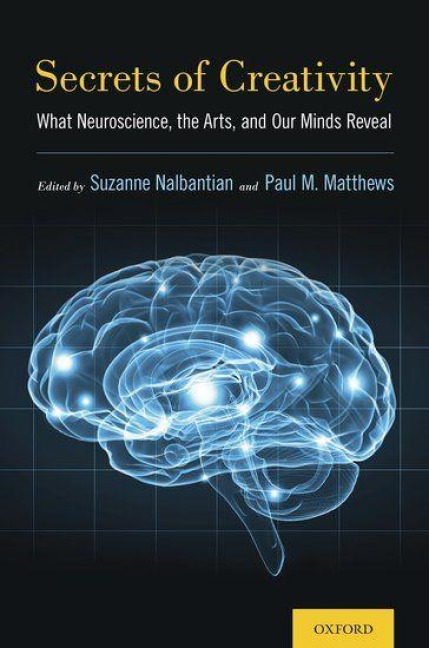
Secrets of Creativity combines insights from an interdisciplinary group of experts to reveal the secrets of creativity that emerge from our everyday lives, and from the minds of exceptional individuals and their discoveries. Neuroscientists describe the functioning of the brain in creative acts of scientific discovery or artistic production. Humanists describe the workings of the creative mind in the composition of literary works and in works of art and music. Creativity is explored with respect to forms of intelligence, modes of experience, emotions, memory, and the interplay between the brain's nonconscious and conscious system activities.
Suzanne Nalbantian is Professor of Comparative Literature at Long Island University and an interdisciplinary scholar who is Chair of the International Comparative Literature Association (ICLA) Research Committee on Literature and Neuroscience. She is the author of four scholarly books and two edited volumes. Her book Memory in Literature: From Rousseau to Neuroscience (Palgrave 2003) forged new pathways linking literary depictions of memory to neuroscience. She is the principal editor of The Memory Process: Neuroscientific and Humanistic Perspectives (MIT Press 2011), which features original essays by both humanists and brain scientists. She has lectured widely throughout the U.S. and Europe on the topic of memory at such institutions as Harvard, Yale, Stanford, College de France (Paris), the European Science Foundation, Max-Planck (Tubingen), and the Pasteur Institute (Paris).
Paul M. Matthews is the Edmund J. and Lily Safra Chair of Translational Neuroscience and Therapeutics, Head of the Division of Brain Sciences in the Department of Medicine of Imperial College, London, and Associate Director of the UK Dementia Research Institute. He is Fellow by Special Election in St. Edmund Hall, Oxford and holds Visiting Professorships at McGill University, Nanyang Technological University and the University of Edinburgh. Professor Matthews was awarded an OBE in 2008 for services to neuroscience and was elected to the Academy of Medical Sciences in 2014. He is the co-author of over 380 scientific papers. He is also co-author (with Jeffrey McQuain) of the book The Bard on the Brain: Understanding the Mind through the Art of Shakespeare and the Science of Brain Imaging and co-editor (with Suzanne Nalbantian and James McClelland) of The Memory Process: Neuroscientific and Humanistic Perspectives (MIT Press 2011).
Introduction by Suzanne Nalbantian, "The Twists and Turns of Creativity: An Overview from Neuroscience and the Arts"
Part I: Theories of Creativity
1. Jean-Pierre Changeux, "Artistic Creativity: A Neuronal Hypothesis"
2. Oshin Vartanian, "Fluid Intelligence, Working Memory and Creativity: A Componential View"
3. Robert J. Sternberg, "The Psychology of Creativity"
4. Charlotte Stagg and Geraint A. Wiggins, "Clues to Human Creativity: From Neurons to Computation"
Part II: Creativity and the Brain
5. Marcus Raichle, "Creativity and the Brain's Default Network"
6. Robert Stickgold, "Creativity of the Dream and Sleep State"
7. Paul M. Matthews, "Creativity: Lessons from Disease, Drugs and Neuroimaging"
8. Nancy C. Andreasen, "Using Neuroscience to Image the Creative Brain"
Part III: Mechanisms of Creativity
9. Alcino J. Silva and John Bickle, "Memory Linking and Creativity: Underlying Molecular, Cellular and Circuit Mechanisms"
10. Jaak Panksepp, "Emotional Foundations of Creativity: The Brain's SEEKING System"
11. Liane Gabora, "Creativity and the Self-Made World View"
Part IV: Literary Creativity in Context
12. Peter Schneck, "Henry James and the Creative Process: The Stewpot of the Imagination"
13. John Burt Foster, "Contrasting Modes of Creativity: Artist Counterparts in Pushkin, Tolstoy, and Nabokov"
14. Suzette Henke, "Twentieth-Century Pathological Writers and Their Creativity: Joyce, Woolf and D. H. Lawrence"
15. Donald R. Wehrs, "Conceptual Blending and Genre Invention from Chretien de Troyes to Cervantes and Shakespeare"
Part V: Aesthetics and Creativity
16. Suzanne Nalbantian, "Creativity in Modernist Literary Writers: Acts of Mental Transformation"
17. Mark Hussey, "Significant Form and Aesthetic Emotion: Bloomsbury Theorizes Modern Art's 'Mysterious Laws' of Creativity"
18. John Onians, "The Distinctive Creativity of Leonardo and Michelangelo: A Perspective from Neuroarthistory"
19. Bruce Adolphe, "The Musical Imagination: Mystery and Method in Musical Composition"
Part VI: An Interview with Richard Powers: Creativity and the Contemporary Novelist
Bios of Contributors