Und dann auf "Zum Home-Bildschirm [+]".

Stöbern
genialokal zum Startbildschirm hinzufügen
Installieren Sie die genialokal App auf Ihrem Startbildschirm für einen schnellen Zugriff und eine komfortable Nutzung.
Installieren Sie die genialokal App auf Ihrem Startbildschirm für einen schnellen Zugriff und eine komfortable Nutzung.
Ihr gewünschter Artikel ist in 0 Buchhandlungen vorrätig - wählen Sie hier eine Buchhandlung in Ihrer Nähe aus:

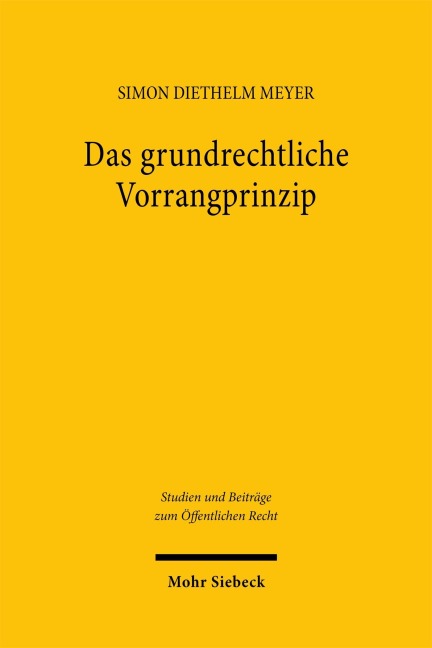
Fundamental rights in the classical sense are based on a principle of primacy: in the overall consideration of entitlement to and obligation under fundamental rights, the human being must always enjoy a higher degree of protection than the state. Fundamental rights never protect the state against its citizens. Simon Diethelm Meyer examines the principle of primacy underlying fundamental rights in the German Basic Law ( Grundgesetz ) from an interdisciplinary and comparative legal perspective. In doing so, he develops a conception of fundamental rights that places the human being at the center: the individual is the bearer, not the addressee, of fundamental rights, whereas the state is bound by them, not entitled to them. Both the entitlement of legal persons to fundamental rights and the horizontal effect of fundamental rights can be justified through this principle of primacy. Within the European system of fundamental rights, it is precisely the diversity of fundamental rights regimes that ensures the highest possible degree of protection for human freedom.
Methodologically, the author proceeds in five steps: first, he lays the interdisciplinary foundations of the principle of primacy of fundamental rights. Second, he elaborates this principle in relation to the dogmatics of fundamental rights under the Basic Law . The third step provides a comparative legal analysis of the various manifestations of the principle of primacy in the constitutions of other EU member states, the ECHR, and the EU Charter of Fundamental Rights. Fourth, he examines the impact of Europeanization on the German conception of fundamental rights. The fifth step focuses on the protection of freedom within the European system of fundamental rights. Simon Diethelm Meyer concludes with an appeal for greater "courage to be human" in fundamental rights doctrine.
Studied law at the University of Kiel; research assistant at the same university; doctoral scholarship from the German National Academic Foundation; PhD in 2025; legal clerkship ( Referendariat ) in the district court of Kiel.
Einleitung
Erster Teil: Grundlagen des Freiheitsschutzes
A. Begriffliche Grundlagen - Das grundrechtliche Vorrangprinzip
B. Historische Grundlagen - Entwicklung der Grundrechte
C. Philosophische Grundlagen - Liberalismus
D. Soziologische Grundlagen - Systemtheorie
E. Kognitive Grundlagen - Wissensverteilung
F. Theoretische Grundlagen - Grundrechtstheorien
Zweiter Teil: Freiheitsschutz nach dem Grundgesetz
A. Menschenwürde als Fundament
B. Zur Grundrechtsberechtigung staatlicher Einheiten nach Art. 19 Abs. 3 GG
C. Zur Grundrechtsverpflichtung Privater
D. Wechselwirkungen von Grundrechtsberechtigung und -verpflichtung
Dritter Teil: Freiheitsschutz in Europa - Rechtsvergleichung
A. Verfassungen anderer EU-Mitgliedstaaten
B. Europäische Menschenrechtskonvention
C. EU-Grundrechte-Charta
D. Rechtsvergleichendes Gesamtbild: Freiheitsschutz in Europa
Vierter Teil: Freiheitsschutz nach dem europäisierten Grundgesetz
A. Offene Staatlichkeit des Grundgesetzes
B. Grundgesetz und EMRK
C. Grundgesetz und GRCh
Fünfter Teil: Freiheitsschutz im europäischen Grundrechtsverbund
A. Die Europäische Union als Grundrechtsverbund
B. Umgang mit Unterschieden im Grundrechtsverständnis
C. Dezentraler Schutz des Dezentralen
D. Vorrangprinzip als gemeineuropäisches Verfassungsrecht
E. Gesamtbild: Einheit in Vielfalt im Grundrechtsverbund
Mehr Mut zum Menschen - Ein Resümee
Ergebnisse in Thesen