Und dann auf "Zum Home-Bildschirm [+]".

Stöbern
genialokal zum Startbildschirm hinzufügen
Installieren Sie die genialokal App auf Ihrem Startbildschirm für einen schnellen Zugriff und eine komfortable Nutzung.
Installieren Sie die genialokal App auf Ihrem Startbildschirm für einen schnellen Zugriff und eine komfortable Nutzung.
Ihr gewünschter Artikel ist in 0 Buchhandlungen vorrätig - wählen Sie hier eine Buchhandlung in Ihrer Nähe aus:

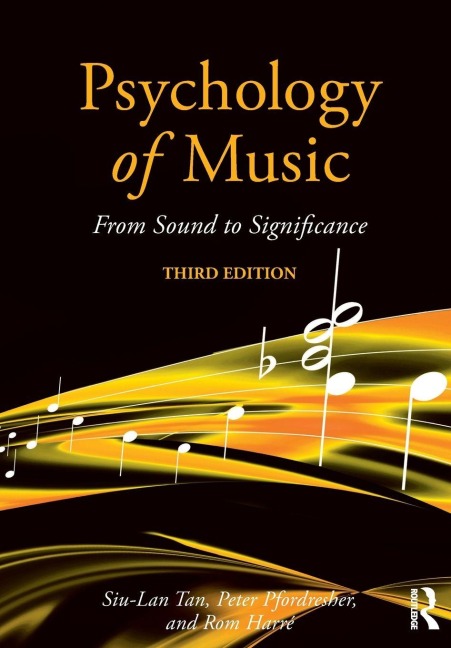
Psychology of Music: From Sound to Significance takes readers on a wide-ranging exploration of this vibrant multidisciplinary field of study. Now in its third edition, the book emphasizes meaningful links between academic learning and real-world contexts, pointing readers towards intriguing strands of research.
Siu-Lan Tan is Professor of Psychology at Kalamazoo College in Michigan, USA. She completed degrees in Music, graduate studies at Oxford University, and a Ph.D. in Psychology at Georgetown University. She has published research on musical form, music notation, and film music, is co-editor of The Psychology of Music in Multimedia and The Oxford Handbook of Music and Advertising, and appears in 'Score: A Film Music Documentary'. Peter Pfordresher is Professor of Psychology at SUNY Buffalo in New York, USA. He completed his Ph.D. in Psychology at the Ohio State University. His research on the relationship between perception and action in music has been published in psychology, music cognition, and music education journals, and he has received support from the National Science Foundation. He sings and plays piano, guitar, and the trumpet. Rom Harré (1927-2019) held appointments in many institutions around the world, including Fellow at Oxford University, Distinguished Research Professor of Psychology at Georgetown University, and Director of the Centre for the Philosophy of the Natural and Social Sciences at the London School of Economics, and authored or edited over 65 scholarly books in numerous fields. For many years, he played clarinet and saron in amateur Western and Indonesian gamelan ensembles.
Introduction 1. The scope of psychology of music. PART I Foundations. 2. The acoustics of music. 3. Music perception and the auditory system. 4 Cognitive neuroscience of music. PART II Perception and cognition of music. 5. Perception of musical pitch and melody. 6. Perception of musical time. 7. Understanding musical structure. PART II Development, learning, and performance. 8. Emergence of music perception.9. Early musical development. 10 Practice and musical expertise. 11. The psychology of music performance. PART IV The meaning and significance of music. 12. The social psychology of music. 13. Meaning in music. 14. The emotional power of music. Final Coda. 15. From sound to significance: Looking forward. Appendix: The chapters in action: Exercises and assignments.