Und dann auf "Zum Home-Bildschirm [+]".

Stöbern
genialokal zum Startbildschirm hinzufügen
Installieren Sie die genialokal App auf Ihrem Startbildschirm für einen schnellen Zugriff und eine komfortable Nutzung.
Installieren Sie die genialokal App auf Ihrem Startbildschirm für einen schnellen Zugriff und eine komfortable Nutzung.
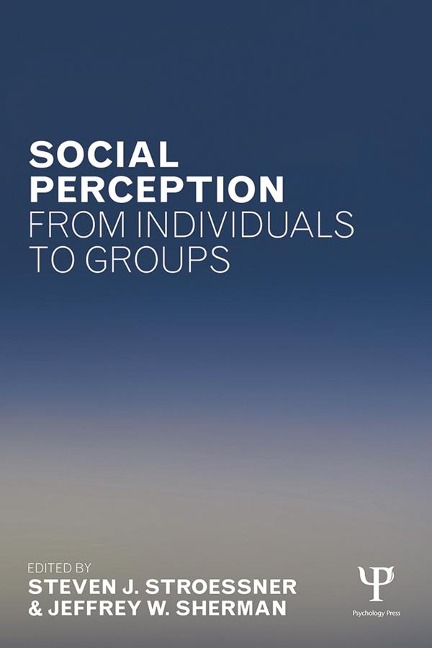
This volume focuses on social perception, the processing of information about people. This issue has always been central to social psychology, but this book brings together literatures that in large part have been separated by the nature of the social target that is involved. Historically, research on person perception developed quite independently from research involving perceptions of groups. Whereas the former research generally focused on the cognitive processes involved in forming impressions of individuals, research on group perception examined the content of stereotypes and the conditions under which they are used in social judgment. There was been little overlap in the theories and methods of these subfields, and different researchers were central in each. The chapters in this book highlight research and theorizing about social perception, exploring the processes involved in social perception from persons to groups. Some chapters describe work that was originally developed in person perception but is being extended to understanding groups. Other chapters illustrate how some processes studied in the domain of stereotyping also affect perceptions of individual persons. Finally, other chapters focus on variables that affect perceptions and judgments of both individuals and groups, proving opportunities for greater recognition of the common set of factors that are central to all types of social perception. This groundbreaking book highlights the research contributions of David L. Hamilton, whose research has played a central role in uniting these previously independent areas of research. It provides essential reading for upper-level courses on social cognition or social perception and could also serve as an auxiliary text in courses on interpersonal perception/relations and courses on stereotyping/intergroup relations.
Steven J. Stroessner is the Ann Whitney Olin Professor of Psychology at Barnard College, Columbia University, New York City, having earned his PhD in social/personailty psychology from University of California, Santa Barbara in 1992. His research examines cognitive, motivation, and affective factors underlying stereotyping and prejudice. Jeffrey W. Sherman is a professor of psychology at the University of California, Davis, having earned his PhD in social psychology from University of California, Santa Barbara in 1994. His research interests are in the cognitive processes underlying social psychology and behavior. In particular, he studies how people perceive themselves, other people, and groups of people. He is currently editor of the journal Social Cognition.
Part 1: Introduction. Social Perception from Individuals to Groups: An Introduction, J.W. Sherman, S.J. Stroessner. Dave and Me: A History of Our Collaboration, S.J. Sherman. Part 2: Perceiving Persons: Impression Formation. The Mental Representation of Persons, Events and Behavioral Mindsets. R.S. Wyer, Jr. Causes and Causal Attributions: Questions Raised by Dave Hamilton and Spontaneous Trait Inferences, J.S. Uleman. From Idiosyncratic Impressions to Distributed Impressions of Others: A Case for Collaborative Person Memory, L.Garcia-Marques, M. Vaz Garrido. Part 3: Perceiving Persons and Groups: Processes in Impression Formation and Stereotyping. When Literatures Collide: Synergies Between Stereotyping and Impression Formation, D.E. Carlston, E.D. Schneid. Variations on a Theme: Attentional Processes in Group and Individual Perception, J.W. Sherman, D.L.M. Sacchi, L. Huang. Two (or more?) Cognitive Approaches to Stereotype Formation: Biased or Reality-based?, R. Spears, W. Stroebe. Part 4: Perceiving Groups: Entitativity. Motivated Entitativity: When We'd Rather See the Forest Than the Trees, M.B. Brewer. Inferring Group Traits and Group Goals: A Unified Approach to Social Perception, S.J. Stroessner, C.S. Dweck. Generalization Processes in Collective Responsibility and Intergroup Conflict, B. Lickel, M. Onuki. Essentialism in Language: Plagiarizing David Hamilton, A. Maass, A. Carnaghi, T. Rakic.
Dieses eBook wird im PDF-Format geliefert und ist mit einem Adobe Kopierschutz (DRM) versehen. Sie können dieses eBook mit allen Geräten lesen, die das PDF-Format und den Adobe Kopierschutz (DRM) unterstützen.
Zum Beispiel mit den folgenden Geräten:
• tolino Reader
Laden Sie das eBook direkt über den Reader-Shop auf dem tolino herunter oder übertragen Sie das eBook auf Ihren tolino mit einer kostenlosen Software wie beispielsweise Adobe Digital Editions.
• Sony Reader & andere eBook Reader
Laden Sie das eBook direkt über den Reader-Shop herunter oder übertragen Sie das eBook mit der kostenlosen Software Sony READER FOR PC/Mac oder Adobe Digital Editions auf ein Standard-Lesegeräte mit epub- und Adobe DRM-Unterstützung.
• Tablets & Smartphones
Möchten Sie dieses eBook auf Ihrem Smartphone oder Tablet lesen, finden Sie hier unsere kostenlose Lese-App für iPhone/iPad und Android Smartphone/Tablets.
• PC & Mac
Lesen Sie das eBook direkt nach dem Herunterladen mit einer kostenlosen Lesesoftware, beispielsweise Adobe Digital Editions, Sony READER FOR PC/Mac oder direkt über Ihre eBook-Bibliothek in Ihrem Konto unter „Meine eBooks“ - „online lesen“.
Schalten Sie das eBook mit Ihrer persönlichen Adobe ID auf bis zu sechs Geräten gleichzeitig frei.
Bitte beachten Sie, dass die Kindle-Geräte das Format nicht unterstützen und dieses eBook somit nicht auf Kindle-Geräten lesbar ist.