Und dann auf "Zum Home-Bildschirm [+]".

Stöbern
genialokal zum Startbildschirm hinzufügen
Installieren Sie die genialokal App auf Ihrem Startbildschirm für einen schnellen Zugriff und eine komfortable Nutzung.
Installieren Sie die genialokal App auf Ihrem Startbildschirm für einen schnellen Zugriff und eine komfortable Nutzung.
Ihr gewünschter Artikel ist in 0 Buchhandlungen vorrätig - wählen Sie hier eine Buchhandlung in Ihrer Nähe aus:

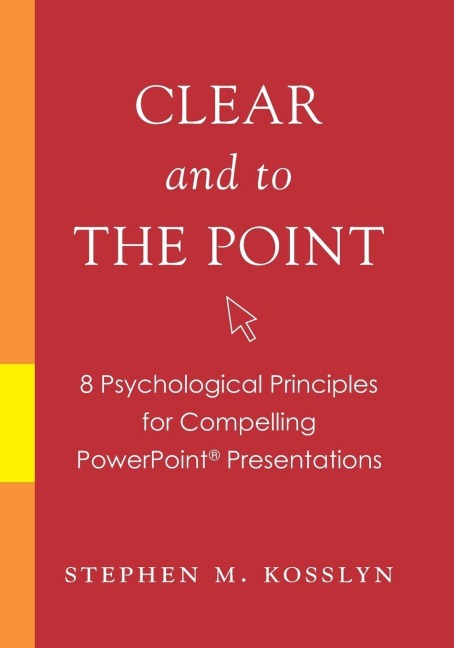
True or False? Most PowerPoint presentations are: �compelling �illuminating �informative �clear and to the point Answer: False Make a change following the principles of Stephen Kosslyn: �a world authority on the visual brain �a clear and engaging writer Making PowerPoint presentations that are clear, compelling, memorable, and even enjoyable is not an obscure art. In this book, Stephen Kosslyn, a renowned cognitive neuroscientist, presents eight simple principles for constructing a presentation that takes advantage of the information modern science has discovered about perception, memory, and cognition. Using hundreds of images and sample slides, he shows the common mistakes many people make and the simple ways to fix them. For example, never use underlining to emphasize a word--the line will cut off the bottom of letters that have descending lines (such as p and g), which interferes with the brain's ability to recognize text. Other tips include why you should state your conclusion at the beginning of a presentation, when to use a line graph versus a bar graph, and how to use color correctly. By following Kosslyn's principles, anyone will be able to produce a presentation that works
Stephen M. Kosslyn is currently the Founder, President and Chief Academic Officer of Foundry College and is Founder and President of Active Learning Sciences. Prior to that, he was Founding Dean and Chief Academic Officer of the Minerva Schools at the Keck Graduate Institute. He previously served as Director of the Center for Advanced Study in the Behavioral Sciences at Stanford University after having been chair of the Department of Psychology, Dean of Social Science, and the John Lindsley Professor of Psychology at Harvard University. While at Harvard, he was also co-director of the Mind of the Market Lab at Harvard Business School and a member of the Department of Neurology at the Mass. General Hospital. He received a B.A. from UCLA and a Ph.D. from Stanford University, both in psychology. Kosslyn's research has focused on the nature of visual cognition, visual communication, and the science of learning; he has authored or coauthored 14 books and over 300 papers on these topics. Kosslyn has received numerous honors, including the National Academy of Sciences Initiatives in Research Award, a Guggenheim Fellowship, three honorary Doctorates (University of Caen, University of Paris Descartes, Bern University), and election to the American Academy of Arts and Sciences.
- 1: Articulate presentations
- 2: The big picture
- 3: Readable text
- 4: Color, texture, animation, and sound
- 5: Communicating quantitative information: using graphs
- 6: Communicating qualitative information: charts, diagrams, maps, and clipart
- 7: The good, the bad, and the incomprehensible
- Appendix: The principles and their specific needs