Und dann auf "Zum Home-Bildschirm [+]".

Stöbern
genialokal zum Startbildschirm hinzufügen
Installieren Sie die genialokal App auf Ihrem Startbildschirm für einen schnellen Zugriff und eine komfortable Nutzung.
Installieren Sie die genialokal App auf Ihrem Startbildschirm für einen schnellen Zugriff und eine komfortable Nutzung.
Ihr gewünschter Artikel ist in 0 Buchhandlungen vorrätig - wählen Sie hier eine Buchhandlung in Ihrer Nähe aus:

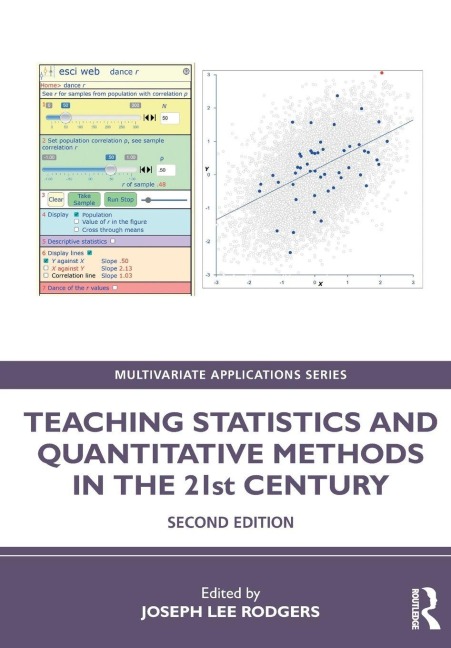
Teaching Statistics and Quantitative Methods in the 21st Century is a guide for rethinking and revitalising statistics and quantitative methods pedagogy for novice and experienced instructors at undergraduate and graduate levels. The result is a call for a broad reimagining of how statistics and quantitative methods are introduced.
Joseph Lee Rodgers earned his PhD in quantitative psychology, with a minor in biostatistics, from the University of North Carolina at Chapel Hill in 1981. He worked at the University of Oklahoma from 1981 to 2012, where he is George Lynn Cross Research Professor Emeritus. He joined the Quantitative Methods program in Peabody College at Vanderbilt in 2012. He retired from that program in 2021 and is Emeritus Professor of Psychology and Human Development at Vanderbilt. He has published three co-authored books, three edited books, and over 200 journal articles/book chapters in Statistics/Quantitative Methods, Psychology, Demography, Behavior Genetics, and related research literature. He has also had a career commitment to classroom teaching and has written many articles in the statistics and quantitative methods literature that are didactic teaching-oriented articles.
List of contributors Preface - Camilla Benbow Foreword - Lisa Harlow 1. Teaching Statistics and Quantitative Methods: An Introduction to 15 Chapters, Some Old and Some New, on Statistical Pedagogy and Philosophy - Joseph Lee Rodgers Section I: Meta-Issues Related to Teaching: Philosophical Considerations 2. Including Philosophy of Science when Teaching Statistics - Michael C. Edwards 3. Teaching Statistics for Knowledge Generation and Principled Argument -- Jolynn Pek, Duane T. Wegener, and Kalina J. Dusenbery 4. When Statistical Assumptions Are Interesting Outcomes Instead of Nuisances - Looking Beyond the Mean - Rachel T. Fouladi 5. Introductory Statistical Pedagogy Should Be Reformed: Transitioning from a Hypothesis Testing to a Modeling Framework -- Dustin A. Fife, Thomas W. O'Kane, Joseph Lee Rodgers 6. Teaching Introductory Statistics to Applied Researchers in the 21st Century: A Dialectic Examination - Joseph Lee Rodgers Section II: Modern Classroom Innovations in Teaching Statistics and Quantitative Methods 7. Artificial Intelligence, COVID-19, and Ways of Knowing: Teaching Introductory Statistics as an Asynchronous Online Course in 2025 - Matthew S. Fritz 8. The Quantitative Methods Homework Unicorn: Providing Scalable Yet Individual Feedback on Analysis Results and Interpretation -- Lesa Hoffman, Jonathan Templin, and David DeWester 9. Teaching Statistics Using Web Applets -- Charles S. Reichardt 10. The Eyes Have It: Emphasizing Data Visualization when Teaching Students Meeting a Quantitative Literacy Requirement - Robert Terry. Vicent T. Ybarra 11. Low- and Medium-Tech Complements to High-Tech Tools for Teaching Statistics: The Case for Using Appropriate Technology to Implement Cognitive Principles for Teaching -- David Rindskopf 12. Flipping the Quantitative Classroom for Individualized, Active Learning - Pascal R. Deboeck 13. Selecting Statistical Software for Teaching and Learning -- Christian L. L. Strauss, R. Shane Hutton, Alexandria R. Hadd 14. Using Projects to Teach Statistics in Social Sciences -- Jennifer D. Timmer, Carolyn J. Anderson 15. Teaching Statistics with a BYOD (Bring Your Own Device) Student Response System -- R. Shane Hutton, Christian L.L. Strauss, and Derek Bruff 16. Can the Replication Crisis Inform our Teaching of Introductory Statistics? -- Patrick E. Shrout, Joseph Lee Rodgers