Und dann auf "Zum Home-Bildschirm [+]".

Stöbern
genialokal zum Startbildschirm hinzufügen
Installieren Sie die genialokal App auf Ihrem Startbildschirm für einen schnellen Zugriff und eine komfortable Nutzung.
Installieren Sie die genialokal App auf Ihrem Startbildschirm für einen schnellen Zugriff und eine komfortable Nutzung.
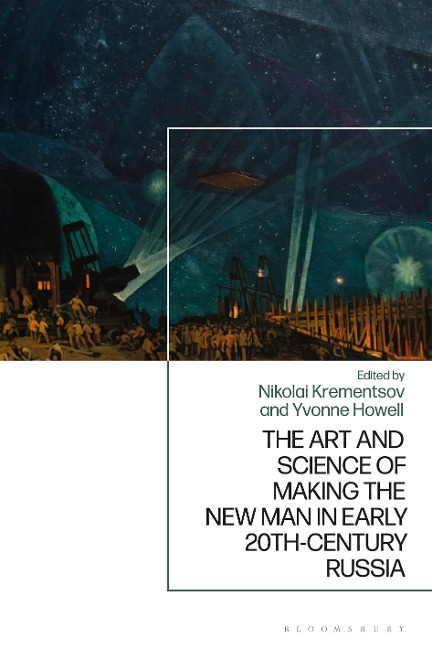
The idea that morally, mentally, and physically superior 'new men' might replace the currently existing mankind has periodically seized the imagination of intellectuals, leaders, and reformers throughout history. This volume offers a multidisciplinary investigation into how the 'new man' was made in Russia and the early Soviet Union in the first third of the 20th century.
The traditional narrative of the Soviet 'new man' as a creature forged by propaganda is challenged by the strikingly new and varied case studies presented here. The book focuses on the interplay between the rapidly developing experimental life sciences, such as biology, medicine, and psychology, and countless cultural products, ranging from film and fiction, dolls and museum exhibits to pedagogical projects, sculptures, and exemplary agricultural fairs. With contributions from scholars based in the United States, Canada, the UK, Germany and Russia, the picture that emerges is emphatically more complex, contradictory, and suggestive of strong parallels with other 'new man' visions in Europe and elsewhere. In contrast to previous interpretations that focused largely on the apparent disconnect between utopian 'new man' rhetoric and the harsh realities of everyday life in the Soviet Union, this volume brings to light the surprising historical trajectories of 'new man' visions, their often obscure origins, acclaimed and forgotten champions, unexpected and complicated results, and mutual interrelations. In short, the volume is a timely examination of a recurring theme in modern history, when dramatic advancements in science and technology conjoin with anxieties about the future to fuel dreams of a new and improved mankind.
Yvonne Howell is Professor of Russian and Global Studies at University of Richmond, USA. She has published extensively on Russian and Soviet science fiction and is the editor of Red Star Tales (2015).
Nikolai Krementsov is Professor at the Institute for the History and Philosophy of Science and Technology, University of Toronto, Canada. He is the author of many publications, including Revolutionary Experiments (2014) and With and Without Galton (2018).
Preface
List of Illustrations
Introduction Nikolai Krementsov (University of Toronto, Canada)
Part 1 - Nurturing the New Man
1. Encyclopedic Worldbuilding: Alexander Bogdanov and the Cognitive Creation of the New Man Michael Coates (University of California, Berkeley, USA)
2. 'The RoadtoLife': Educating the New Man Lyubov Bugaeva (Saint Petersburg State University, Russia)
3. The New Man in the Nursery: Making Soviet Dolls and Regulating Children's Play in the 1920s and 30s Olga Ilyukha (Russian Academy of Sciences, Russia)
Part 2 - Imagining the New Man
4. New Sciences, New Worlds, and 'New Men' Nikolai Krementsov (University of Toronto, Canada)
5. Entertaining Sciences, Unlikely Horrors: The Changing Image of Man in Soviet Popular-Scientific Literary Genres Matthias Schwartz (Leibniz Center for Literary and Cultural Research, Germany)
6. The New Man as a Monster of Eugenic Imagination: The Criminal Brain in Mikhail Bulgakov's 'Heart of a Dog' and James Whale's Frankenstein Irina Golovacheva (St. Petersburg State University, Russia)
Part 3 - Displaying the New Man
7. 'A School of the Peasantry of the Future': Constructing the Image of a 'New Peasant' at the 1923 All-Russian Agricultural Exhibition Olga Elina (Russian Academy of Sciences, Russia)
8. Revolutionary Evolution in Apes and Humans in the 1920s: Sculpture and Constructs of the New Man at the Moscow Darwin Museum Pat Simpson (University of Hertfordshire, UK)
9. A New Man in the Ethnographic Museum: Between the Socialist Content and the National Form Stanislav Petriashin (Russian Museum of Ethnography, Russia)
Part 4 - Conclusion
The New Man: One Hundred Years Later Yvonne Howell (University of Richmond, USA)
List of Contributors
Index
Dieses eBook wird im PDF-Format geliefert und ist mit einem Adobe Kopierschutz (DRM) versehen. Sie können dieses eBook mit allen Geräten lesen, die das PDF-Format und den Adobe Kopierschutz (DRM) unterstützen.
Zum Beispiel mit den folgenden Geräten:
• tolino Reader
Laden Sie das eBook direkt über den Reader-Shop auf dem tolino herunter oder übertragen Sie das eBook auf Ihren tolino mit einer kostenlosen Software wie beispielsweise Adobe Digital Editions.
• Sony Reader & andere eBook Reader
Laden Sie das eBook direkt über den Reader-Shop herunter oder übertragen Sie das eBook mit der kostenlosen Software Sony READER FOR PC/Mac oder Adobe Digital Editions auf ein Standard-Lesegeräte mit epub- und Adobe DRM-Unterstützung.
• Tablets & Smartphones
Möchten Sie dieses eBook auf Ihrem Smartphone oder Tablet lesen, finden Sie hier unsere kostenlose Lese-App für iPhone/iPad und Android Smartphone/Tablets.
• PC & Mac
Lesen Sie das eBook direkt nach dem Herunterladen mit einer kostenlosen Lesesoftware, beispielsweise Adobe Digital Editions, Sony READER FOR PC/Mac oder direkt über Ihre eBook-Bibliothek in Ihrem Konto unter „Meine eBooks“ - „online lesen“.
Schalten Sie das eBook mit Ihrer persönlichen Adobe ID auf bis zu sechs Geräten gleichzeitig frei.
Bitte beachten Sie, dass die Kindle-Geräte das Format nicht unterstützen und dieses eBook somit nicht auf Kindle-Geräten lesbar ist.