Und dann auf "Zum Home-Bildschirm [+]".

Stöbern
genialokal zum Startbildschirm hinzufügen
Installieren Sie die genialokal App auf Ihrem Startbildschirm für einen schnellen Zugriff und eine komfortable Nutzung.
Installieren Sie die genialokal App auf Ihrem Startbildschirm für einen schnellen Zugriff und eine komfortable Nutzung.
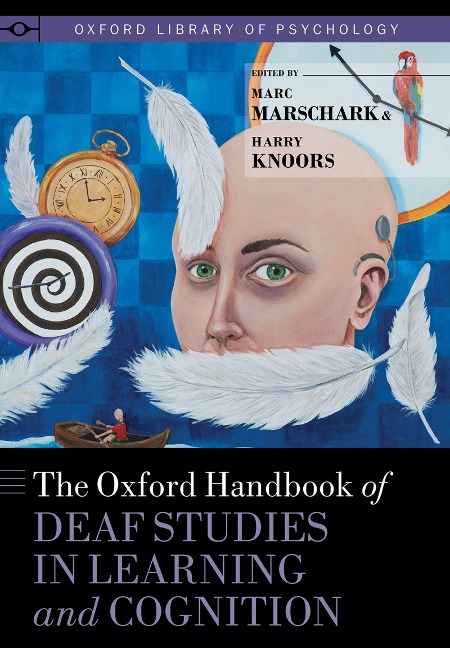
In recent years, the intersection of cognitive psychology, developmental psychology, and neuroscience with regard to deaf individuals has received increasing attention from a variety of academic and educational audiences. Both research and pedagogy have addressed questions about whether deaf children learn in the same ways that hearing children learn, how signed languages and spoken languages might affect different aspects of cognition and cognitive development, and the ways in which hearing loss influences how the brain processes and retains information. There are now a number of preliminary answers to these questions, but there has been no single forum in which research into learning and cognition is brought together. The Oxford Handbook of Deaf Studies in Learning and Cognition aims to provide this shared forum, focusing exclusively on learning, cognition, and cognitive development from theoretical, psychological, biological, linguistic, social-emotional, and educational perspectives. Each chapter includes state-of-the-art research conducted and reviewed by international experts in the area. Drawing this research together, this volume allows for a synergy of ideas that possesses the potential to move research, theory, and practice forward.
Marc Marschark is Professor at the National Technical Institute for the Deaf, a college of Rochester Institute of Technology, where he directs the Center for Education Research Partnerships. His primary interest is in relations among language, learning, and cognition; current research focuses on such relations among deaf children and adults in formal and informal educational settings. Harry Knoors is Professor at the Behavioural Science Institute of the Radboud University Nijmegen, the Netherlands, and Academic Director at Royal Dutch Kentalis. Knoors is trained as a psycholinguist, specializing in language and literacy of deaf children. He is involved in research on childhood deafness (mainly language, literacy, and psychosocial development) and research on the effectiveness of special education.
Contents
Preface Deaf Studies in Learning and Cognition: A Coming-of-Age Story Marc Marschark and Harry Knoors
Part One: Language, Learning, and Cognition 1. Foundations of Language Development in Deaf and Hard-of-hearing Infants: Cognitive and Social Processes Dani Levine, Daniela Avelar, Roberta Michnick Golinkoff, Derek Houston, and Kathy Hirsh-Pasek 2. Developmental, Cognitive, and Neurocognitive Perspectives on Language Development in Children Who Use Cochlear Implants Pasquale Rinaldi, Francesco Pavani, and Maria Cristina Caselli 3. Investigating Early Preimplant Predictors of Language and Cognitive Development in Children With Cochlear Implants Mary K. Fagan, Laurie S. Eisenberg, and Karen C. Johnson 4. The Effect of Communication Mode on Learning Outcomes for Children With Severe-Profound Hearing Loss Julia Sarant and Ann Geers
Part Two: Cognition and Language: Foundations and Outcomes 5. It Is More Than Language: The Role of Cognition in the Pragmatic Skills of Children Who Are Deaf or Hard-of-hearing Dianne Toe, Louise Paatsch, and Amy Szarkowski 6. Dissociating the Impact of Auditory Access and Language Access in Deaf Children's Cognitive Development Matthew Hall 7. How Early Auditory Experience Affects Children's Ability to Learn Spoken Words Derek Houston, Chi-Hsin Chen, Claire Monroy, and Irina Castellanos 8. Triggering, Configuration, and Engagement: Spoken Word Learning Processes in Young Children With Hearing Loss Emily Lund 9. Bilingual Cognitive Advantages in Multilingual and Multimodal Deaf and Hard-of-hearing Children and Adults Kathryn Crowe and Linda Cupples 10. I Should Do as I Say, Not as I Do: Self-regulation and Psychosocial Outcomes in Deaf Children With Cochlear Implants Irina Castellanos, David B. Pisoni, and William G. Kronenberger
Part Three: Learning and Cognition in Development 11. Verbal Learning and Memory Processes After Cochlear Implantation David B. Pisoni, William G. Kronenberger, Michael S. Harris, and Aaron C. Moberly 12. Cognitive Development: The Impact of Pediatric Cochlear Implantation Lindsey Edwards and Peter Isquith 13. Theory of Mind and Conversation in Deaf and Hearing Children Candida C. Peterson 14. Theory of Mind: Implications for Cognition and Learning in Deaf and Hard-of-hearing Learners Stacey Tucci and Susan Easterbrooks 15. Why Are Children With Cochlear Implants at Risk for Executive Functioning Delays: Language Only or Something More? William G. Kronenberger and David B. Pisoni 16. Executive Functions and Access to Language: The Importance of Intersubjectivity Gary Morgan and Matt Dye 17. Working Memory for Signs and Gestures Mary Rudner and Jerker Rönnberg
Part Four: Cognition and Literacy 18. Executive Function, Memory, and Literacy in Deaf Learners: Reading and Writing Involve More Than Just Words and Grammar Donna Morere 19. The Influence of Explicit and Implicit Memory Processes on the Spoken-Written Language Learning of Children With Cochlear Implants Barbara Arfé and Ambra Fastelli 20. Changing Perspectives for the 21st Century: Digital Literacy and Computational Thinking for Deaf/Hard-of-hearing Learners Karen L. Kritzer and Chad Smith 21. The Neurobiology of Reading Differs for Deaf and Hearing Adults Karen Emmorey
Part Five: Learning and Cognition in the Real World 22. Framing Educational Needs of Deaf and Hard-of-Hearing Infants and Toddlers Using the Developmental Systems Approach Manfred Hintermair 23. Making "Normal" Count: Mediating for Early Mathematics Learning in Young Deaf and Hard-of-hearing Children Karen L. Kritzer 24. Tickets for the Inclusive Museum: Accessible Opportunities for Nonformal Learning by Deaf and Hard-of-hearing Individuals Magda Nikolaraizi, Charikleia Kanari, and Marc Marschark 25. Technology Makes Things Possible: Improving the Abilities of Deaf and Hard-of-hearing Children with Advanced Technologies Sigal Eden 26. Accommodating Deaf and Hard of Hearing Children With Cognitive Deficits Harry Knoors and Marc Marschark Index
Dieses eBook wird im PDF-Format geliefert und ist mit einem Adobe Kopierschutz (DRM) versehen. Sie können dieses eBook mit allen Geräten lesen, die das PDF-Format und den Adobe Kopierschutz (DRM) unterstützen.
Zum Beispiel mit den folgenden Geräten:
• tolino Reader
Laden Sie das eBook direkt über den Reader-Shop auf dem tolino herunter oder übertragen Sie das eBook auf Ihren tolino mit einer kostenlosen Software wie beispielsweise Adobe Digital Editions.
• Sony Reader & andere eBook Reader
Laden Sie das eBook direkt über den Reader-Shop herunter oder übertragen Sie das eBook mit der kostenlosen Software Sony READER FOR PC/Mac oder Adobe Digital Editions auf ein Standard-Lesegeräte mit epub- und Adobe DRM-Unterstützung.
• Tablets & Smartphones
Möchten Sie dieses eBook auf Ihrem Smartphone oder Tablet lesen, finden Sie hier unsere kostenlose Lese-App für iPhone/iPad und Android Smartphone/Tablets.
• PC & Mac
Lesen Sie das eBook direkt nach dem Herunterladen mit einer kostenlosen Lesesoftware, beispielsweise Adobe Digital Editions, Sony READER FOR PC/Mac oder direkt über Ihre eBook-Bibliothek in Ihrem Konto unter „Meine eBooks“ - „online lesen“.
Schalten Sie das eBook mit Ihrer persönlichen Adobe ID auf bis zu sechs Geräten gleichzeitig frei.
Bitte beachten Sie, dass die Kindle-Geräte das Format nicht unterstützen und dieses eBook somit nicht auf Kindle-Geräten lesbar ist.