Und dann auf "Zum Home-Bildschirm [+]".

Stöbern
genialokal zum Startbildschirm hinzufügen
Installieren Sie die genialokal App auf Ihrem Startbildschirm für einen schnellen Zugriff und eine komfortable Nutzung.
Installieren Sie die genialokal App auf Ihrem Startbildschirm für einen schnellen Zugriff und eine komfortable Nutzung.

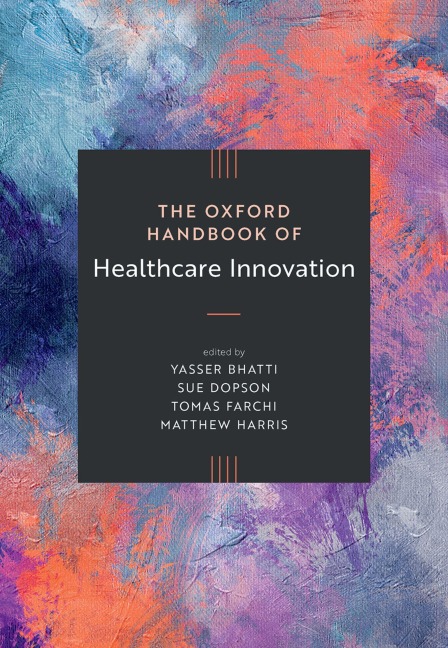
The Oxford Handbook of Healthcare Innovation bridges theory and practice of mainstream innovation studies as applied in the healthcare sector, offering valuable resources to professionals, policymakers, and researchers who are dedicated to addressing the complexities of modern healthcare. It advances the latest developments in healthcare innovation research and practice and, with its global emphasis, draws from research and case studies from both high-income as well as low and middle-income countries. The diverse selection of topics covered in the chapters are categorized into three parts reflective broadly of the innovation process: development, diffusion, and evaluation and governance. With over fifty contributors, a range of twenty-seven topics are explored, from frugal, reverse, disruptive and open innovation, to knowledge brokerage, epistemic communities, decolonization, and change management. Within each chapter, contributors discuss the state-of-the-debate in their domain of expertise at three levels of analysis -- micro, meso, and macro -- and with respect to the organizational, social, and technological aspects of healthcare.
Yasser Bhatti is a scholar of strategy and innovation and conducts research in emerging models of innovation and strategies which promote equitable and sustainable growth. He is currently based at the MBS College of Business and Entrepreneurship and holds honorary affiliations at his prior institutions of work: Oxford University, Imperial College London, and Queen Mary University of London.
Sue Dopson is Deputy Dean for People and Equity, Diversity and Inclusion (EDI), and Professor of Organisational Behaviour at the Saïd Business School, University of Oxford. She is also a Fellow of Green Templeton College. She has led a number of research projects in public and private sector organizations and her research within the healthcare sector informs government policy and practice.
Tomas Farchi is a professor of Organizational Behavior in the Management and Human Resource department at HEC Paris, and Associate Fellow at Saïd Business School, University of Oxford. His research focuses on how groups and organizations can mobilize and translate knowledge from different fields to address complex business, scientific and/or societal challenges.
Matthew Harris is a Clinical Reader in Public Health Medicine at Imperial College London; Theme lead for Innovation and Evaluation in the NW London NIHR Applied Research Collaboration; Director of Postgraduate Taught Programmes in the School of Public Health; and Honorary NHS Consultant in Public Health Medicine in the Imperial College NHS Trust.
- Introduction - Part 1: Development - 1: Chandni Hindocha and Matthew Harris: Identifying Innovation - 2: James Barlow: Disruptive Innovation - 3: Susan Stead, Torsten Oliver Salge, and David Antons: Open Innovation: Conceptual Framework, Literature Review, and Research Opportunities in Healthcare - 4: Yasser Bhatti, Benjamin Mogoye, and Hafiza Sultana: Frugal Innovation - 5: Mark Skopec and Matthew Harris: Reverse Innovation: Cost-Effective Solutions for Health Systems in Crisis - 6: Marya Besharov and Tara Montgomery: Social Innovation - 7: Andre Fleury, Sara Miriam Goldchmidt, Tiago Lazzaretti Fernandes, and Maria Alice Gonzales: Design Thinking: Advancing Innovative Cultures in the Healthcare Sector - 8: Simon May: The Impeller Approach: A Different Way to Look at Innovation - 9: Julie Davies, Nora Colton, and Rodolfo Catena: Institutional Innovation: The Case of Business School Education in Healthcare - Part 2: Diffusion - 10: Matthew Prime, Yasser Bhatti, and Matthew Harris: Sourcing Innovations - 11: Tomas Farchi: Translational Research - 12: Gerry McGivern: Governmentality in Healthcare - 13: Ninna Meier and Charlotte Wegener: The Role of Objects in Social Innovation across Epistemic Communities - 14: Sarah Wong, Amali Lokugamage, and Christine Douglass: Decolonization - 15: Jean-Louis Denis, Nancy Côté, Dave Laverdière, and Sara Moayedi: Innovation in Health Systems and Organizations: Context, Process, and Agency - 16: Jacqueline del Castillo: Social Movements and Healthcare Innovation - 17: Cynthia A. Vinson and David Chambers: Adoption, Implementation, Scale-Up, and Long-Term Use of Evidence-Based Health Interventions - 18: Markus C. Becker and Thim Prætorius: Organizational Routines and Healthcare Innovation - Part 3: Evaluation and Governance - 19: Laura Lennox, Rayan Altayeb, and Grazia Antonacci: Evaluating and Influencing Sustainability and Scale-Up of Healthcare Innovations - 20: Sania Nishtar and Amn Nasir: Evaluation of Healthcare Expenditure: Towards a Third, Fund-Based Health Financing Solution for Mixed Health Systems - 21: Matthew Prime, Saira Ghafur, Gianluca Fontana, and Afua van Haasteren: Evaluation of Digital Health Technologies - 22: Dhananjaya Sharma, Pawan Agarwal, Vikesh Agrawal, and Sanjay Kumar Yadav: Evaluation of Low-Cost Surgical Innovations - 23: Bernard Naughton and Eleni Niarchou: Evaluation of Pharmaceutical Innovation - 24: Ewan Ferlie, Jean Ledger, and Davide Nicolini: Networks and Innovation in Healthcare: Some Evidence from the English NHS - 25: Hamdi Issa and Matthew Harris: International Health Partnerships and Knowledge Mobilization - 26: Sue Dopson: Leadership and Innovation - 27: Vjera Magdalenic-Moussavi, Emma Toumi, and Anna Gregson: Intellectual Property in Healthcare Innovation