Und dann auf "Zum Home-Bildschirm [+]".

Stöbern
genialokal zum Startbildschirm hinzufügen
Installieren Sie die genialokal App auf Ihrem Startbildschirm für einen schnellen Zugriff und eine komfortable Nutzung.
Installieren Sie die genialokal App auf Ihrem Startbildschirm für einen schnellen Zugriff und eine komfortable Nutzung.
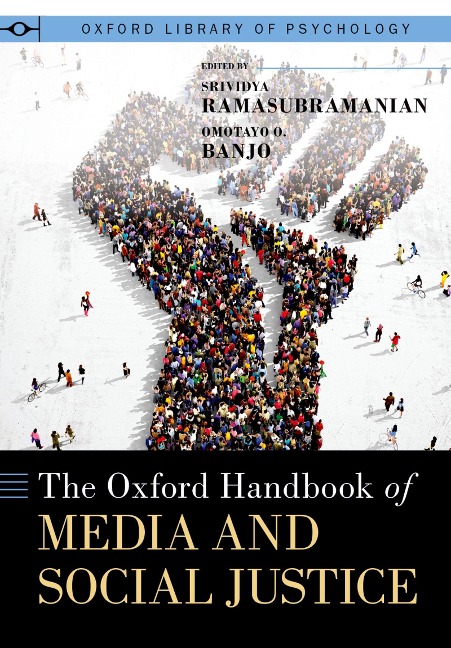
The urgency and complexity of contemporary social justice issues facing the world today mean that activists, scholars, and storytellers need a readily available compendium of cutting-edge scholarship on media and social justice. The Oxford Handbook of Media and Social Justice gathers over forty leading scholars and presents a state-of-the-art systematic overview of media and social justice. Representing leading voices across positionalities and perspectives, geographies and generations, meta-theories and methods, and issues and identities, the Handbook explores intersecting identities, social structures, and power networks within media ownership, representation, selection, uses, effects, networks, and social transformation. These theories, methods, and practices expose media and digital divides, polarization, marginalization, exclusion, alienation, invisibilities, stigma, and trivializations. Yet, they also showcase how individuals and communities also have agency through refusal and resistance. Each of the 32 chapters includes a brief history, key concepts, contemporary debates and dialogues, and future directions, and the volume concludes with reflections on resistances, reckoning, and reparative justice. Connecting critical media scholarship with intersectional feminism, postcolonial/anticolonial theory, Indigenous approaches, queer theory, diaspora studies, and environmental justice frameworks, the Handbook re-envisions the role of media and technology with an inclusive trauma-informed approach to scholarship that is essential for the future of this research.
Srividya Ramasubramanian is Newhouse Professor & Endowed Chair at Syracuse University. She is widely recognized for her pioneering work on race and media, media literacy initiatives, implicit bias reduction, and scholar-activism. She also has over 100 publications to her credit, including her co-authored book with Erica Scharrer Quantitative Research Methods in Communication: The Power of Numbers for Social Justice (2021). She is the Editor-in-Chief of Communication Monographs, Founding Director of the Difficult Dialogues Project and CODESHIFT (Collaboratory for Data Equity, Social Healing, Inclusive Futures, and Transformation), and Co-Founder and Executive Director of the nonprofit Media Rise. Omotayo O. Banjo is Professor of Communication at the University of Cincinnati and the Associate Dean of the Graduate College. She is a mixed-methods media effects scholar whose work centers on identity construction in entertainment media. Banjo has published four books and authored over two dozen journal articles and book chapters. She is a Fulbright award winner and engaged scholar, having presented her to policymakers and tech experts.
Acknowledgements Contributor Bios Section A: Introduction Chapter 1: Perspectives, Positionalities, and Paradigms in Media & Social Justice Scholarship -Omotayo O. Banjo and Srividya Ramasubramanian Section B: Approaches and Analytic Frameworks Chapter 2: Political Economy of Communication in the Digital Platform Era -Dal Yong Jin Chapter 3: The Limits of Diversity and Popular Anti-Racism: The Need for Reparative Justice in the Cultural Industries -Anamik Saha Chapter 4: Critical Media Effects: A Framework for Bridging Critical Cultural Communication with Media Effects Research -Srividya Ramasubramanian and Omotayo O. Banjo Chapter 5: Black Audiences and Media Resistance -David Stamps Chapter 6: "How Do You Shift That?": Dialoguing Social Justice, Activism, and Black Joy in Media Studies -jas l. moultrie and Ralina L. Joseph Chapter 7: Latine Media Studies: From Near Omission to Radical Intersectionality -Angharad N. Valdivia Chapter 8: Queer of Color Approaches to Critical Cultural Media Studies -Keisuke Kimura and Shinsuke Eguchi Chapter 9: Queer and Transgender Media Studies -Erique Zhang and Thomas J. Billard Chapter 10: Digital Religion and the Negotiation of Gender/Sex Norms -Ruth Tsuria Chapter 11: Critical Disability Media Studies -Katie Ellis and Jessica Keeley Section C: Methods and Meaning Making Chapter 12: Critical Discourse Analysis -Marissa Doshi Chapter 13: Data Justice: The Role of Data in Media and Social Justice -Srividya Ramasubramanian, Shannon Burth, and Minnie Macmillian Chapter 14: Justice Informatics, Justice for Us All: Liberation from Techno-Ideology -Jasmina Tacheva and Tanya Loughead Chapter 15: Researching Closed Fields: What We Can Learn from Analyzing So-Called Constrained, Inaccessible and Invisible Media Contexts -Hanan Badr Chapter 16: Digital Archives and Unexpected Crossings: A Data Feminist Approach to Transnational Feminist Media Studies and Social Media Activism -Ololade M. Faniyi & Radhika Gajjala Section D: Resistance and Revisioning Chapter 17: Mediated Socioeconomic Injustice: Representations of Poor and Working Class People in Mainstream Media -Charisse L'Pree Corsbie-Massay Chapter 18: Challenging Caste Hierarchies in Tamil Cinema -Swarnavel Eswaran Chapter 19: Media Representations, Incarceration, and Social Justice -Adam Key Chapter 20: Heroes of the Border: Using Counternarratives to Break Border Stereotypes and Create Superhero Narratives -Anthony R. Ramirez Chapter 21: Media Creation and Consumption as Activism among African Transnational and Diasporic communities -Omotayo O. Banjo and Tomide Oloruntobi Chapter 22: Subaltern Digital Cultures: Precarious Migrants on TikTok -Elisha Lim, Satveer Kaur-Gill, and Krittiya Kantachote Chapter 23: Media & Mental Health Interventions among Migrants: Addressing the Disparities -Rukhsana Ahmed and Seulgi Park Chapter 24: Health Media Activism: Latin American Organizing in Response to Feminicides -Leandra Hinojosa Hernandez Chapter 25: Using Artificial Intelligence to Address Health Disparities: Challenges and Solutions -Kelly Merrill Jr. Chapter 26: Pedagogies of Resistance - Social Movements and the Construction of Communicative Knowledge in Brazil -Paola Sartoretto Chapter 27: Emboldening Democratic Pedagogies about Media and Justice through Critical Media Literacy and Peer Teaching -Andrea Gambino and Jeff Share Chapter 28: Alternative Cultures of Resistance and Collective Organizing in the Platform Economy -Cheryll Ruth Soriano Chapter 29: LGBT Activism, Social Media and the Politics of Queer Visibility in Ghana -Godfried A. Asante, Wunpini Fatimata Mohammed, and Ama B. Appiah-Kubi Chapter 30: Indigenous Environmental Media Activism in South Asia -Uttaran Dutta Chapter 31: Indigenous Media Organizing -Mohan J. Dutta and Christine Elers Section E: Conclusion Chapter 32: The Future of Media & Social Justice: Resistances, Reckoning, and Reparative Justice -Srividya Ramasubramanian and Omotayo O. Banjo Index
Dieses eBook wird im PDF-Format geliefert und ist mit einem Adobe Kopierschutz (DRM) versehen. Sie können dieses eBook mit allen Geräten lesen, die das PDF-Format und den Adobe Kopierschutz (DRM) unterstützen.
Zum Beispiel mit den folgenden Geräten:
• tolino Reader
Laden Sie das eBook direkt über den Reader-Shop auf dem tolino herunter oder übertragen Sie das eBook auf Ihren tolino mit einer kostenlosen Software wie beispielsweise Adobe Digital Editions.
• Sony Reader & andere eBook Reader
Laden Sie das eBook direkt über den Reader-Shop herunter oder übertragen Sie das eBook mit der kostenlosen Software Sony READER FOR PC/Mac oder Adobe Digital Editions auf ein Standard-Lesegeräte mit epub- und Adobe DRM-Unterstützung.
• Tablets & Smartphones
Möchten Sie dieses eBook auf Ihrem Smartphone oder Tablet lesen, finden Sie hier unsere kostenlose Lese-App für iPhone/iPad und Android Smartphone/Tablets.
• PC & Mac
Lesen Sie das eBook direkt nach dem Herunterladen mit einer kostenlosen Lesesoftware, beispielsweise Adobe Digital Editions, Sony READER FOR PC/Mac oder direkt über Ihre eBook-Bibliothek in Ihrem Konto unter „Meine eBooks“ - „online lesen“.
Schalten Sie das eBook mit Ihrer persönlichen Adobe ID auf bis zu sechs Geräten gleichzeitig frei.
Bitte beachten Sie, dass die Kindle-Geräte das Format nicht unterstützen und dieses eBook somit nicht auf Kindle-Geräten lesbar ist.