Und dann auf "Zum Home-Bildschirm [+]".

Stöbern
genialokal zum Startbildschirm hinzufügen
Installieren Sie die genialokal App auf Ihrem Startbildschirm für einen schnellen Zugriff und eine komfortable Nutzung.
Installieren Sie die genialokal App auf Ihrem Startbildschirm für einen schnellen Zugriff und eine komfortable Nutzung.
Ihr gewünschter Artikel ist in 0 Buchhandlungen vorrätig - wählen Sie hier eine Buchhandlung in Ihrer Nähe aus:

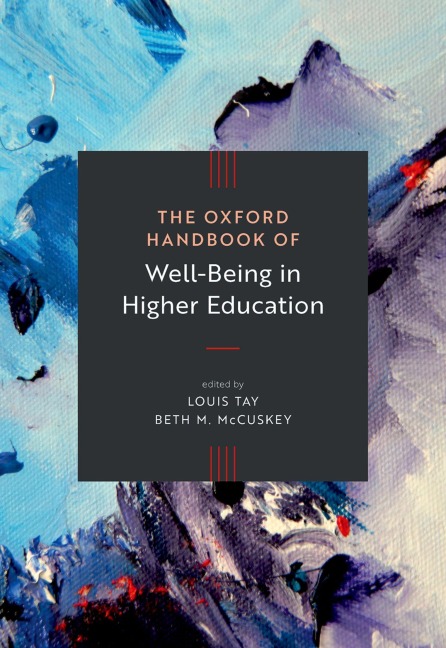
Well-being has become one of the defining challenges and opportunities of higher education in the twenty-first century. Alongside the traditional pursuit of academic excellence, colleges and universities must now address unprecedented levels of stress, depression, anxiety, and burnout among students, staff, and faculty. In The Oxford Handbook of Well-Being in Higher Education, Louis Tay and Beth M. McCuskey bring together leading researchers, educators, and practitioners to provide the first comprehensive, interdisciplinary resource on the multifaceted nature of well-being across different populations and contexts. The volume examines mental health trends, digital and social challenges, sense of belonging across diverse backgrounds, faculty and staff well-being, and the role of institutional culture and policy. The Handbook also highlights evidence-based interventions, innovative programs, and global perspectives, offering both theoretical depth and practical guidance. Organized around key themes-from foundational concepts and empirical trends to interventions, policies, and inclusive approaches-this volume integrates rigorous research with lived expertise from higher education leaders worldwide to address well-being at individual, relational, community, institutional, and societal levels. Essential for scholars, educators, administrators, student affairs professionals, policymakers, and anyone committed to higher education's transformative mission, this Handbook charts a path toward creating institutions that not only pursue knowledge but also cultivate thriving communities.
Louis Tay is William C. Byham Professor of Industrial-Organizational Psychology at Purdue University. His substantive research interests include well-being and character virtues. His methodological research interests include measurement, data science, and AI. He co-edited the Handbook of Well-Being (2018), Big Data in Psychological Research (2020), The Oxford Handbook of the Positive Humanities (Oxford, 2022), and other volumes. He has contributed to the United Nations' research reports on well-being and serves in consulting roles to top tech companies. He is the co-founder of the tech startup ExpiWell (www.expiwell.com) that advances the science of ecological momentary assessments. Beth M. McCuskey serves as Vice Provost for Student Life and Clinical Professor of Technology Leadership and Innovation at Purdue University. With a career spanning more than thirty-five years and three land-grant universities, her focus has been maximizing the impact of a residential campus on student learning and engagement. Well-being, in all of its forms, underpins this effort by bringing together the growth of individuals and the supportive nature of higher education communities. McCuskey has been an active member in the Student Affairs community, has published several articles and has served as President of the Association of College and University Housing Officers-International.
- Introduction - Part I Backdrop: Issues and Trends - 1: Sarah Ketchen Lipson, Christina Freibott, Sasha Zhou, Justin Heinze, and Daniel Eisenberg: Mental Health in College Student Populations: The Importance of Relationships and Other Social Factors - 2: Bridgette M. Bewick and Clare Mawson: Pedagogical Well-Being and the Compassionate Campus - 3: Aimee J. Hourigan and Kirsten Kennedy: Student Mental Health: A Public Health Approach to Student Development - 4: William R. Watson, Sunnie Lee Watson, Deepti Tagare, Samet Baydar, and Chi-Jia Hsieh: Instructional Design for Student and Instructor Well-Being in Online Learning - 5: Maureen De Armond: A Focus on Staff Well-Being - 6: Brianne H. Roos and Carey Borkoski: Faculty Well-Being - 7: Kevin Eagan: Exploring Well-Being Among Contingent Faculty in Postsecondary Education - Part II Integration and Synthesis of Well-Being Trends and Factors - 8: Bridgette M. Bewick and Emma Broglia: Understanding Changes in College Student Well-Being Over Time: An International Perspective - 9: Xiangyu Tao: Impact of the COVID-19 Pandemic on College Students' Well-Being - 10: Kristin Kosyluk, Kathryn Amanda Maranzan, and Patrick Corrigan: Mental Illness and Stigma Among College Students - 11: Daniel J. Madigan and Thomas Curran: What Do Reviews Tell Us About Higher Education Student Burnout? - 12: Crystal L. Park and Jeanne M. Slattery: College Student Stress and Coping - 13: Chia-chen Yang, Paul Hunhoff, and Jaime Lewandowski: Well-Being Implications of Social Media Use Among College Students - 14: Audrey E. Palmeri and Melissa E. Robertson: Friendships and Well-Being in College - 15: Elizabeth A. Jach and Yaa Essah Armah: Student-Faculty Interactions and Well-Being - 16: Ming Cui, Oluranti Ogundele, and Yinuo Zhang: Parenting and College Students' Well-Being - 17: Zhanjia Zhang: Physical Activity and Well-Being in College Students - 18: Michael Aaron Levine, Marianna Graziosi, and David B. Yaden: Spirituality, Mental Health, and Well-Being in Higher Education - Part III Interventions and Programs - 19: Ramona L. Martinez, Tanya K. Vannoy, and Sonja Lyubomirsky: Self-Administered Positive Activity Interventions - 20: Sandra Garrido: Digital Interventions - 21: Sarah Jelbert, Laurie R. Santos, and Bruce Hood: College Well-Being Courses - 22: Andrea Zammitti, Angela Russo, Rita Zarbo, Giuseppe Santisi, and Paola Magnano: Career Development for Personal and Societal Well-Being: Building Inclusive and Sustainable Futures - 23: Nicholas A. Bowman and Maria-Victoria Perez: College Student Success and Well-Being: Theories and Interventions - Part IV Policies and Program Implementation - 24: Bridget Yuhas and Frank E. Ross III: Assessing Institutional Climate for Well-Being to Drive Student Success - 25: Mary Jo Desprez, Joseph Zichi, Martino Harmon, and Robert Ernst: The University of Michigan and the Okanagan Charter: A Case Study - 26: Andrew Epaphroditus Swee Kwang Tay: Integrative Systems Approach - 27: Benoit Dubé: Perspectives of a Chief Wellness Officer - 28: Michele C. Everett: Enhancing the First-Year Experience - 29: Sara Abelson, David Thompson, Bryce McKibben, Lauren Bohn, and Jiayao Wu: Basic Needs for Student Well-Being - 30: R. Jason Lynch, Luis Jimenez Inoa, and Holly A. Stapleton: Fostering Social-Emotional Wellbeing through Campus Housing Programs - 31: Carl Krieger and Martia Brawner King: Acknowledging the Role for Student Leadership of Well-Being - 32: Rick H. Hoyle and Larry Moneta: The Role of Research in the Development and Evaluation of College Student Well-Being Initiatives - Part V Inclusive Approaches Across Diverse Experiences - 33: Sylvia Hurtado, Gabriel Gutierrez Aragon, and David Ulises Vargas Ezquivel: Advancing Individual and Community Well-Being Through Transformational Social Justice, Equity, and Inclusion - 34: Jue Wu and Rodolfo Mendoza-Denton: Impact of Ethnic and Socioeconomic Identities on Well-Being - 35: Derrick R. Brooms, Johnnie L. Campbell, and M. Alexander Lester: Black College Students' Well-Being - 36: Crystal Han, Shinny-Yi (Cindy) Chou, Elliott Schwebach, and Justin A. Chen: Culture and Race in Asian American Mental Well-Being - 37: Tin D. Vo, Michael R. Woodford, and Jason Fernandes: Understanding and Promoting Well-Being Among 2SLGBTQ+ Students - 38: Sarah Arduin: Inclusion and Well-Being of Students with Disabilities - Part VI Disciplinary and Global Perspectives - 39: Sarah Sidoti, Alina Spas, Katherine N. Cotter, and James O. Pawelski: The Humanities and Higher Education: Possibilities for Student Flourishing - 40: Allison Godwin, Sarah Wilson, Karin Jensen, Matilde Sánchez-Peña, and Kelly J. Cross: Engineering a Culture of Well-Being: Current Trends and Implications for Change in Engineering Education - 41: Rebecca J. Jarden, Aaron Jarden, Bernadette M. Twomey, Tarli Young, and Marie F. Gerdtz: Higher Education for Nursing Students: A "Whole" New Way Forward for Well-Being in the Academic-Clinical Nexus - 42: Andrea Ortega Bechara, Zhuo Job Chen, Stefano Vinaccia Alpi, Richard G. Cowden, and Everett L. Worthington Jr.: Student Flourishing in a Colombian Higher Education Context - 43: Tina Li Yi Ng, Andree Hartanto, and William Tov: Well-Being of University Students in Singapore - 44: Xinqiao Liu and Yifan Zhang: Trends, Related Factors, and Improvement of Well-Being Among Chinese College Students - 45: Serdar Karabat-: Well-Being in the Turkish Higher Education Context - 46: Munyi Shea, Paul Youngbin Kim, and Kyu Jin Yon: Addressing Help-Seeking Challenges and Promoting Mental Health Well-Being: A Case Study of a South Korean Institution with Global Implications