Und dann auf "Zum Home-Bildschirm [+]".

Stöbern
genialokal zum Startbildschirm hinzufügen
Installieren Sie die genialokal App auf Ihrem Startbildschirm für einen schnellen Zugriff und eine komfortable Nutzung.
Installieren Sie die genialokal App auf Ihrem Startbildschirm für einen schnellen Zugriff und eine komfortable Nutzung.
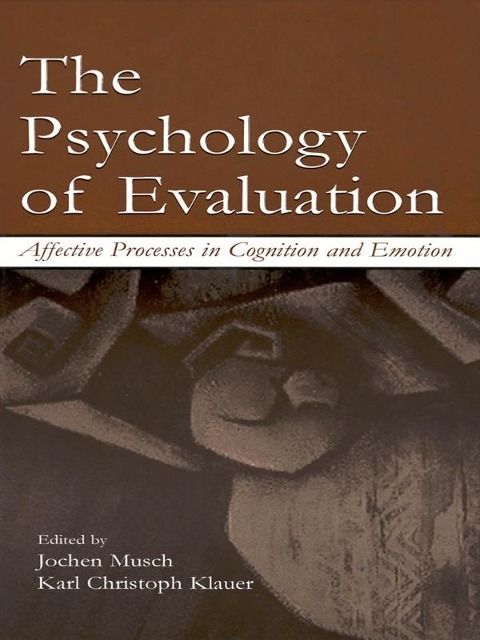
The affective connotations of environmental stimuli are evaluated spontaneously and with minimal cognitive processing. The activated evaluations influence subsequent emotional and cognitive processes. Featuring original contributions from leading researchers active in this area, this book reviews and integrates the most recent research and theories on this exciting new topic. Many fundamental issues regarding the nature of and relationship between evaluations, cognition, and emotion are covered. The chapters explore the mechanisms and boundary conditions of automatic evaluative processes, the determinants of valence, indirect measures of individual differences in the evaluation of social stimuli, and the relationship between evaluations and mood, as well as emotion and behavior. Offering a highly integrated and comprehensive coverage of the field, this book is suitable as a core textbook in advanced courses dealing with the role of evaluations in cognition and emotion.
Contents: J. Musch, K.C. Klauer, The Psychology of Evaluation: An Introduction. Part I:Mechanisms, Boundary Conditions, and Theories of Automatic Evaluation.K.C. Klauer, J. Musch, Affective Priming: Findings and Theories. D. Wentura, K. Rothermund, The "Meddling-In" of Affective Information: A General Model of Automatic Evaluation. J. Glaser, Reverse Priming: Implications for the (Un)conditionality of Automatic Evaluation. K. Fiedler, The Hidden Vicissitudes of the Priming Paradigm in Evaluative Judgment Research. Part II:Evaluative Judgments and the Acquisition of Evaluations.D. Hermans, F. Baeyens, P. Eelen, On the Acquisition and Activation of Evaluative Information in Memory: The Study of Evaluative Learning and Affective Priming Combined. M. Ferguson, J. Bargh, The Constructive Nature of Automatic Evaluation. P. Winkielman, N. Schwarz, T. Fazendeiro, R. Reber, The Hedonic Marking of Processing Fluency: Implications for Evaluative Judgment. Part III:Individual Differences and Indirect Measures of Evaluation.J. De Houwer, A Structural Analysis of Indirect Measures of Attitudes. R. Banse, Beyond Verbal Self-Report: Priming Methods in Relationship Research. M.D. Robinson, P.T. Vargas, E.C. Crawford, Putting Process Into Personality, Appraisal, and Emotion: Evaluative Processing as a Missing Link. Part IV:The Role of Evaluation in Mood, Emotion, and Behavior.P. Niedenthal, A. Rohmann, N. Dalle, What Is Primed by Emotion Concepts and Emotion Words? G. Clore, S. Colcombe, The Parallel Worlds of Affective Concepts and Feelings. R. Neumann, J. Förster, F. Strack, Motor Compatibility: The Bidirectional Link Between Behavior and Evaluation.
Dieses eBook wird im PDF-Format geliefert und ist mit einem Adobe Kopierschutz (DRM) versehen. Sie können dieses eBook mit allen Geräten lesen, die das PDF-Format und den Adobe Kopierschutz (DRM) unterstützen.
Zum Beispiel mit den folgenden Geräten:
• tolino Reader
Laden Sie das eBook direkt über den Reader-Shop auf dem tolino herunter oder übertragen Sie das eBook auf Ihren tolino mit einer kostenlosen Software wie beispielsweise Adobe Digital Editions.
• Sony Reader & andere eBook Reader
Laden Sie das eBook direkt über den Reader-Shop herunter oder übertragen Sie das eBook mit der kostenlosen Software Sony READER FOR PC/Mac oder Adobe Digital Editions auf ein Standard-Lesegeräte mit epub- und Adobe DRM-Unterstützung.
• Tablets & Smartphones
Möchten Sie dieses eBook auf Ihrem Smartphone oder Tablet lesen, finden Sie hier unsere kostenlose Lese-App für iPhone/iPad und Android Smartphone/Tablets.
• PC & Mac
Lesen Sie das eBook direkt nach dem Herunterladen mit einer kostenlosen Lesesoftware, beispielsweise Adobe Digital Editions, Sony READER FOR PC/Mac oder direkt über Ihre eBook-Bibliothek in Ihrem Konto unter „Meine eBooks“ - „online lesen“.
Schalten Sie das eBook mit Ihrer persönlichen Adobe ID auf bis zu sechs Geräten gleichzeitig frei.
Bitte beachten Sie, dass die Kindle-Geräte das Format nicht unterstützen und dieses eBook somit nicht auf Kindle-Geräten lesbar ist.