Und dann auf "Zum Home-Bildschirm [+]".

Stöbern
genialokal zum Startbildschirm hinzufügen
Installieren Sie die genialokal App auf Ihrem Startbildschirm für einen schnellen Zugriff und eine komfortable Nutzung.
Installieren Sie die genialokal App auf Ihrem Startbildschirm für einen schnellen Zugriff und eine komfortable Nutzung.
Ihr gewünschter Artikel ist in 0 Buchhandlungen vorrätig - wählen Sie hier eine Buchhandlung in Ihrer Nähe aus:


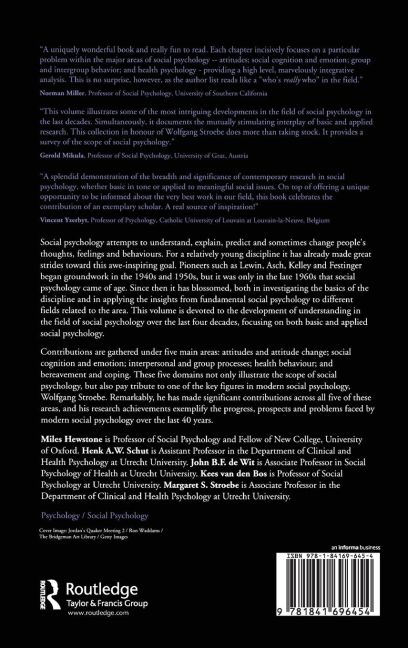
This volume is devoted to the development of understanding in the field of social psychology over the last four decades, covering both basic and applied social psychology.
Miles Hewstone is Professor of Social Psychology and Fellow of New College, University of Oxford. Henk Schut is Assistant Professor in the Department of Clinical and Health Psychology at Utrecht University. John B.F. de Wit is Associate Professor in Social Psychology of Health at Utrecht University. Kees van den Bos is Professor of Social Psychology at Utrecht University. Margaret S. Stroebe is Associate Professor in the Department of Clinical and Health Psychology at Utrecht University.
Introduction. K. van den Bos, M. Hewstone, M.S. Stroebe, H.A.W. Schut, J.B.F. de Wit, On the Scope of Social Psychology: An Introduction. Section 1: Attitudes and attitude change. R.Eiser, Positive accentuation: Or why a good product still needs an advertisement. K. Jonas, Attitudinal Ambivalence. I. Ajzen, T. Manstead, Changing Health-Related Behaviors: An Approach Based on the Theory of Planned Behavior. A. Eagly, In Defense of Ourselves: The Effects of Defensive Processing on Attitudinal Phenomena. Section 2: Social cognition and emotion. D. Hamilton, M. Hewstone, Conceptualizing Group Perception: A 35-Year Evolution. A. Kruglanski, G. Semin, The Epistemic Bases of Interpersonal Communication. F. Strack, N. Schwarz, Thinking About Your life: Healthy Lessons From Social Cognition. Section 3: Interpersonal and group processes. C. Insko, Situational Variance in Intergroup Conflict: Matrix Correlations, Matrix Interactions, and Social Support. B. Nijstad, J. Levine, Group Creativity and the Stages of Creative Problem Solving. K. Stroebe, R. Spears, H. Lodewijkx, Contrasting and Integrating Social Identity and Interdependence Approaches to Intergroup Discrimination in the Minimal Group Paradigm. Section 4: Health behavior (change). S. Folkman, J. Moskowitz, Positive Affect and Meaning-Focused Coping during Significant Psychological Stress. J.B.F. de Wit, E. Das, N. de Hoog, Self-Regulation of Health Communications: A Motivated Processing Approach to Risk Perception and Persuasion. A.B. Bakker, W.B. Schaufeli, E. Demerouti, M.C. Euwema, An Organizational and Social Psychological Perspective on Burnout and Work Engagement. Section 5: Bereavement and coping. R. Weiss, Reflections on Extended Bowlby Theory. E. Zech, B. Rimé, J. Pennebaker, The Effects of Emotional Disclosure During Bereavement. G. Abakoumkin, K. Gergen, M. Gergen, R. Hansson, H.A.W. Schut, M.S. Stroebe, A Scientist's Role in Bereavement Research: The Case of Wolfgang Stroebe. Section 6: Psychology in context. K. Opp, Social Psychology is not Enough: The Interdisciplinary Social Science Working Group. Epilogue. L. Strickland, J. Rabbie, R. van der Vegt, L. Hoekert, Impressions of Wolfgang Stroebe.