Und dann auf "Zum Home-Bildschirm [+]".

Stöbern
genialokal zum Startbildschirm hinzufügen
Installieren Sie die genialokal App auf Ihrem Startbildschirm für einen schnellen Zugriff und eine komfortable Nutzung.
Installieren Sie die genialokal App auf Ihrem Startbildschirm für einen schnellen Zugriff und eine komfortable Nutzung.
Ihr gewünschter Artikel ist in 0 Buchhandlungen vorrätig - wählen Sie hier eine Buchhandlung in Ihrer Nähe aus:

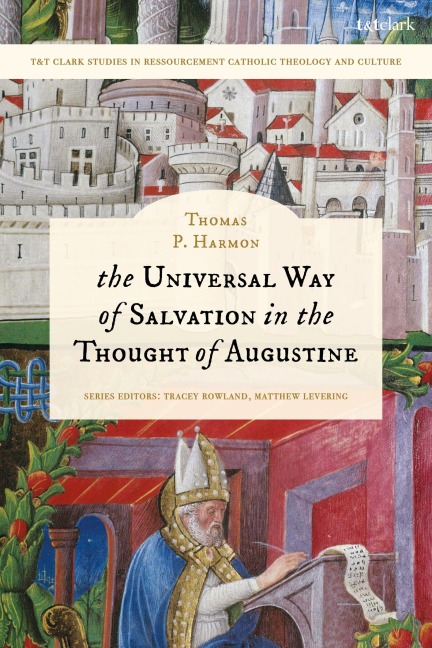
This work examines Augustine's critique of his Roman predecessors to reveal key aspects of Christ's mediation of the universal way of salvation.Porphyry of Tyre had noticed that Christianity can make a claim that pagan religion and pagan philosophy cannot: that all types of human being can be saved through the one salvific action of Christ mediated sacramentally through the one Catholic Church.Augustine's response to Porphyry is grounded firmly on Christology, especially on what Augustine sees to be the unique act of Christ as mediator, based in turn on Christ's unique position as true God and true man, which in turn is capable of healing the whole man and, by healing the whole man, also healing each of the parts of the soul. Christ himself, as concretely universal, is capable of saving each and any type of human being, no matter which part of the soul rules within him, Augustine counters, which is not a claim his pagan interlocutors can replicate.
In addition to careful considerations of ancient authors like Plato, Cicero, Varro, and Porphyry, this book also ranges through Plutarch, Shakespeare, and contemporary political thinkers like Pierre Manent and Leo Strauss; scholars of religion such as Michael Bland Simmons, theologians such as Erik Peterson and Ernest L. Fortin, as well as well-known Augustine scholars such as James Wetzel, G.R. Evans, John Cavadini, Robert Dodaro, Mary Keys, Michael Foley, Rowan Williams, Oliver O'Donovan, John Rist, and many others.
Thomas P. Harmon is Professor & Scanlan Foundation Chair in Theology, Directory of the MA in Evangelization & Culture and Associate Director of Catholic Studies at the University of St. Thomas in Houston, Texas.
Introduction Part One: Setting up the Argument about the Universal Way of Salvation Chapter One: Politics, Perception, and Religion from Republic to Empire Chapter Two: Religious Universalism in the late Roman Empire and the Arguments of Porphyry of Tyre Chapter Three: The Few, the Many, and the Universal Way of Salvation in Augustine's Early Works Part Two: Christ's Mediation of the Universal Way of Salvation Chapter Four: Human Wholeness and the Universal Way of Salvation in the City of God Chapter Five: Plato on the Divisions Among Human Beings Chapter Six: Augustine's Engagement with Platonic Political Philosophy on Ignorance and Difficulty Chapter Seven: Augustine's Argument with Porphyry on the Universal Way of Salvation Chapter Eight: Christ the Mediator of the Universal Way of Salvation Chapter Nine: Charity, Justice, and Reconciliation in the Transpolitical City of God Part Three: The Universal Way of Salvation and Augustine Himself Chapter Ten: Human Wholeness in the Confessions Chapter Eleven: Augustine's Philosophic Ascent Chapter Twelve: Salvation for the Philosopher and the Non-Philosopher: The Cases of Victorinus and Antony Chapter Thirteen: Augustine's Moral and Religious Conversion: Soul and Body, Few and Many Conclusion Bibliography Index