Und dann auf "Zum Home-Bildschirm [+]".

Stöbern
genialokal zum Startbildschirm hinzufügen
Installieren Sie die genialokal App auf Ihrem Startbildschirm für einen schnellen Zugriff und eine komfortable Nutzung.
Installieren Sie die genialokal App auf Ihrem Startbildschirm für einen schnellen Zugriff und eine komfortable Nutzung.
Ihr gewünschter Artikel ist in 0 Buchhandlungen vorrätig - wählen Sie hier eine Buchhandlung in Ihrer Nähe aus:

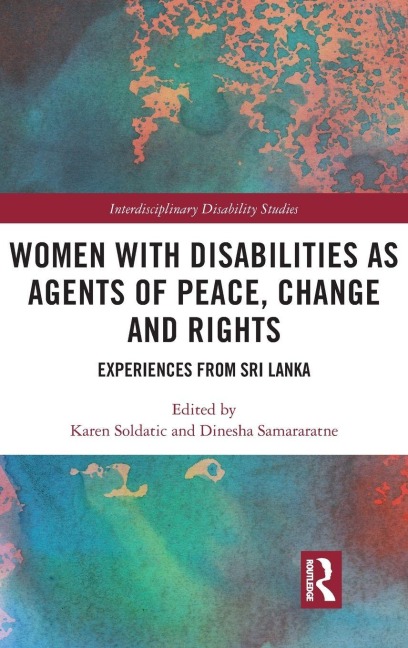

Drawing on rich empirical work emerging from core conflict regions within the island nation of Sri Lanka, this book illustrates the critical role that women with disabilities play in post-armed conflict rebuilding and development.
Karen Soldatic is an Associate Professor, School of Social Sciences, and Institute Fellow, Institute for Culture and Society, at Western Sydney University. She was awarded a Fogarty Foundation Excellence in Education Fellowship for 2006-09, a British Academy International Fellowship in 2012, a fellowship at The Centre for Human Rights Education at Curtin University (2011-12), where she remains an Adjunct Fellow, and an Australian Research Council DECRA Fellowship (2016-19). Her research on global welfare regimes builds on her 20 years of experience as an international, national and state-based senior policy analyst, researcher and practitioner. She obtained her PhD (Distinction) in 2010 from the University of Western Australia. Dinesha Samararatne is a Senior Lecturer at the Department of Public & International Law at the Faculty of Law at the University of Colombo, Sri Lanka. She is also a Postdoctoral Fellow in the ARC Laureate Program in Comparative Constitutional Law (2019-20), a Co-Convenor of Constitution Transformation Network (CTN) of the Melbourne Law School and co-editor of the Blog of the International Association for Constitutional Law (IACL). Her recent research has been in relation to constitution-making, methodology of comparative constitutional law, women's rights and rights of persons with disabilities.
1. Introduction: Out of the shadows: Women with disabilities as agents of peace, justice and reparations in Sri Lanka. 2. Going beyond disability identity and creating communities of belonging: Perception management and gendered disability advocacy. 3. Music, resistance and change: The gendered-disability performativity of a Tamil woman with multiple disabilities. 4. Raging (e)motions. 5. Women with disabilities, advocacy and the law. 6. Learning about rights, claiming a gendered-disability identity: The role of reparations and gendered-disability justice. 7. Conclusion and recommendations: Enabling women with disabilities' advocacy and activism in the peace-building landscape