Und dann auf "Zum Home-Bildschirm [+]".

Stöbern
genialokal zum Startbildschirm hinzufügen
Installieren Sie die genialokal App auf Ihrem Startbildschirm für einen schnellen Zugriff und eine komfortable Nutzung.
Installieren Sie die genialokal App auf Ihrem Startbildschirm für einen schnellen Zugriff und eine komfortable Nutzung.
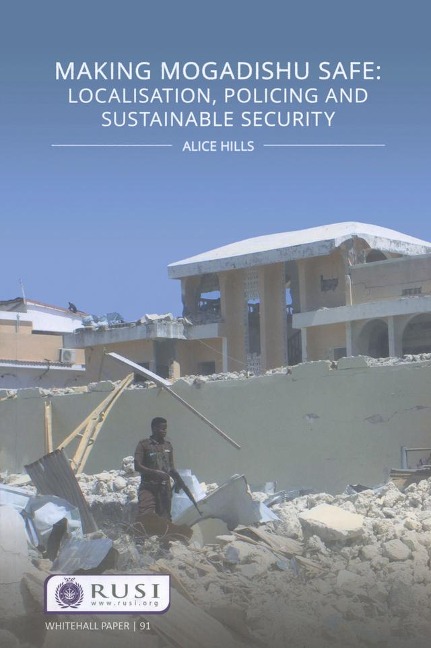
This Whitehall Paper explores the ways in which Mogadishu's inhabitants try to stay out of harm's way, from security officials in the presidential compound of Villa Somalia to the city's powerful district commissioners, from patrolling policemen to the women road-sweepers in the rubbish-filled alleyways of the Waberi district. Its central proposition is that security is best understood as a coherent relationship or activity based on the need for physical safety today, rather than in the future. It uses the neighbourhood-watch schemes developed in certain districts of Mogadishu - most notably Waberi - to understand the ways in which the city's inhabitants respond to the security models promoted by international advisers.
Alice Hills is professor of conflict studies at Durham University, where she specialises in police development, post-conflict policing and sub-state security. Before joining Durham she was professor of conflict and security at the University of Leeds. Prior to that she taught defence studies at the UK's Joint Services Command and Staff College where she specialised in urban operations and police-military relations. She has published widely on police development and on urban operations such as counter-insurgency and war fighting. Her publications include Policing Africa: Internal security and the limits of liberalization (2000); Future War in Cities: Rethinking a Liberal Dilemma (2004); Policing Post-Conflict Cities (2009) as well as numerous articles in journals including International Affairs, the British Journal of Criminology, the RUSI Journal and Stability.
Introduction I. Making Mogadishu Safer II. Policing Mogadishu III. Managing Neighbourhood Security IV. ICT for Community Security V. Hargeisa's Modest Experiment
Dieses eBook wird im PDF-Format geliefert und ist mit einem Adobe Kopierschutz (DRM) versehen. Sie können dieses eBook mit allen Geräten lesen, die das PDF-Format und den Adobe Kopierschutz (DRM) unterstützen.
Zum Beispiel mit den folgenden Geräten:
• tolino Reader
Laden Sie das eBook direkt über den Reader-Shop auf dem tolino herunter oder übertragen Sie das eBook auf Ihren tolino mit einer kostenlosen Software wie beispielsweise Adobe Digital Editions.
• Sony Reader & andere eBook Reader
Laden Sie das eBook direkt über den Reader-Shop herunter oder übertragen Sie das eBook mit der kostenlosen Software Sony READER FOR PC/Mac oder Adobe Digital Editions auf ein Standard-Lesegeräte mit epub- und Adobe DRM-Unterstützung.
• Tablets & Smartphones
Möchten Sie dieses eBook auf Ihrem Smartphone oder Tablet lesen, finden Sie hier unsere kostenlose Lese-App für iPhone/iPad und Android Smartphone/Tablets.
• PC & Mac
Lesen Sie das eBook direkt nach dem Herunterladen mit einer kostenlosen Lesesoftware, beispielsweise Adobe Digital Editions, Sony READER FOR PC/Mac oder direkt über Ihre eBook-Bibliothek in Ihrem Konto unter „Meine eBooks“ - „online lesen“.
Schalten Sie das eBook mit Ihrer persönlichen Adobe ID auf bis zu sechs Geräten gleichzeitig frei.
Bitte beachten Sie, dass die Kindle-Geräte das Format nicht unterstützen und dieses eBook somit nicht auf Kindle-Geräten lesbar ist.