Und dann auf "Zum Home-Bildschirm [+]".

Stöbern
genialokal zum Startbildschirm hinzufügen
Installieren Sie die genialokal App auf Ihrem Startbildschirm für einen schnellen Zugriff und eine komfortable Nutzung.
Installieren Sie die genialokal App auf Ihrem Startbildschirm für einen schnellen Zugriff und eine komfortable Nutzung.
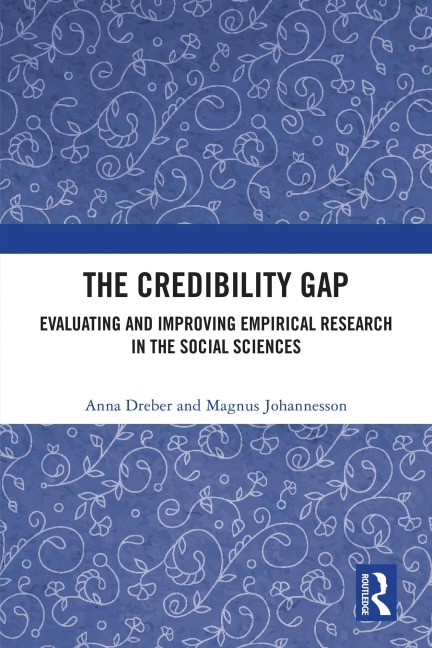
Which scientific results can we trust? This question has been brought to the forefront of research in the social sciences in recent years with the movement towards open science practices and preregistration. Systematic replication studies of laboratory experiments in the social sciences have found that only about half of the "statistically significant" results published in top journals can be replicated in the sense that similar results are achieved with new data. This low replicability may be even lower in studies based on observational data as such studies have more degrees of freedom in the analysis of the data leading to larger possibilities to selectively report more publishable findings. In this book, the authors provide a framework for evaluating reproducibility, replicability and generalizability of empirical research in the social sciences. They define different types of reproducibility and replicability and show how they can be measured to evaluate the credibility of published findings. Different approaches to improving the credibility of published findings, such as preregistration with detailed pre-analysis plans, Registered Report publications, and preregistered prospective meta-analysis are also outlined and discussed. Even if published results are not systematically biased, the variation in results across populations, research designs, and analyses decreases the reliability and generalizability of published findings. The book shows how such heterogeneity in results can be measured and incorporated in the analysis to more accurately represent the uncertainty and thereby generalizability of reported results.
Anna Dreber is Professor of economics at the Stockholm School of Economics, Sweden. Magnus Johannesson is Professor of economics at the Stockholm School of Economics, Sweden.
1. Introduction 2. p-values, power and p-hacking 3. Pre-registration 4. A framework for evaluating reproducibility and replicability 5. Results from large-scale reproducibility studies 6. Results from large-scale replicability studies 7. Predicting replications 8. A framework for evaluating heterogeneity and generalizability 9. Empirical estimates of heterogeneity 10. Meta-analysis and aggregating research findings 11. Debugging observational data studies 12. Conclusion
Dieses eBook wird im PDF-Format geliefert und ist mit einem Adobe Kopierschutz (DRM) versehen. Sie können dieses eBook mit allen Geräten lesen, die das PDF-Format und den Adobe Kopierschutz (DRM) unterstützen.
Zum Beispiel mit den folgenden Geräten:
• tolino Reader
Laden Sie das eBook direkt über den Reader-Shop auf dem tolino herunter oder übertragen Sie das eBook auf Ihren tolino mit einer kostenlosen Software wie beispielsweise Adobe Digital Editions.
• Sony Reader & andere eBook Reader
Laden Sie das eBook direkt über den Reader-Shop herunter oder übertragen Sie das eBook mit der kostenlosen Software Sony READER FOR PC/Mac oder Adobe Digital Editions auf ein Standard-Lesegeräte mit epub- und Adobe DRM-Unterstützung.
• Tablets & Smartphones
Möchten Sie dieses eBook auf Ihrem Smartphone oder Tablet lesen, finden Sie hier unsere kostenlose Lese-App für iPhone/iPad und Android Smartphone/Tablets.
• PC & Mac
Lesen Sie das eBook direkt nach dem Herunterladen mit einer kostenlosen Lesesoftware, beispielsweise Adobe Digital Editions, Sony READER FOR PC/Mac oder direkt über Ihre eBook-Bibliothek in Ihrem Konto unter „Meine eBooks“ - „online lesen“.
Schalten Sie das eBook mit Ihrer persönlichen Adobe ID auf bis zu sechs Geräten gleichzeitig frei.
Bitte beachten Sie, dass die Kindle-Geräte das Format nicht unterstützen und dieses eBook somit nicht auf Kindle-Geräten lesbar ist.