Und dann auf "Zum Home-Bildschirm [+]".

Stöbern
genialokal zum Startbildschirm hinzufügen
Installieren Sie die genialokal App auf Ihrem Startbildschirm für einen schnellen Zugriff und eine komfortable Nutzung.
Installieren Sie die genialokal App auf Ihrem Startbildschirm für einen schnellen Zugriff und eine komfortable Nutzung.
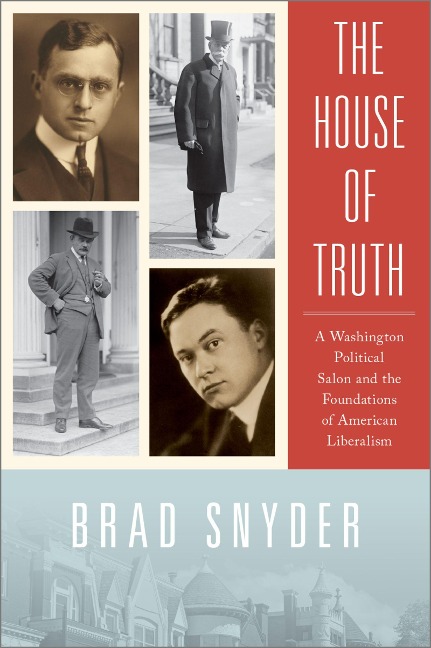
In 1912, a group of ambitious young men, including future Supreme Court justice Felix Frankfurter and future journalistic giant Walter Lippmann, became disillusioned by the sluggish progress of change in the Taft Administration. The individuals started to band together informally, joined initially by their enthusiasm for Theodore Roosevelt's Bull Moose campaign. They self-mockingly called the 19th Street row house in which they congregated the "House of Truth," playing off the lively dinner discussions with frequent guest (and neighbor) Oliver Wendell Holmes, Jr. about life's verities. Lippmann and Frankfurter were house-mates, and their frequent guests included not merely Holmes but Louis Brandeis, Herbert Hoover, Herbert Croly - founder of the New Republic - and the sculptor (and sometime Klansman) Gutzon Borglum, later the creator of the Mount Rushmore monument. Weaving together the stories and trajectories of these varied, fascinating, combative, and sometimes contradictory figures, Brad Snyder shows how their thinking about government and policy shifted from a firm belief in progressivism - the belief that the government should protect its workers and regulate monopolies - into what we call liberalism - the belief that government can improve citizens' lives without abridging their civil liberties and, eventually, civil rights. Holmes replaced Roosevelt in their affections and aspirations. His famous dissents from 1919 onward showed how the Due Process clause could protect not just business but equality under the law, revealing how a generally conservative and reactionary Supreme Court might embrace, even initiate, political and social reform. Across the years, from 1912 until the start of the New Deal in 1933, the remarkable group of individuals associated with the House of Truth debated the future of America. They fought over Sacco and Vanzetti's innocence; the dangers of Communism; the role the United States should play the world after World War One; and thought dynamically about things like about minimum wage, child-welfare laws, banking insurance, and Social Security, notions they not only envisioned but worked to enact. American liberalism has no single source, but one was without question a row house in Dupont Circle and the lives that intertwined there at a crucial moment in the country's history.
Brad Snyder teaches constitutional law, civil procedure, twentieth century American legal history, and sports law at the University of Wisconsin, Madison. He has written two critically acclaimed books about baseball, including A Well-Paid Slave: Curt Flood's Fight for Free Agency in Professional Sports, and contributed articles to Slate and the Washington Post. He has also appeared on ESPN, C-SPAN, and in HBO and New York Times documentaries. For many years, he lived two blocks away from the House of Truth in Washington, DC, where he and his family still reside.
Dedication Introduction Chapter 1: Expanding Horizons Chapter 2: 1727 Nineteenth Street Chapter 3: The Call of the Moose Chapter 4: The Center of the Universe Chapter 5: Buddha Chapter 6: The Soldier's Faith Chapter 7: Temperamentally Unfit Chapter 8: Our Founder Chapter 9: Fighting Valentine's Fight Chapter 10: The House at War Chapter 11: One Man War Chapter 12: Uniting the Labor Army Chapter 13: The Inquiry Chapter 14: The Wonderful One Chapter 15: The H/T Cannot Be Re-constituted Chapter 16: Harvard's Dangerous Men Chapter 17: Touched with Fire Chapter 18: Protestant of Nordic Stock Chapter 19: We Live By Symbols Chapter 20: The 1924 Election and the Basic Issues of Liberalism Chapter 21: Eloquence May Set Fire to Reason Chapter 22: A Fly on an Elephant Chapter 23: No Ordinary Case Chapter 24: This World Cares More for Red than for Black Chapter 25: A Damn Poor Psychologist Chapter 26: The Happy Warrior Chapter 27: Freedom for the Thought that We Hate Chapter 28: America's Shrine for Political Democracy Chapter 29: The Best Men Chapter 30: A Very Great Beginning Chapter 31: The Hard Case Has Melted Epilogue Appendix Photo Credits and Bibliography Acknowledgments
Dieses eBook wird im PDF-Format geliefert und ist mit einem Adobe Kopierschutz (DRM) versehen. Sie können dieses eBook mit allen Geräten lesen, die das PDF-Format und den Adobe Kopierschutz (DRM) unterstützen.
Zum Beispiel mit den folgenden Geräten:
• tolino Reader
Laden Sie das eBook direkt über den Reader-Shop auf dem tolino herunter oder übertragen Sie das eBook auf Ihren tolino mit einer kostenlosen Software wie beispielsweise Adobe Digital Editions.
• Sony Reader & andere eBook Reader
Laden Sie das eBook direkt über den Reader-Shop herunter oder übertragen Sie das eBook mit der kostenlosen Software Sony READER FOR PC/Mac oder Adobe Digital Editions auf ein Standard-Lesegeräte mit epub- und Adobe DRM-Unterstützung.
• Tablets & Smartphones
Möchten Sie dieses eBook auf Ihrem Smartphone oder Tablet lesen, finden Sie hier unsere kostenlose Lese-App für iPhone/iPad und Android Smartphone/Tablets.
• PC & Mac
Lesen Sie das eBook direkt nach dem Herunterladen mit einer kostenlosen Lesesoftware, beispielsweise Adobe Digital Editions, Sony READER FOR PC/Mac oder direkt über Ihre eBook-Bibliothek in Ihrem Konto unter „Meine eBooks“ - „online lesen“.
Schalten Sie das eBook mit Ihrer persönlichen Adobe ID auf bis zu sechs Geräten gleichzeitig frei.
Bitte beachten Sie, dass die Kindle-Geräte das Format nicht unterstützen und dieses eBook somit nicht auf Kindle-Geräten lesbar ist.