Und dann auf "Zum Home-Bildschirm [+]".

Stöbern
genialokal zum Startbildschirm hinzufügen
Installieren Sie die genialokal App auf Ihrem Startbildschirm für einen schnellen Zugriff und eine komfortable Nutzung.
Installieren Sie die genialokal App auf Ihrem Startbildschirm für einen schnellen Zugriff und eine komfortable Nutzung.
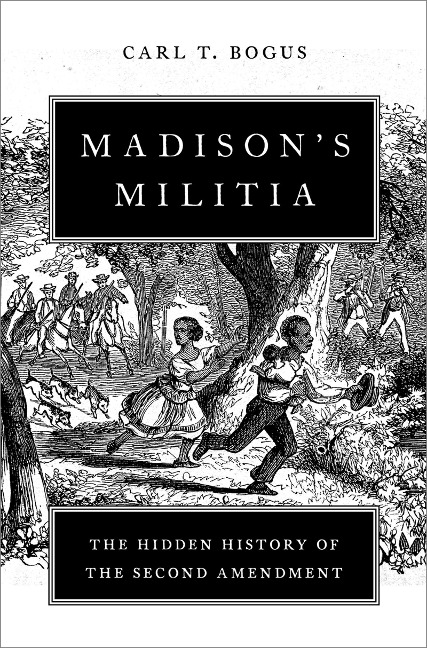
This engaging history overturns the conventional wisdom about the Second Amendment--showing that the right to bear arms was not about protecting liberty but about preserving slavery. In Madison's Militia, Carl Bogus illuminates why James Madison and the First Congress included the right to bear arms in the Bill of Rights. Linking together dramatic accounts of slave uprisings and electric debates over whether the Constitution should be ratified, Bogus shows that--contrary to conventional wisdom--the fitting symbol of the Second Amendment is not the musket in the hands of the minuteman on Lexington Green but the musket wielded by a slave patrol member in the South. Bogus begins with a dramatic rendering of the showdown in Virginia between James Madison and his federalist allies, who were arguing for ratification of the new Constitution, and Patrick Henry and the antifederalists, who were arguing against it. Henry accused Madison of supporting a constitution that empowered Congress to disarm the militia, on which the South relied for slave control. The narrative then proceeds to the First Congress, where Madison had to make good a congressional campaign promise to write a Bill of Rights--and seizing that opportunity to solve the problem Henry had raised. Three other collections of stories--on slave insurrections, Revolutionary War battles, and the English Declaration of Rights--are skillfully woven into the narrative and show how arming ragtag militias was never the primary goal of the amendment. And as the puzzle pieces come together, even initially skeptical readers will be surprised by the completed picture: one that forcefully demonstrates that the Second Amendment was intended in the first instance to protect slaveholders from the people they owned.
Carl T. Bogus is a Professor of Law Emeritus at the Roger Williams University School of Law in Bristol, Rhode Island. He has also held visiting positions at the George Washington, Drexel, and Rutgers University law schools. He is the author of two previous books--Buckley: William F. Buckley Jr. and the Rise of American Conservatism (Bloomsbury Press) and Why Lawsuits Are Good for America: Disciplined Democracy, Big Business, and the Common Law (NYU Press)--and the editor of The Second Amendment in Law and History: Historians and Constitutional Scholars on the Right to Bear Arms (The New Press). His writings have appeared in professional journals as well as the New York Times, USA Today, Los Angeles Times, Boston Globe, The Nation, American Prospect, American Conservative, and other popular venues.
Introduction Chapter One: Showdown in Richmond Chapter Two: Debate in Richmond Chapter Three: Decision in Richmond Chapter Four: Southern Terror Chapter Five: The Militia--War in the North Chapter Six: The Militia--War in the South Chapter Seven: Mr. Madison Goes to Congress Chapter Eight: The Ghost of Patrick Henry Chapter Nine: The English Declaration of Rights of 1689 Chapter Ten: Chimeras of Liberty Conclusion Author's Note Notes Index
Dieses eBook wird im PDF-Format geliefert und ist mit einem Adobe Kopierschutz (DRM) versehen. Sie können dieses eBook mit allen Geräten lesen, die das PDF-Format und den Adobe Kopierschutz (DRM) unterstützen.
Zum Beispiel mit den folgenden Geräten:
• tolino Reader
Laden Sie das eBook direkt über den Reader-Shop auf dem tolino herunter oder übertragen Sie das eBook auf Ihren tolino mit einer kostenlosen Software wie beispielsweise Adobe Digital Editions.
• Sony Reader & andere eBook Reader
Laden Sie das eBook direkt über den Reader-Shop herunter oder übertragen Sie das eBook mit der kostenlosen Software Sony READER FOR PC/Mac oder Adobe Digital Editions auf ein Standard-Lesegeräte mit epub- und Adobe DRM-Unterstützung.
• Tablets & Smartphones
Möchten Sie dieses eBook auf Ihrem Smartphone oder Tablet lesen, finden Sie hier unsere kostenlose Lese-App für iPhone/iPad und Android Smartphone/Tablets.
• PC & Mac
Lesen Sie das eBook direkt nach dem Herunterladen mit einer kostenlosen Lesesoftware, beispielsweise Adobe Digital Editions, Sony READER FOR PC/Mac oder direkt über Ihre eBook-Bibliothek in Ihrem Konto unter „Meine eBooks“ - „online lesen“.
Schalten Sie das eBook mit Ihrer persönlichen Adobe ID auf bis zu sechs Geräten gleichzeitig frei.
Bitte beachten Sie, dass die Kindle-Geräte das Format nicht unterstützen und dieses eBook somit nicht auf Kindle-Geräten lesbar ist.