Und dann auf "Zum Home-Bildschirm [+]".

Stöbern
genialokal zum Startbildschirm hinzufügen
Installieren Sie die genialokal App auf Ihrem Startbildschirm für einen schnellen Zugriff und eine komfortable Nutzung.
Installieren Sie die genialokal App auf Ihrem Startbildschirm für einen schnellen Zugriff und eine komfortable Nutzung.
Ihr gewünschter Artikel ist in 0 Buchhandlungen vorrätig - wählen Sie hier eine Buchhandlung in Ihrer Nähe aus:

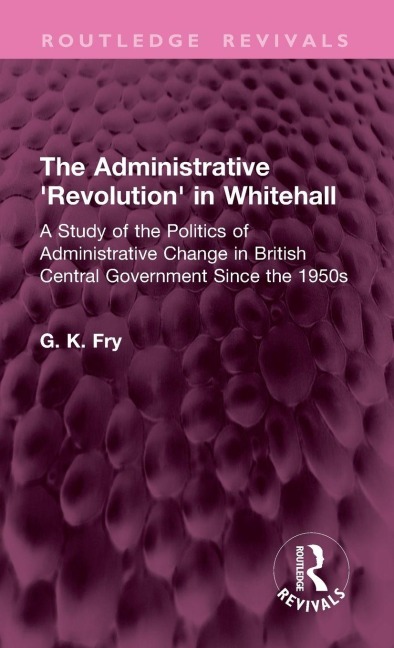
In the latter half of the twentieth century, an administrative revolution took place in British central government, which few parts of central government, from the Treasury downwards, escaped. Originally published in 1981, this book provides a comprehensive, analytical review of these changes. It relates them to the context of policy changes, and poses the question, what did this 'orgy of reform' actually achieve? The author maintains that the basic aim of the reformers was to create new administrative machinery which would halve Britain's economic decline, find a new role in the world for post-Imperial Britain and lead to a new, more positive role for the State within Britain. He argues convincingly that although some reforms were useful in themselves, others were not, and that the basic aim of the reformers met with failure. At a time when there is much scrutiny of the British Civil Service, this classic book has an enduring relevance.
Emeritus Professor Geoffrey K. Fry who died in 2023 spent his career at the University of Leeds in the field of British Government and Administration having studied for his doctorate at the LSE. A prolific author of nine books and over forty papers, he is perhaps best known for his highly successful book Statesmen in Disguise (1969), a study of the Administrative Class of the UK Civil Service from 1853 to 1966, that became the standard history of the Higher Civil Service. He followed up with The Growth of Government (1979) which looked at the development of the role of the state, machinery and function of government since 1780. The timing of the publication, appropriately enough, aligning with the arrival of Thatcherism and the associated reform agenda. Through books such as The Administrative 'Revolution' in Whitehall, The Changing Civil Service (1985), Reforming the Civil Service (1993) and Policy and Management in the British Civil Service (1995); Fry explores a range of themes including the machinery of government, the changes to ministerial responsibilities, the reform agenda, management effectiveness and the post war super-ministries. In his later works, Fry published a trio of titles about British political history covering the period of 1931 to 1990 entitled The Politics of Crisis (2001), The Politics of Decline (2005), The Politics of the Thatcher Revolution (2008). Across his academic research and writing Fry drew on his working class upbringing and experience of working in the Civil Service. His background and life experience was one of the reasons for his non-conformist perspective. A rigorous researcher and meticulous academic, he frequently sought out insights from the rank and file Civil Servants through digesting their own association publications rather than solely focusing on the Whitehall elite. Fry consistently wrote against the prevailing academic viewpoint of the time particularly in the analysis of Civil Service reform and their effectiveness, or lack thereof. He often credited this ability to not being aligned with a particular political tribe which gave him the freedom to write on his own terms. He used his talent of being able to talk to anyone and his engaging matter to find political gems in the most unlikely of places. Famously quizzing the University of Leeds cleaners on who they thought would win the 1992 UK General Election. The cleaners got it right unlike the leading political scientists of the day.
1.The Administrative 'Revolution' 2. The Origins of the Administrative 'Revolution' 3. The Machinery of Central Government and the Pursuit of 'National Efficiency' 4. Trying to Manage the Economy 5. Failing to Control Public Expenditure 6. Picking Up the Losers?: The State and the Private Sector 7. Striving to be the Universal Provider: Education and the Social Services 8. Searching for the Best Form of Defence 9. Changing the Guardians: The Reform of Overseas Representation 10. Changing the Guardians: The Reform of the Home Civil Service 11. Guarding the Guardians: The Parliamentary Commissioner for Administration 12. 'The Party Is Over'.