Und dann auf "Zum Home-Bildschirm [+]".

Stöbern
genialokal zum Startbildschirm hinzufügen
Installieren Sie die genialokal App auf Ihrem Startbildschirm für einen schnellen Zugriff und eine komfortable Nutzung.
Installieren Sie die genialokal App auf Ihrem Startbildschirm für einen schnellen Zugriff und eine komfortable Nutzung.
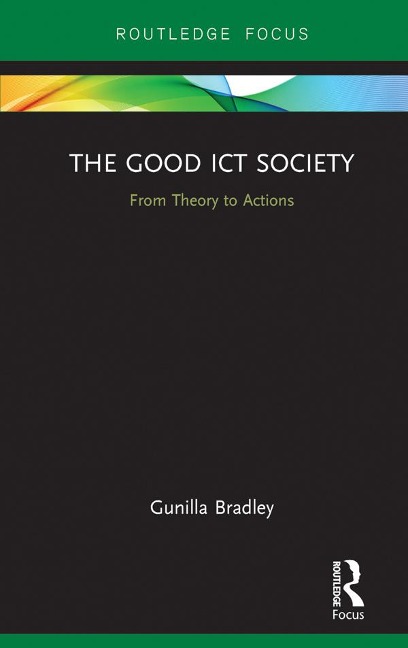
What is Quality of Life in a society that has embraced information and communication technology (ICT)? What is Wisdom in this kind of society? And what things are helping or hindering us from having both wisdom and a good quality of life in ICT societies? Taking the reader through a quick analysis of the current social and psychological changes in the Information and Communication Society, Bradley challenges us to avoid becoming victims of technology - whether we are professionals, policymakers, parents or citizens. Indeed, she introduces a theoretical model based on four decades' worth of research to help the reader to understand this complex, technological world. In addition to focusing the reader's attention on convergence and acceleration, this model describes the interplay between technology, societal structure, organizational design and human roles, thus leading to what Bradley describes as a "good ICT society". Emphasising the necessity of a co-operative parallel between the automation and humanization of society, this innovative volume will be of interest to undergraduate and postgraduate students and postdoctoral researchers interested in the subjects such as Information and Communication Technology and Social Change, Psychology and Sociology, Computer Technology and Media Technology.
Gunilla Bradley is Professor Emerita in Informatics at Royal Institute of Technology (KTH) - School of ICT in Stockholm. GB is originally a psychologist and has a broad background in the social and behavioral sciences. Her research concerns the interplay between Information and Communication Technology (ICT), Human Beings, and Society - Social Informatics. Her cross disciplinary research groups were first hosted by Stockholm University for twenty years. She has then been a visiting professor at Stanford University two years and professor of Technology and Social Change at the Royal Institute of Technology. From 1997-2001 she served as professor in Informatics at Umeå University and Mid Sweden University. In 1997 she received the prestigious Namur Award from IFIP for her pioneering research to increase the social awareness of the impact of ICT. Gunilla has authored thirteen books and contributed extensively in international scientific journals and the popular science press. Her latest book Social and Community Informatics - Humans on the Net (Routledge 2006) is widely used in both ICT related disciplines and in the social sciences. In 2008 Gunilla was invited as guest professor in Salzburg. She initiated and chaired the annual IADIS conference on "ICT, Society and Humans" for some years. In 2010 she was honored by a "Fest Symposium" at Linnaeus University in Sweden and a "Festschrift" (Eds. Haftor & Mirijamdotter, 2011). More than 60 distinguished researchers from all continents of the world contributed with chapters. Gunilla is currently writing the book The Good Information and Communication Society - From Theory to Action (Routledge).
Chapter 1. Visions of a Way Forward 1.1 Introduction 1.2 Major Goals in the ICT society 1.3 Effects on Human Beings 1.4 Voices from around the world 1.5 The Good ICT society and Actions to reach that society References Chapter 2. In Search of Quality of Life and Wisdom in the ICT Society 2.1 Introduction 2.2 Work life and Private life 2.3 Humans to Robots 2.4 Stress 2.5 Communication between People 2.6 Summing up References Appendix (Chapter 2) Chapter 3. The Convergence Model: A Path to the Golden Rule 3.1 What is Convergence? 3.2 The Convergence Model-s Main Parts 3.3 Effects on Human Beings 3.4 Dynamics of the Model 3.5 Societal Self-Production 3.6 What is the Good ICT society? 3.7 From Theory, Visions to Actions References Chapter 4. Towards Peace on Earth 4.1 Some Observations on ICT, War, Cyber Warfare and Infrastructure 4.2 Researching and Reporting on ICT and War 4.3 Starting to study the Problems 4.4 A Need for Growth in Alternative Thinking and Acting 4.5 Constructive Suggestions 4.6 Emerging suggestions 4.7 Acknowledgements References Chapter 5. Voices from around the world on Quality of Life and Wellbeing in the ICT Society 5.1 Background to the survey 5.2 Questions about the Self and Daily Life 5.3 Questions about life in general, human life and people's lives 5.4 Aspects regarded as the most positive and most negative with regard to ICT 5.5 Direct quotes from respondents 5.6 Some interviews in 2016 5.7 Interviewing myself in 2013 5.8 What are my answers in 2016? Chapter 6. The Good ICT Society - What is a Good Quality of Life? 6.2 From an Information Society for All to Quality of Life for All 6.3 The Human element - Humanization 6.4 So what is a Good ICT Society? References Appendix (Chapter 6) Chapter 7 Tree of Action 7.1 Many Trees of Actions 7.2 Other Manifestos 7.3 Towards an information society for all 7.4 Where do we go from here? 7.5 Manifesto - The 10 top Actions towards the Good and Sustainable ICT Society 7.6 Manifesto - The 10 top Principles for the Good ICT Society 7.7 The Good ICT Society - From Theory to Actions References
Dieses eBook wird im PDF-Format geliefert und ist mit einem Adobe Kopierschutz (DRM) versehen. Sie können dieses eBook mit allen Geräten lesen, die das PDF-Format und den Adobe Kopierschutz (DRM) unterstützen.
Zum Beispiel mit den folgenden Geräten:
• tolino Reader
Laden Sie das eBook direkt über den Reader-Shop auf dem tolino herunter oder übertragen Sie das eBook auf Ihren tolino mit einer kostenlosen Software wie beispielsweise Adobe Digital Editions.
• Sony Reader & andere eBook Reader
Laden Sie das eBook direkt über den Reader-Shop herunter oder übertragen Sie das eBook mit der kostenlosen Software Sony READER FOR PC/Mac oder Adobe Digital Editions auf ein Standard-Lesegeräte mit epub- und Adobe DRM-Unterstützung.
• Tablets & Smartphones
Möchten Sie dieses eBook auf Ihrem Smartphone oder Tablet lesen, finden Sie hier unsere kostenlose Lese-App für iPhone/iPad und Android Smartphone/Tablets.
• PC & Mac
Lesen Sie das eBook direkt nach dem Herunterladen mit einer kostenlosen Lesesoftware, beispielsweise Adobe Digital Editions, Sony READER FOR PC/Mac oder direkt über Ihre eBook-Bibliothek in Ihrem Konto unter „Meine eBooks“ - „online lesen“.
Schalten Sie das eBook mit Ihrer persönlichen Adobe ID auf bis zu sechs Geräten gleichzeitig frei.
Bitte beachten Sie, dass die Kindle-Geräte das Format nicht unterstützen und dieses eBook somit nicht auf Kindle-Geräten lesbar ist.