Und dann auf "Zum Home-Bildschirm [+]".

Stöbern
genialokal zum Startbildschirm hinzufügen
Installieren Sie die genialokal App auf Ihrem Startbildschirm für einen schnellen Zugriff und eine komfortable Nutzung.
Installieren Sie die genialokal App auf Ihrem Startbildschirm für einen schnellen Zugriff und eine komfortable Nutzung.
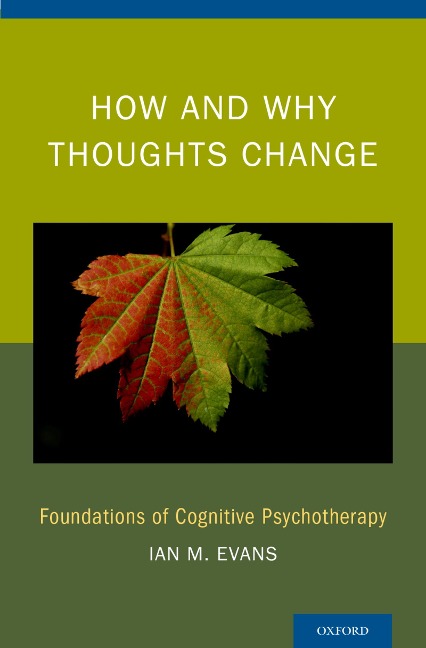
Cognitive therapy, a core approach within a collection of psychotherapeutic techniques known as cognitive behavioral therapy (CBT), is fundamentally about changing peoples' thoughts-helping them overcome difficulties by recognizing and changing dysfunctional thinking styles. Among other strategies, it requires encouraging the development of skills for rehearsing new habits of thought, modifying biases in judging and interpreting social and emotional information, and for testing assumptions underlying dysfunctional and negative, distorted thinking. In How and Why Thoughts Change, Dr. Ian Evans deconstructs the nature of cognitive therapy by examining the cognitive element of CBT, that is, how and why thoughts change behavior and emotion. There are a number of different approaches to cognitive therapy, including the classic Beck approach, the late Albert Ellis's rational-emotive psychotherapy, Young's schema-focused therapy, and newer varieties such as mindfulness training, Acceptance and Commitment Therapy (ACT), and problem-solving strategies. Evans identifies the common principles underlying these methods, attempts to integrate them, and makes suggestions as to how our current cognitive therapies might be improved. He draws on a broad survey of contemporary research on basic cognitive processes and integrates these with therapeutic approaches. While it may seem obvious that how and what we think determines how and in what manner we behave, the relationship between thought and action is not a simple one. Evans addresses questions such as: What is the difference between a thought and a belief? How do we find the cause of a thought? And can it really be that thought causes behavior and emotion, or could it be the other way around? In a reader-friendly style that avoids jargon, this innovative book answers some pertinent questions about cognitive therapy in a way that clarifies exactly how and why thoughts change. Evans demonstrates that understanding these concepts is a linchpin to providing and improving therapy for clients.
Ian Evans completed his PhD in experimental and clinical psychology in 1970 at the Institute of Psychiatry, London University, under the supervision of Hans J. Eysenck. His first academic position was at the University of Hawaii, before moving to the State University of New York at Binghamton where he was director of clinical training for 12 years. He then moved to New Zealand and directed a clinical program as well as later being Head of School of Psychology at Massey University. His research interests include positive approaches to challenging behavior in children with severe disabilities, the emotional development of children at home and at school, and the theory, practice, and ethics of culturally informed cognitive-behavior therapy.
Contents
Preface
Chapter 1: Introduction: Cogito Ergo Sum
Chapter 2: Changing Thoughts in Practice: The Basic Concepts of Cognitive Therapies
Chapter 3: Thinking About Thoughts
Chapter 4: The "Stream" of Consciousness: Mind-wandering, Introspection, Rumination, Meditation, and Mindfulness
Chapter 5: Distorted Thoughts
Chapter 6: How Thoughts Influence Mood and Feelings-Or Is It the Other Way Around?
Chapter 7: How Thoughts Lead to Action-and Why They Sometimes Do Not
Chapter 8: General Principles of How and Why Thoughts Change
Chapter 9: Can Cognitive Treatments Be Enhanced?
References
About the Author
Dieses eBook wird im PDF-Format geliefert und ist mit einem Adobe Kopierschutz (DRM) versehen. Sie können dieses eBook mit allen Geräten lesen, die das PDF-Format und den Adobe Kopierschutz (DRM) unterstützen.
Zum Beispiel mit den folgenden Geräten:
• tolino Reader
Laden Sie das eBook direkt über den Reader-Shop auf dem tolino herunter oder übertragen Sie das eBook auf Ihren tolino mit einer kostenlosen Software wie beispielsweise Adobe Digital Editions.
• Sony Reader & andere eBook Reader
Laden Sie das eBook direkt über den Reader-Shop herunter oder übertragen Sie das eBook mit der kostenlosen Software Sony READER FOR PC/Mac oder Adobe Digital Editions auf ein Standard-Lesegeräte mit epub- und Adobe DRM-Unterstützung.
• Tablets & Smartphones
Möchten Sie dieses eBook auf Ihrem Smartphone oder Tablet lesen, finden Sie hier unsere kostenlose Lese-App für iPhone/iPad und Android Smartphone/Tablets.
• PC & Mac
Lesen Sie das eBook direkt nach dem Herunterladen mit einer kostenlosen Lesesoftware, beispielsweise Adobe Digital Editions, Sony READER FOR PC/Mac oder direkt über Ihre eBook-Bibliothek in Ihrem Konto unter „Meine eBooks“ - „online lesen“.
Schalten Sie das eBook mit Ihrer persönlichen Adobe ID auf bis zu sechs Geräten gleichzeitig frei.
Bitte beachten Sie, dass die Kindle-Geräte das Format nicht unterstützen und dieses eBook somit nicht auf Kindle-Geräten lesbar ist.