Und dann auf "Zum Home-Bildschirm [+]".

Stöbern
genialokal zum Startbildschirm hinzufügen
Installieren Sie die genialokal App auf Ihrem Startbildschirm für einen schnellen Zugriff und eine komfortable Nutzung.
Installieren Sie die genialokal App auf Ihrem Startbildschirm für einen schnellen Zugriff und eine komfortable Nutzung.
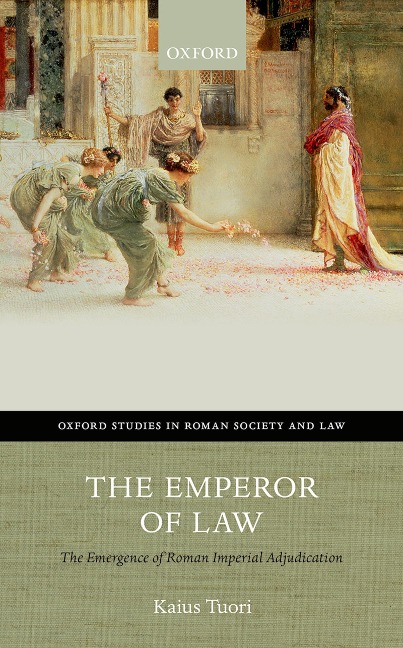
In the days of the Roman Empire, the emperor was considered not only the ruler of the state, but also its supreme legal authority, fulfilling the multiple roles of supreme court, legislator, and administrator. The Emperor of Law explores how the emperor came to assume the mantle of a judge, beginning with Augustus, the first emperor, and spanning the years leading up to Caracalla and the Severan dynasty. While earlier studies have attempted to explain this change either through legislation or behaviour, this volume undertakes a novel analysis of the gradual expansion and elaboration of the emperor's adjudication and jurisdiction: by analysing the process through historical narratives, it argues that the emergence of imperial adjudication was a discourse that involved not only the emperors, but also petitioners who sought their rulings, lawyers who aided them, the senatorial elite, and the Roman historians and commentators who described it. Stories of emperors settling lawsuits and demonstrating their power through law, including those depicting 'mad' emperors engaging in violent repressions, played an important part in creating a shared conviction that the emperor was indeed the supreme judge alongside the empirical shift in the legal and political dynamic. Imperial adjudication reflected equally the growth of imperial power during the Principate and the centrality of the emperor in public life, and constitutional legitimation was thus created through the examples of previous actions - examples that historical authors did much to shape. Aimed at readers of classics, Roman law, and ancient history, The Emperor of Law offers a fundamental reinterpretation of the much debated problem of the advent of imperial supremacy in law that illuminates the importance of narrative studies to the field of legal history.
Kaius Tuori is currently an Academy of Finland Research Fellow. He studied at the Universities of Helsinki, Finland, and La Sapienza in Rome, and holds a doctorate in Law and an M.A. in History. His research interests include legal history, Roman law, legal anthropology, classical archaeology, and their intellectual history, and his publications include two academic monographs and several articles in journals such as Law, Culture and the Humanities, The Journal of Legal History, the Journal of Legal Pluralism, Revue internationale des droits de l'Antiquite, and the Legal History Review. He is also a co-editor of the forthcoming Oxford Handbook of Roman Law and Society alongside Paul J. du Plessis and Clifford Ando.
- List of Illustrations - Introduction - 1: Caesar, Cicero, and the Models of Legal Autocracy - 2: Augustus as Judge and the Relegation of Ovid - 3: Divine or Insane: Emperors as Judges from Tiberius to Trajan - 4: Hadrian as the Ideal Judge - 5: Caracalla, the Severans, and the Legal Interest of Emperors - 6: Conclusions - Appendix - Known Instances of Imperial Adjudication from Caesar to Severus Alexander and their Sources - Endmatter - Bibliography - Index
Dieses eBook wird im PDF-Format geliefert und ist mit einem Adobe Kopierschutz (DRM) versehen. Sie können dieses eBook mit allen Geräten lesen, die das PDF-Format und den Adobe Kopierschutz (DRM) unterstützen.
Zum Beispiel mit den folgenden Geräten:
• tolino Reader
Laden Sie das eBook direkt über den Reader-Shop auf dem tolino herunter oder übertragen Sie das eBook auf Ihren tolino mit einer kostenlosen Software wie beispielsweise Adobe Digital Editions.
• Sony Reader & andere eBook Reader
Laden Sie das eBook direkt über den Reader-Shop herunter oder übertragen Sie das eBook mit der kostenlosen Software Sony READER FOR PC/Mac oder Adobe Digital Editions auf ein Standard-Lesegeräte mit epub- und Adobe DRM-Unterstützung.
• Tablets & Smartphones
Möchten Sie dieses eBook auf Ihrem Smartphone oder Tablet lesen, finden Sie hier unsere kostenlose Lese-App für iPhone/iPad und Android Smartphone/Tablets.
• PC & Mac
Lesen Sie das eBook direkt nach dem Herunterladen mit einer kostenlosen Lesesoftware, beispielsweise Adobe Digital Editions, Sony READER FOR PC/Mac oder direkt über Ihre eBook-Bibliothek in Ihrem Konto unter „Meine eBooks“ - „online lesen“.
Schalten Sie das eBook mit Ihrer persönlichen Adobe ID auf bis zu sechs Geräten gleichzeitig frei.
Bitte beachten Sie, dass die Kindle-Geräte das Format nicht unterstützen und dieses eBook somit nicht auf Kindle-Geräten lesbar ist.