Und dann auf "Zum Home-Bildschirm [+]".

Stöbern
genialokal zum Startbildschirm hinzufügen
Installieren Sie die genialokal App auf Ihrem Startbildschirm für einen schnellen Zugriff und eine komfortable Nutzung.
Installieren Sie die genialokal App auf Ihrem Startbildschirm für einen schnellen Zugriff und eine komfortable Nutzung.

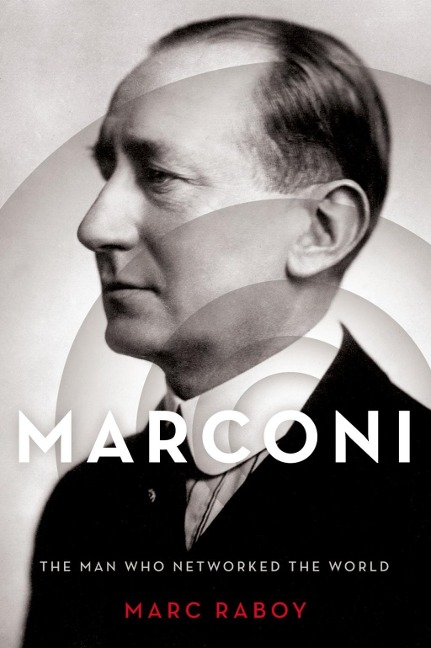
A little over a century ago, the world went wireless. Cables and all their limiting inefficiencies gave way to a revolutionary means of transmitting news and information almost everywhere, instantaneously. By means of "Hertzian waves," as radio waves were initially known, ships could now make contact with other ships (saving lives, such as on the doomed S.S. Titanic); financial markets could coordinate with other financial markets, establishing the price of commodities and fixing exchange rates; military commanders could connect with the front lines, positioning artillery and directing troop movements. Suddenly and irrevocably, time and space telescoped beyond what had been thought imaginable. Someone had not only imagined this networked world but realized it: Guglielmo Marconi. As Marc Raboy shows us in this enthralling and comprehensive biography, Marconi was the first truly global figure in modern communications. Born to an Italian father and an Irish mother, he was in many ways stateless, working his cosmopolitanism to advantage. Through a combination of skill, tenacity, luck, vision, and timing, Marconi popularized--and, more critically, patented--the use of radio waves. Soon after he burst into public view at the age of 22 with a demonstration of his wireless apparatus in London, 1896, he established his Wireless Telegraph & Signal Company and seemed unstoppable. He was decorated by the Czar of Russia, named an Italian Senator, knighted by King George V of England, and awarded the Nobel Prize for Physics--all before the age of 40. Until his death in 1937, Marconi was at the heart of every major innovation in electronic communication, courted by powerful scientific, political, and financial interests. He established stations and transmitters in every corner of the globe, from Newfoundland to Buenos Aires, Hawaii to Saint Petersburg. Based on original research and unpublished archival materials in four countries and several languages, Raboy's book is the first to connect significant parts of Marconi's story, from his early days in Italy, to his groundbreaking experiments, to his protean role in world affairs. Raboy also explores Marconi's relationshps with his wives, mistresses, and children, and examines in unsparing detail the last ten years of the inventor's life, when he returned to Italy and became a pillar of Benito Mussolini's fascist regime. Raboy's engrossing biography, which will stand as the authoritative work of its subject, proves that we still live in the world Marconi created.
Marc Raboy is Beaverbrook Professor Emeritus in Ethics, Media, and Communications in the Department of Art History and Communication Studies at McGill University.
Prologue: Marconi in His Time and Ours
PART I The Prodigy Chapter 1: Bologna: Beginnings Chapter 2: Priority and Detractors Chapter 3: London: Start-up Chapter 4: The Magician Chapter 5: New York: New Frontiers Chapter 6: Love and Imperialism Chapter 7: The Upstart Technology Chapter 8: "The Great Thing" Chapter 9: Newfoundland: The World Shrinks
PART II The Player Chapter 10: Corralling the Brand Chapter 11: Regulation Chapter 12: Marriage Chapter 13: A Life in Litigation Chapter 14: The Marconi Aura Chapter 15: A New World Order Chapter 16: On the Way to Somewhere Chapter 17: The Perfect Laureate
PART III The Pat Riot Chapter 18: The Godsend Chapter 19: Signals of War Chapter 20: Wireless and Disaster Chapter 21: "The Marconi Scandal" Chapter 22: The Invisible Weapon Chapter 23: "L'eroe magico" Chapter 24: The Statesman Chapter 25: The Spark
PART IV The Outsider Chapter 26: The Master of the House Chapter 27: The Beam Indenture Chapter 28: Radio Chapter 29: The Merger Chapter 30: The Anchor
PART V The Conformist Chapter 31: A Servant of the Regime Chapter 32: Science and Fascism Chapter 33: "Your Every Wish Is My Command" Chapter 34: Controlling His Legacy Chapter 35: The Heritage Chapter 36: He Only Cared About Wireless . . .
Postscript Acknowledgements Sources and Abbreviations Notes Bibliography Index