Und dann auf "Zum Home-Bildschirm [+]".

Stöbern
genialokal zum Startbildschirm hinzufügen
Installieren Sie die genialokal App auf Ihrem Startbildschirm für einen schnellen Zugriff und eine komfortable Nutzung.
Installieren Sie die genialokal App auf Ihrem Startbildschirm für einen schnellen Zugriff und eine komfortable Nutzung.
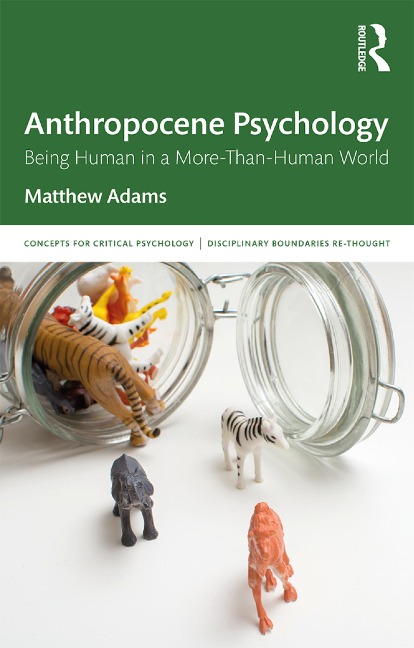
This ground-breaking book critically extends the psychological project, seeking to investigate the relations between human and more-than-human worlds against the backdrop of the Anthropocene by emphasising the significance of encounter, interaction and relationships. Interdisciplinary environmental theorist Matthew Adams draws inspiration from a wealth of ideas emerging in human-animal studies, anthrozoology, multi-species ethnography and posthumanism, offering a framing of collective anthropogenic ecological crises to provocatively argue that the Anthropocene is also an invitation - to become conscious of the ways in which human and nonhuman are inextricably connected. Through a series of strange encounters between human and nonhuman worlds, Adams argues for the importance of cultivating attentiveness to the specific and situated ways in which the fates of multiple species are bound together in the Anthropocene. Throughout the book this argument is put into practice, incorporating everything from Pavlov's dogs, broiler chickens, urban trees, grazing sheep and beached whales, to argue that the Anthropocene can be good to think with, conducive to a seeing ourselves and our place in the world with a renewed sense of connection, responsibility and love. Building on developments in feminist and social theory, anthropology, ecopsychology, environmental psychology, (post)humanities, psychoanalysis and phenomenology, this is fascinating reading for academics and students in the field of critical psychology, environmental psychology, and human-animal studies.
Matthew Adams is based in the School of Applied Social Science at the University of Brighton, UK. His previous books include Ecological Crisis, Sustainability & the Psychosocial Subject (2016) and Self & Social Change (2007).
Preface Chapter 1. Welcome to the Anthropocene: A parenthesis of infinitesimal brevity Chapter 2. Why Pavlov's dogs still matter: Animals, experimental psychology and the Anthropocene invitation Chapter 3. Eating animals in the Anthropocene: the broiler chicken, speciesism and vegatopia Chapter 4. Crafting new human-animal attachments: Do Anthropoceneans dream of eclectic sheep? Chapter 5. Heartbreaking losses in real places: Losing and finding solace in the Anthropocene Chapter 6. Between the whale and the kauri tree: multi-species encounters, indigenous knowledge and ethical relationality in the Anthropocene Afterword
Dieses eBook wird im PDF-Format geliefert und ist mit einem Adobe Kopierschutz (DRM) versehen. Sie können dieses eBook mit allen Geräten lesen, die das PDF-Format und den Adobe Kopierschutz (DRM) unterstützen.
Zum Beispiel mit den folgenden Geräten:
• tolino Reader
Laden Sie das eBook direkt über den Reader-Shop auf dem tolino herunter oder übertragen Sie das eBook auf Ihren tolino mit einer kostenlosen Software wie beispielsweise Adobe Digital Editions.
• Sony Reader & andere eBook Reader
Laden Sie das eBook direkt über den Reader-Shop herunter oder übertragen Sie das eBook mit der kostenlosen Software Sony READER FOR PC/Mac oder Adobe Digital Editions auf ein Standard-Lesegeräte mit epub- und Adobe DRM-Unterstützung.
• Tablets & Smartphones
Möchten Sie dieses eBook auf Ihrem Smartphone oder Tablet lesen, finden Sie hier unsere kostenlose Lese-App für iPhone/iPad und Android Smartphone/Tablets.
• PC & Mac
Lesen Sie das eBook direkt nach dem Herunterladen mit einer kostenlosen Lesesoftware, beispielsweise Adobe Digital Editions, Sony READER FOR PC/Mac oder direkt über Ihre eBook-Bibliothek in Ihrem Konto unter „Meine eBooks“ - „online lesen“.
Schalten Sie das eBook mit Ihrer persönlichen Adobe ID auf bis zu sechs Geräten gleichzeitig frei.
Bitte beachten Sie, dass die Kindle-Geräte das Format nicht unterstützen und dieses eBook somit nicht auf Kindle-Geräten lesbar ist.