Und dann auf "Zum Home-Bildschirm [+]".

Stöbern
genialokal zum Startbildschirm hinzufügen
Installieren Sie die genialokal App auf Ihrem Startbildschirm für einen schnellen Zugriff und eine komfortable Nutzung.
Installieren Sie die genialokal App auf Ihrem Startbildschirm für einen schnellen Zugriff und eine komfortable Nutzung.
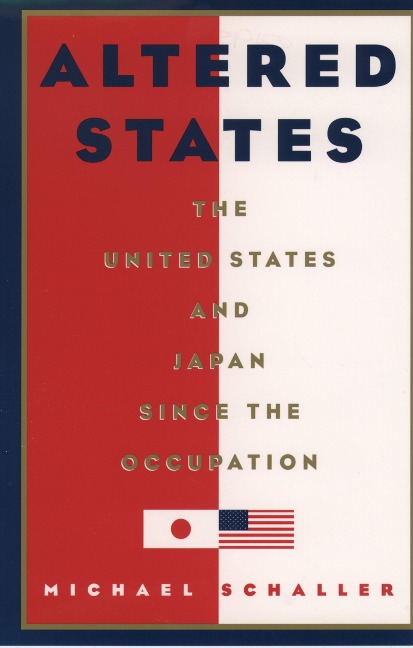
The relationship between the United States and Japan is torn by contrary impulses. We face each other across the Pacific as friends and allies, as the two most powerful economies in the world--and as suspicious rivals. Americans admire the industry of the Japanese, but we resent the huge trade deficit that has developed between us, due to what we consider to be unfair trade practices and "unlevel playing fields." Now, in Altered States, historian Michael Schaller strips away the stereotypes and misinformation clouding American perceptions of Japan, providing the historical background that helps us make sense of this important relationship. Here is an eye-opening history of U.S.-Japan relations from the end of World War II to the present, revealing its rich depths and startling complexities. Perhaps Schaller's most startling revelation is that modern Japan is what we made it--that most of what we criticize in Japan's behavior today stems directly from U.S. policy in the 1950s. Indeed, as the book shows, for seven years after the end of the war, our occupational forces exerted enormous influence over the shape and direction of Japan's economic future. Stunned by the Communist victory in China and the outbreak of war in Korea, and fearful that Japan might form ties with Mao's China, the U.S. encouraged the rapid development of the Japanese economy, protecting the huge industrial conglomerates and creating new bureaucracies to direct growth. Thus Japan's government-guided, export-driven economy was nurtured by our own policy. Moreover, the United States fretted about Japan's economic weakness--that they would become dependent on us--and sought to expand Tokyo's access to markets in the very areas it had just tried to conquer, the old Co Prosperity Sphere. Schaller documents how, as the Cold War deepened throughout the 1950s, Washington showered money on what it saw as the keystone of the eastern shore of Asia, working assiduously to expand the Japanese economy and, in fact, worrying intensely over the American trade surplus. Fear of Japanese instability ran so deep that Presidents Eisenhower, Kennedy, and Johnson approved secret financial help to Japanese conservative politicians, some of whom had been accused of war crimes against Americans. Then came the 1960s, and the surplus faded into a deficit. The book reveals how Washington's involvement in Vietnam provided the Japanese government with political cover for quietly pursuing a more independent course. Even in the 1970s, however, with America's one time ward turned into an economic powerhouse, the Nixon administration failed to pay much attention to Tokyo. Schaller shows that Kissinger openly preferred the more charismatic company of Zhou Enlai to that of Japanese technocrats, while economics bored him. The United States almost missed the fact that Japan had developed into a country that could say no, and very loudly. Michael Schaller has won widespread acclaim for his earlier books on U. S. relations with Asia. His fearless judgments, his fluid pen, his depth of knowledge and research have all lifted him to the front rank of historians writing today. In Altered States, he illuminates the most important, and troubled, relationship in the world in a work certain to cement his reputation.
Michael Schaller is Professor of History at the University of Arizona. He is the author of a number of books, including Reckoning with Reagan: America and its President in the 1980s; Douglas McArthur: Far Eastern General; The American Occupation of Japan: The Origins of the Cold War in Asia; and The United States and China in the Twentieth Century.
Dieses eBook wird im PDF-Format geliefert und ist mit einem Adobe Kopierschutz (DRM) versehen. Sie können dieses eBook mit allen Geräten lesen, die das PDF-Format und den Adobe Kopierschutz (DRM) unterstützen.
Zum Beispiel mit den folgenden Geräten:
• tolino Reader
Laden Sie das eBook direkt über den Reader-Shop auf dem tolino herunter oder übertragen Sie das eBook auf Ihren tolino mit einer kostenlosen Software wie beispielsweise Adobe Digital Editions.
• Sony Reader & andere eBook Reader
Laden Sie das eBook direkt über den Reader-Shop herunter oder übertragen Sie das eBook mit der kostenlosen Software Sony READER FOR PC/Mac oder Adobe Digital Editions auf ein Standard-Lesegeräte mit epub- und Adobe DRM-Unterstützung.
• Tablets & Smartphones
Möchten Sie dieses eBook auf Ihrem Smartphone oder Tablet lesen, finden Sie hier unsere kostenlose Lese-App für iPhone/iPad und Android Smartphone/Tablets.
• PC & Mac
Lesen Sie das eBook direkt nach dem Herunterladen mit einer kostenlosen Lesesoftware, beispielsweise Adobe Digital Editions, Sony READER FOR PC/Mac oder direkt über Ihre eBook-Bibliothek in Ihrem Konto unter „Meine eBooks“ - „online lesen“.
Schalten Sie das eBook mit Ihrer persönlichen Adobe ID auf bis zu sechs Geräten gleichzeitig frei.
Bitte beachten Sie, dass die Kindle-Geräte das Format nicht unterstützen und dieses eBook somit nicht auf Kindle-Geräten lesbar ist.