Und dann auf "Zum Home-Bildschirm [+]".

Stöbern
genialokal zum Startbildschirm hinzufügen
Installieren Sie die genialokal App auf Ihrem Startbildschirm für einen schnellen Zugriff und eine komfortable Nutzung.
Installieren Sie die genialokal App auf Ihrem Startbildschirm für einen schnellen Zugriff und eine komfortable Nutzung.

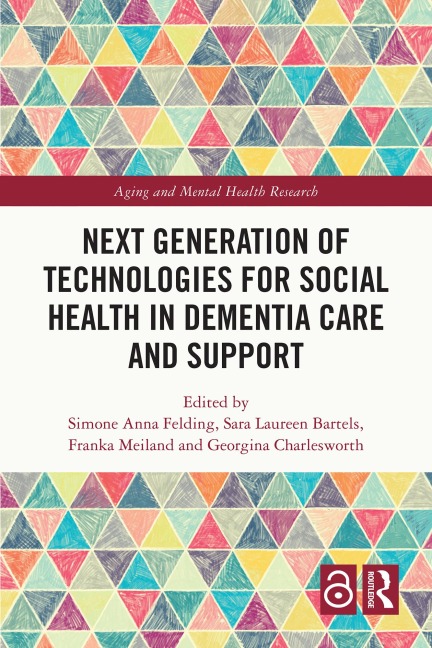
Analysing a broad range of digital health innovations and research studies that demonstrate working collaboratively with people with dementia and their caregivers, this timely volume offers new insights, latest evidence, and research-based solutions for managing the role of technology in dementia care and support. The book comprehensively examines four key research areas: the role of technology in addressing the diversity of needs in dementia care and support, the effectiveness of social media websites in meeting care and support needs, the assessment of smartphone apps and websites in helping increase independence and social interactions, and the use of social robots at home and in institutional care settings. Chapters highlight the rigorous development, evaluation, and implementation of technologies such as apps and co-created websites by combining experience and research from leaders in the field, early-career researchers, and their collaborators with applied knowledge in the field. Benefitting significantly from research funded through the European Marie-Curie training network, DISTINCT (Dementia: Intersectoral Strategies for Training and Innovation Network for Current Technology), contributions are truly international, spanning across Belgium, Czech Republic, Germany, Ireland, the Netherlands, the UK, and Spain. Serving as a vital resource and inspiration for future research and clinical practice, this volume will be of interest to scholars, researchers, and practitioners in the fields of gerontology and ageing, dementia, and medical technology and engineering. Policy makers may also find this volume of use.
Simone Anna Felding is a Social Anthropologist and a Postdoctoral Researcher, Department of Public Health, University of Copenhagen, Denmark. Sara Laureen Bartels is an Assistant Professor in Psychosocial Innovation in Dementia at the Alzheimer Centrum Limburg, Mental Health and Neuroscience Research Institute, Maastricht University, the Netherlands. Franka Meiland is senior researcher and teacher, Amsterdam Public Health Research Institute, department of Medicine for older people, Amsterdam UMC, Amsterdam Public Health Research Institute, The Netherlands. Georgina Charlesworth is Professor of Clinical Psychology of Ageing and Dementia, Division of Psychology & Language Sciences, UCL, UK.
INTRODUCTION Chapter 1: An introduction to technology, social health, and innovative dementia research and care Simone Anna Felding, Sara Laureen Bartels, Kevin Quaid, Franka Meiland, Georgina Charlesworth Chapter 2: Train and retain: An international perspective on challenges, training, and resources for early-stage researchers Sara Laureen Bartels, Esther Loseto-Gerritzen, Charlèss Dupont, Bryony Waters-Harvey, Fania Dassen, Frans Verhey PART 1: Apps for independence and social interaction Chapter 3: Social media use and self-disclosure among people with dementia and family caregivers Gianna Kohl, Wei Qi Koh, Katrina Scior, Georgina Charlesworth Chapter 4: Benefits of personalised eHealth in dementia: Lessons from a hybrid tablet-app intervention David Neal, Teake Ettema, Karin Dijkstra, Majon Muller, Rose-Marie Dröes, Chapter 5: Connecting with people with dementia through digital artistic photos Josephine Rose Orejana Tan, Caroline H.M. Planting, Soraya Clark, Petra Boersma, Teake P. Ettema, Laurence Aëgerter, Robbert Gobbens, Max L. Stek, Rose-Marie Dröes PART 2: Websites for communication and wellbeing throughout the care trajectory Chapter 6: How far away is it? Accessing dementia care through technologies in rural and remote areas Mauricio Molinari-Ulate, Rebecca Woodcock, Michael P. Craven, Alfonso Bahillo, Henriëtte van der Roest, Manuel-Ángel Franco-Martín Chapter 7: Online peer support for people with Young Onset Dementia Esther Loseto-Gerritzen, Orii McDermott, Martin Orrell Chapter 8: Empowering family caregivers through eHealth interventions: The potential of Acceptance and Commitment Therapy Golnaz Atefi, Sara Laureen Bartels, Rosalia J.M. van Knippenberg, Frans R.J. Verhey, Marjolein E. de Vugt Chapter 9: A website to support advance care planning for people with dementia and family caregivers Fanny Monnet, Charlèss Dupont, Tinne Smets, Lara Pivodic, Lieve Van den Block PART 3: Social robots in (smart) homes and care facilities Chapter 10: Companion robots, smart homes, and digital security in dementia care Jaroslav Cibulka, Olga Stepankova, Iva Holmerova Chapter 11: Addressing loneliness through social robots and multimedia systems for people living with dementia in European nursing homes Kübra Beliz Budak, Franziska Laporte Uribe, Franka Meiland, Martina Roes Chapter 12: Designing social robots for people with dementia and mild cognitive impairments: Key considerations for user experience and acceptance Aysan Mahmoudi, Kübra Beliz Budak, Wei Qi Koh, Henriëtte Geralde Van der Roest, Manuel Franco-Martín Chapter 13: The woman with the dog: Relationships between pet robots and humans in a Danish nursing home for people with dementia Simone Anna Felding, Karin Johansson, Lena Rosenberg, Sonja Teupen, Martina Roes CONCLUSIONS Chapter 14: Designing and implementing technology to improve social health in dementia care: An occupational perspective Wei Qi Koh, Pascale Heins, Aisling Flynn, Aysan Mahmoudi, Lesley Garcia, Anna Brorsson, Camilla Malinowsky Chapter 15: Advancing technology for social health: Best Practice Guidance and future directions in dementia care Rose-Marie Dröes, Golnaz Atefi, Franka Meiland, Martin Orrell, Martina Roes, Georgina Charlesworth