Und dann auf "Zum Home-Bildschirm [+]".

Stöbern
genialokal zum Startbildschirm hinzufügen
Installieren Sie die genialokal App auf Ihrem Startbildschirm für einen schnellen Zugriff und eine komfortable Nutzung.
Installieren Sie die genialokal App auf Ihrem Startbildschirm für einen schnellen Zugriff und eine komfortable Nutzung.
Ihr gewünschter Artikel ist in 0 Buchhandlungen vorrätig - wählen Sie hier eine Buchhandlung in Ihrer Nähe aus:

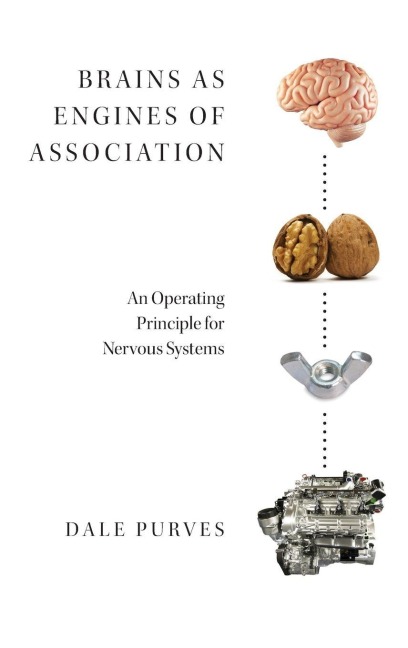
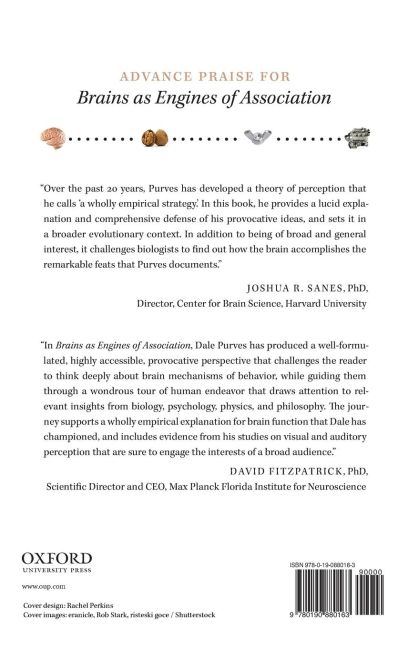
Brains as Engines of Association tackles a fundamental question in neuroscience: what is the operating principle of the human brain? While a similar question has been asked and answered for virtually every other human organ during the last few centuries, how the brain operates has remained a central challenge in biology. Based on evidence derived from vision, audition, speech and music--much of it based on the author's own work over the last twenty years--Brains as Engines of Association argues that brains operate wholly on the basis of trial and error experience, encoded in neural circuitry over evolutionary and individual time. This concept of neural function runs counter to current concepts that view the brain as a computing machine, and research programs based on the idea that the only way to answer such questions is by reconstructing the connectivity of brains in their entirety. This view also implies that the best way to understand the details of brain function is to recapitulate their history using artificial neural networks. While this viewpoint has received support in the last few years from work showing that computers can win complex games, the brain plays a much more complex game--the "game" of biological survival--which Purves concludes is based on trial-and-error experience.
Dale Purves is Geller Professor of Neurobiology Emeritus at Duke University, where he moved in 1990 as the founding chair of the Department of Neurobiology. He was subsequently Director of Duke's Center for Cognitive Neuroscience and the Director of the Neuroscience and Behavioral Disorders Program at the Duke-NUS Graduate Medical School in Singapore. His research has sought to explain why we see and hear what we do. He is a member of the National Academy of Sciences, the American Academy of Arts and Sciences, and the National Academy of Medicine.
- Preface - PART I. What Nervous Systems Do for Animals - Chapter 1. Putting the Question in Perspective - Introduction - Life on Earth - Defining life - Energy - Evolution - Mechanisms - Teleology - Conclusion - Suggested Reading - Chapter 2. Organisms without Nervous Systems - Introduction - Bacteria - Protists - Plants - The general strategy - Conclusion - Suggested Reading - Chapter 3. Organisms with Nervous Systems - Introduction - Defining nervous systems - The emergence of nervous systems - The emergence of central nervous systems - What do nervous systems add? - What do brains add? - Conclusion - Suggested Reading - PART II. Neural Systems as Engines of Association - Chapter 4. The Organization of Nervous Systems - Introduction - Stimuli - Pre-neural processing - Neural processing - Behavioral output - Neural systems and subsystems are interactive - Conclusion - Suggested Reading - Chapter 5. The Problem - Introduction - Vision as an example - The basic challenge - The answer in general terms - Qualia determined by empirical ranking - Perceptual discrepancies - Mechanisms - Other modalities - The meaning of 'illusions' - Conclusion - Suggested Reading - Chapter 6. Neural Associations - Introduction - Associations wrought be evolution - Associations wrought by lifetime learning - Associations wrought by culture - Behavioral categories of associations - Reward - Behavioral responses as reflexes - What gets associated? - Counterarguments - Conclusion - Suggested Reading - PART III. Evidence that Neural Systems Operate EMPIRICALLY - Chapter 7. Evidence from Lightness and Color - Introduction - Luminance and lightness - Analyzing the occurrence of luminance patterns - Effects of other luminance patterns - Spectral energy and color - The general strategy - Conclusion - Suggested Reading - Chapter 8. Evidence from Geometry - Introduction - Seeing intervals - Seeing angles - Seeing object sizes in 2-D - Seeing object sizes in 3-D - Seeing stereo depth - Conclusion - Suggested Reading - Chapter 9. Evidence from Motion - Introduction - Apparent motion - The perception of speed - Implications for the perception of time - The perception of direction - Conclusion - Suggested Reading - Chapter 10. Evidence from Audition - Introduction - Sound signals - Sources of tones - Sound signal spectra - The problem in audition - An empirical approach - Evidence from speech - Evidence from music - Implications for any sensory system - Conclusion - Suggested Reading - PART IV. alternative Concepts Neural Function - Chapter 11. The Major Options - Introduction - Neural function as feature detection - Neural function as statistical inference - Neural function as efficient coding - Neural function as computation - Conclusion - Suggested Reading - Chapter 12. Summing Up - Introduction - A way around some fundamental obstacles - Empirical ranking - Insight from games - Artificial intelligence - Consequences for neuroscience - The status of reasoning - Novel situations - Choice - Culture - The frequency of stimuli - Conclusion - Suggested Reading - Bibliography - Glossary - Index - Acknowledgments